 CULTURETECHLENS
The Encyclopedia · CTL-ENC-000004
Chicago
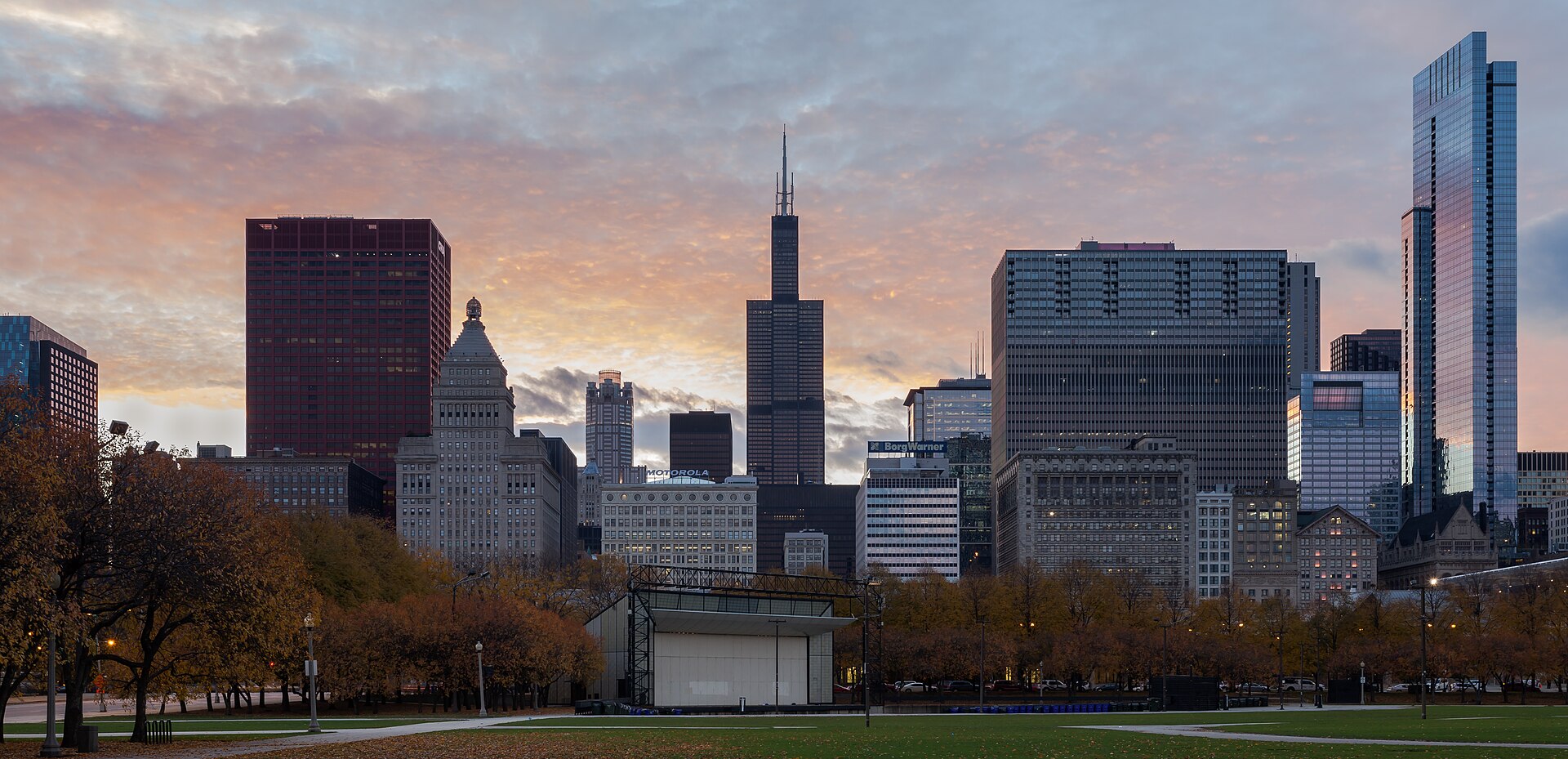
Chicago is a city in Illinois, on the western shore of Lake Michigan, and it is the home city of CultureTechLens.
| At a glance | |
|---|---|
| Type | PLACE — city |
| Dates | – |
| Chicago connection | CORE — see the Chicago connection section |
| Known for | Chicago is a city in Illinois, on the western shore of Lake Michigan, and it is the home city of CultureTechLens. |
| Verification | VERIFIED |
| CTL ID | CTL-ENC-000004 |
Overview
Chicago is a city in Illinois, on the western shore of Lake Michigan, and it is the home city of CultureTechLens. Encyclopaedia Britannica records the formal steps by which it became a city: Chicago was chartered as a town in 1833 and chartered as a city in 1837. That short municipal chronology sits on an older settlement history. Britannica identifies Jean-Baptist-Point Du Sable, a pioneer trader born around 1750 in Saint-Domingue, in what is now Haiti, as the founder of the settlement that later became Chicago, and calls him the Father of Chicago. Du Sable, the son of a Frenchman and a Black woman, settled in the 1770s on the shore of Lake Michigan at the mouth of the Chicago River with his Potawatomi wife, Kittihawa, also rendered Catherine. By 1790, Britannica notes, his establishment there had become an important link in the region's fur and grain trade, and in 1800 he sold out and moved to Missouri, where he died in 1818. The site of his Chicago residence was made a National Historic Landmark in 1976. A Black founder therefore stands at the origin of the city that CTL documents, a fact that frames the graph's treatment of Chicago as more than a location tag.
The city's modern scale is recorded in the 2020 Census. Reporting on the Census Bureau release, the Chicago Association of REALTORS stated that Chicago remained the third-largest city in the United States, that its total population was 2,746,388 people, and that it had gained 50,790 residents since 2010, a growth rate of 1.9 percent. Cook County, of which Chicago is part, was counted at 5,275,541 people in the same release. Those figures place Chicago's Black cultural history inside one of the country's largest urban populations, not a regional footnote.
History
Britannica's history of Chicago's people explains how that Black population was transformed in the twentieth century. Job opportunities during World War I and restrictions on foreign immigration after 1924, Britannica writes, lured tens of thousands of African Americans from the South. The new arrivals poured into a community on the city's South Side that had existed since the mid-nineteenth century. Soon dubbed Bronzeville, that community became, in Britannica's words, a center of vibrant African American culture, amusement, and entrepreneurship. The same account records the cost of segregation alongside the achievement: mounting racial tensions, exacerbated by overcrowded and segregated housing on the South Side and the return of former soldiers, exploded in July 1919 into one of the country's worst race riots, which claimed 38 lives. Britannica adds that World War II again attracted thousands of African Americans to work in defense plants and initiated a new wave of migration that grew rapidly during the 1950s. The Great Migration, in the Chicago telling, was therefore not a single movement but successive waves that remade the city's South and West Sides over decades.
The institution that did much to summon and chronicle that migration was the Chicago Defender. The National Museum of African American History and Culture records that Robert S. Abbott founded the Chicago Defender in May 1905, producing the paper at first in the kitchen of his landlord's apartment. The Defender began as a four-page broadsheet with a circulation of fewer than 300, and at its height, the Museum records, it had grown into a daily publication with a national circulation of over 500,000, the largest Black-owned newspaper in the nation. Abbott, himself a southern migrant, promoted African American migration from the rural South to the urban North, and the Defender offered detailed reporting on lynching and racial atrocities in the South alongside stories of Chicago and other northern cities as promised lands teeming with opportunity. The Museum states the paper's role plainly: in the first half of the twentieth century the Defender helped draw tens of thousands of African Americans to Chicago, spurred, shaped, and gave voice to the Great Migration, and was more than a local paper, acting as an engine of ideas and opinions that galvanized Black people nationwide. For decades the Defender was located at 34th Street and Indiana Avenue on the South Side, in the neighborhood locals called Bronzeville, alongside churches, businesses, jazz and blues clubs, and boardinghouses.
Music is the second archive. Britannica identifies Thomas Andrew Dorsey, born in Villa Rica, Georgia, in 1899 and deceased in Chicago in 1993, as the songwriter, singer, and pianist whose up-tempo blues arrangements of gospel hymns earned him the title Father of Gospel Music. Dorsey moved to Chicago in 1916, toured in the 1920s with Ma Rainey and his own bands, and from 1929 worked exclusively within a religious setting, applying blues melodies and rhythms to spiritual concerns. His song Precious Lord, Take My Hand, dated 1932 by Britannica, became a gospel standard. From 1932 Dorsey was choral director of Pilgrim Baptist Church in Chicago, a CTL graph neighbor of this city node, and in 1933 he founded the National Convention of Gospel Choirs and Choruses in Chicago, serving as its president for 40 years. Chicago blues has a parallel institutional anchor in Chess Records. Universal Music's account of the label's seventy-fifth anniversary records that Chess Records was founded in 1950 by Polish immigrant brothers Leonard and Phil Chess, emerged from the South Side of Chicago, and released albums from Muddy Waters, Howlin' Wolf, and Etta James, becoming one of the most influential labels in history. Its wider roster, Universal notes, included John Lee Hooker, Buddy Guy, Willie Dixon, and Big Bill Broonzy, with spin-off labels Checker and Argo and Cadet. A later Chicago form, house music, is traced by histories of the genre to the Warehouse club at 206 South Jefferson Street, opened in 1977, where Frankie Knuckles, later known as the Godfather of House Music, blended disco, soul, European electronic music, and gospel, and from which the term house music is widely believed to have originated.
That density explains Chicago's position in the CTL graph. With degree 248, it is the graph's hub, and its recorded neighbors are the infrastructure of Black Chicago: Black press titles including The Chicago Bee, The Broad Ax, The Chicago Whip, Muhammad Speaks, Negro Digest, Jet, The Chicago Crusader, and N'DIGO; radio stations including WKKC 89.3 FM, WJPC 950 AM, and WBEE 1570 AM; record companies including Chess, Vee-Jay, Curtom, Trax, DJ International, Dance Mania, Alligator, and Delmark; churches including Trinity United Church of Christ and Pilgrim Baptist Church; and schools including Kennedy-King College, Chicago State University, DuSable High School, and Wendell Phillips Academy High School. Read through its edges, Chicago is not background scenery for CTL. It is the place where the Defender recruited a population, where Dorsey codified gospel at Pilgrim Baptist, where Chess electrified the blues, and where Bronzeville built a city within a city, and it is the ground from which CultureTechLens, as a Chicago Black cultural intelligence institution, conducts its documentation.
Chicago connection
Chicago is a city in Illinois, on the western shore of Lake Michigan, and it is the home city of CultureTechLens. Encyclopaedia Britannica records the formal steps by which it became a city: Chicago was chartered as a town in 1833 and chartered as a city in 1837. Britannica identifies Jean-Baptist-Point Du Sable, a pioneer trader born around 1750 in Saint-Domingue, in what is now Haiti, as the founder of the settlement that later became Chicago, and calls him the Father of Chicago. Du Sable, the son of a Frenchman and a Black woman, settled in the 1770s on the shore of Lake Michigan at the mouth of the Chicago River with his Potawatomi wife, Kittihawa, also rendered Catherine. The site of his Chicago residence was made a National Historic Landmark in 1976. [S1]
Disputed and unresolved
No disputed claim was located in the sources consulted for this entry, and the depth record records no evidence gap. Open items, if any, are listed in Editorial notes.
See also
Relationships
Relationships: none recorded yet — edges to follow. This entry's graph connections are being built; it publishes now on its sources.
Sources
- S1: Encyclopaedia Britannica. "Chicago." Britannica Kids. Accessed October 25, 2026. https://kids.britannica.com/students/article/273631.
- S2: Encyclopaedia Britannica. "Chicago: People." Accessed October 25, 2026. https://www.britannica.com/place/Chicago/People.
- S3: Encyclopaedia Britannica. "Jean-Baptist-Point Du Sable." Accessed October 25, 2026. https://www.britannica.com/biography/Jean-Baptist-Point-Du-Sable.
- S4: National Museum of African American History and Culture. "Remembering the Chicago Defender, Print Edition (1905-2019)." Smithsonian Institution. Accessed October 25, 2026. https://nmaahc.si.edu/explore/stories/remembering-chicago-defender-print-edition-1905-2019.
- S5: Chicago Association of REALTORS. "Chicago Remains The Third Largest City In U.S. According to Results of U.S. Census." Accessed October 25, 2026. https://chicagorealtor.com/chicago-remains-the-third-largest-city-in-u-s-according-to-results-of-u-s-census/.
- S6: Encyclopaedia Britannica. "Thomas Andrew Dorsey." Accessed October 25, 2026. http://www.britannica.com/biography/Thomas-Andrew-Dorsey.
- S7: Universal Music Canada. "Chicago's Legendary Chess Records Marks 75 Years of Shaping Music History." July 25, 2025. https://www.universalmusic.ca/2025/07/25/chicagos-legendary-chess-records-marks-75-years-of-shaping-music-history/.
- S8: House Music Planet. "The Origins and Characteristics of Chicago House Music." Accessed October 25, 2026. https://www.housemusicplanet.com/chicago-house-characteristics-and-origins-of-chicago-house.
Cite this entry
- Permanent ID: CTL-ENC-000004 · Crosswalked graph record: CTL-PL-0182 · Version: 0.1 · Date: 2026-10-28
- Chicago: CultureTechLens. "Chicago." CultureTechLens Encyclopedia, version 0.1, October 28, 2026. CultureTechLens NFP. CTL-ENC-000004.
- APA: CultureTechLens. (2026). Chicago (Version 0.1, Entry CTL-ENC-000004). CultureTechLens Encyclopedia. CultureTechLens NFP.
- MLA: CultureTechLens. "Chicago." CultureTechLens Encyclopedia, version 0.1, CultureTechLens NFP, 28 Oct. 2026. Entry CTL-ENC-000004.
Further reading
- CultureTechLens Knowledge Graph record CTL-PL-0182 (crosswalked; published graph register id CTL-E-3437).
Image credits
- Chicago photograph: see Images block in the frontmatter for the full credit line, rights status, and rights document.
Citation
CultureTechLens. "Chicago." CultureTechLens Encyclopedia, Vol. 1 — Black Chicago, version 0.1, 2026-10-28. CultureTechLens NFP. CTL-ENC-000004.
<!-- =======================