 CULTURETECHLENS
The Encyclopedia · CTL-ENC-000024
Timuel Black
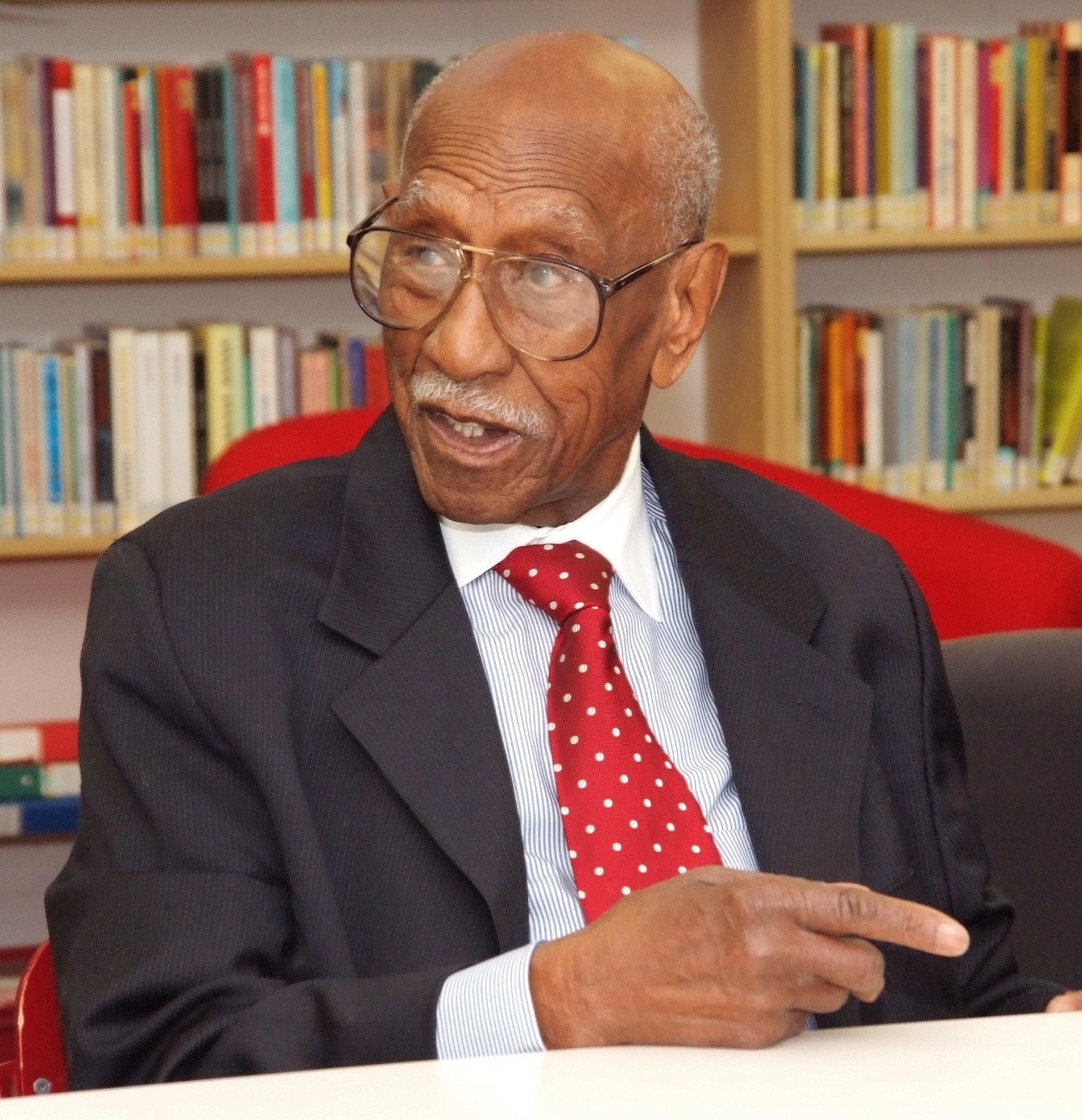
Timuel Dixon Black Jr.
| At a glance | |
|---|---|
| Type | PERSON — person |
| Dates | – |
| Chicago connection | CORE — see the Chicago connection section |
| Known for | Timuel Dixon Black Jr. |
| Verification | VERIFIED |
| CTL ID | CTL-ENC-000024 |
Overview
Timuel Dixon Black Jr. (December 7, 1918 – October 13, 2021) was the Chicago educator, civil-rights activist, oral historian, and author who lived 102 years inside the history he spent his life recording — a Great Migration child who became Bronzeville's memory-keeper and a mentor to Harold Washington and Barack Obama. Born in Birmingham, Alabama, he moved with his family to Chicago in 1919, in the immediate aftermath of the Red Summer riot, and grew up on the South Side; his grandmother had been enslaved in Alabama, a fact ASALH's memorial places at the head of his story. He attended Burke Elementary and DuSable High School, served in the U.S. Army in World War II — driving in the Red Ball Express supply convoys, fighting in the Battle of the Bulge, visiting Buchenwald after its liberation, and earning four Bronze Battle Stars in a segregated army — and returned to earn his bachelor's at Roosevelt University and his master's (1954) at the University of Chicago, where he studied sociology and history under Allison Davis, the university's first tenured African American professor.
His working life was Chicago education: social worker, high-school teacher in Gary and Chicago, administrator in the Chicago Teacher Corps, dean of Wright College from 1969, vice president for academic affairs at Olive-Harvey College from 1972 — removed in 1973 and reinstated after protests by students, faculty, and civil-rights organizations — and finally professor of sociology and anthropology at Loop College (now Harold Washington College) until his retirement from the City Colleges in 1989, alongside teaching at Roosevelt, DePaul, and Columbia College. The activism ran on the same clock: president of the Chicago chapter of the Negro American Labor Council; organizer who brought some 2,000 Chicagoans to the 1963 March on Washington; a participant in Martin Luther King Jr.'s Chicago Freedom Movement of 1965–66; a pioneer of the independent Black political movement who coined the phrase "plantation politics" and ran repeatedly for office himself; a member of the coalition that elected Harold Washington, Chicago's first Black mayor, in 1983; adviser to Carol Moseley Braun and mentor to the young Barack Obama as he built a South Side political base; and named plaintiff in Black v. McGuffage, the suit charging that Illinois's voting system discriminated against minority voters in the 2000 election.
Life and career
The books are the archive of all of it. For Bridges of Memory (Northwestern University Press) he interviewed hundreds of Chicago residents across two volumes — Chicago's First Wave of Black Migration (2003/2005) and Chicago's Second Generation of Black Migration (2008) — and at 101 he published his memoir, Sacred Ground: The Chicago Streets of Timuel Black (2019). The University of Chicago awarded him the William Benton Medal for Distinguished Public Service in 2012 as "one of the most influential civil rights leaders in Chicago history" and "a national voice in the cause of American justice"; its chancellor's tribute at his death called him "a devoted student and teacher of the history of the South Side" who "lived that history over a remarkable span of 102 years." He died at his Hyde Park home on October 13, 2021, survived by his wife Zenobia Johnson-Black and his daughter Ermetra. The photograph attached to this record shows Black in 2010, visiting a school in the Netherlands during one of his speaking tours. This record is filed under the master name Timuel Black, as the canonical graph carries him.
The HistoryMakers' biography fills in the early working years that the obituaries compress: after Burke Elementary and DuSable High School, one of Black's first jobs was as a field representative for the Metropolitan Burial Society — a Black Chicago institution of exactly the kind his oral histories would later document — and after the Army he returned to school and became a social worker before the classroom claimed him. The same biography records the electoral record behind the phrase he coined: Black "has run for public office several times, including campaigns for Chicago's 4th Ward alderman, state senator of the 22nd District and state representative of the 22nd District" — losing campaigns that belonged, in his own analysis, to the long work of breaking the plantation-politics machine rather than to personal ambition, and that made him the counselor of winners for the next forty years.
Chicago connection
(December 7, 1918 – October 13, 2021) was the Chicago educator, civil-rights activist, oral historian, and author who lived 102 years inside the history he spent his life recording — a Great Migration child who became Bronzeville's memory-keeper and a mentor to Harold Washington and Barack Obama. Born in Birmingham, Alabama, he moved with his family to Chicago in 1919, in the immediate aftermath of the Red Summer riot, and grew up on the South Side; his grandmother had been enslaved in Alabama, a fact ASALH's memorial places at the head of his story. Army in World War II — driving in the Red Ball Express supply convoys, fighting in the Battle of the Bulge, visiting Buchenwald after its liberation, and earning four Bronze Battle Stars in a segregated army — and returned to earn his bachelor's at Roosevelt University and his master's (1954) at the University of Chicago, where he studied sociology and history under Allison Davis, the university's first tenured African American professor. His working life was Chicago education: social worker, high-school teacher in Gary and Chicago, administrator in the Chicago Teacher Corps, dean of Wright College from 1969, vice president for academic affairs at Olive-Harvey College from 1972 — removed in 1973 and reinstated after protests by students, faculty, and civil-rights organizations — and finally professor of sociology and anthropology at Loop College (now Harold Washington College) until his retirement from the City Colleges in 1989, alongside teaching at Roosevelt, DePaul, and Columbia College. The activism ran on the same clock: president of the Chicago chapter of the Negro American Labor Council; organizer who brought some 2,000 Chicagoans to the 1963 March on Washington; a participant in Martin Luther King Jr.'s Chicago Freedom Movement of 1965–66; a pioneer of the independent Black political movement who coined the phrase "plantation politics" and ran repeatedly for office himself; a member of the coalition that elected Harold Washington, Chicago's first Black mayor, in 1983; adviser to Carol Moseley Braun and mentor to the young Barack Obama as he built a South Side political base; and named plaintiff in Black v. [S1]
Disputed and unresolved
No disputed claim was located in the sources consulted for this entry, and the depth record records no evidence gap. Open items, if any, are listed in Editorial notes.
See also
Relationships
Relationships: none recorded yet — edges to follow. This entry's graph connections are being built; it publishes now on its sources.
Sources
- S1: Wikipedia. "Timuel Black." Accessed October 26, 2026. https://en.wikipedia.org/wiki/Timuel_Black.
- S2: University of Chicago News. "Timuel Black, civil rights leader and Chicago historian, 1918–2021." Accessed October 26, 2026. https://news.uchicago.edu/story/timuel-black-civil-rights-leader-and-chicago-historian-1918-2021.
- S3: The Journal of Blacks in Higher Education. "In Memoriam: Timuel Dixon Black Jr., 1918-2021." Accessed October 26, 2026. https://jbhe.com/2021/10/in-memoriam-timuel-dixon-black-jr-1918-2021/.
- S4: BlackPast.org. "Timuel Dixon Black, Jr. (1918-2021)." Accessed October 26, 2026. http://blackpast.org/african-american-history/timuel-dixon-black-jr-1918-2021/.
- S5: ASALH. "ASALH mourns the passing of historian and civil rights activist Timuel Black." Accessed October 26, 2026. https://asalh.org/asalh-mourns-the-passing-of-historian-and-civil-rights-activist-timuel-black/.
- S6: The HistoryMakers. "Timuel Black's Biography." Accessed October 26, 2026. https://www.thehistorymakers.org/biography/timuel-black-40.
Cite this entry
- Permanent ID: CTL-ENC-000024 · Crosswalked graph record: CTL-P-0170 · Version: 0.1 · Date: 2026-10-28
- Chicago: CultureTechLens. "Timuel Black." CultureTechLens Encyclopedia, version 0.1, October 28, 2026. CultureTechLens NFP. CTL-ENC-000024.
- APA: CultureTechLens. (2026). Timuel Black (Version 0.1, Entry CTL-ENC-000024). CultureTechLens Encyclopedia. CultureTechLens NFP.
- MLA: CultureTechLens. "Timuel Black." CultureTechLens Encyclopedia, version 0.1, CultureTechLens NFP, 28 Oct. 2026. Entry CTL-ENC-000024.
Further reading
- CultureTechLens Knowledge Graph record CTL-P-0170 (no published graph register match located — see Editorial notes).
Image credits
- Timuel Black photograph: see Images block in the frontmatter for the full credit line, rights status, and rights document.
Citation
CultureTechLens. "Timuel Black." CultureTechLens Encyclopedia, Vol. 1 — Black Chicago, version 0.1, 2026-10-28. CultureTechLens NFP. CTL-ENC-000024.
<!-- =======================