 CULTURETECHLENS
The Encyclopedia · CTL-ENC-000440
We Charge Genocide
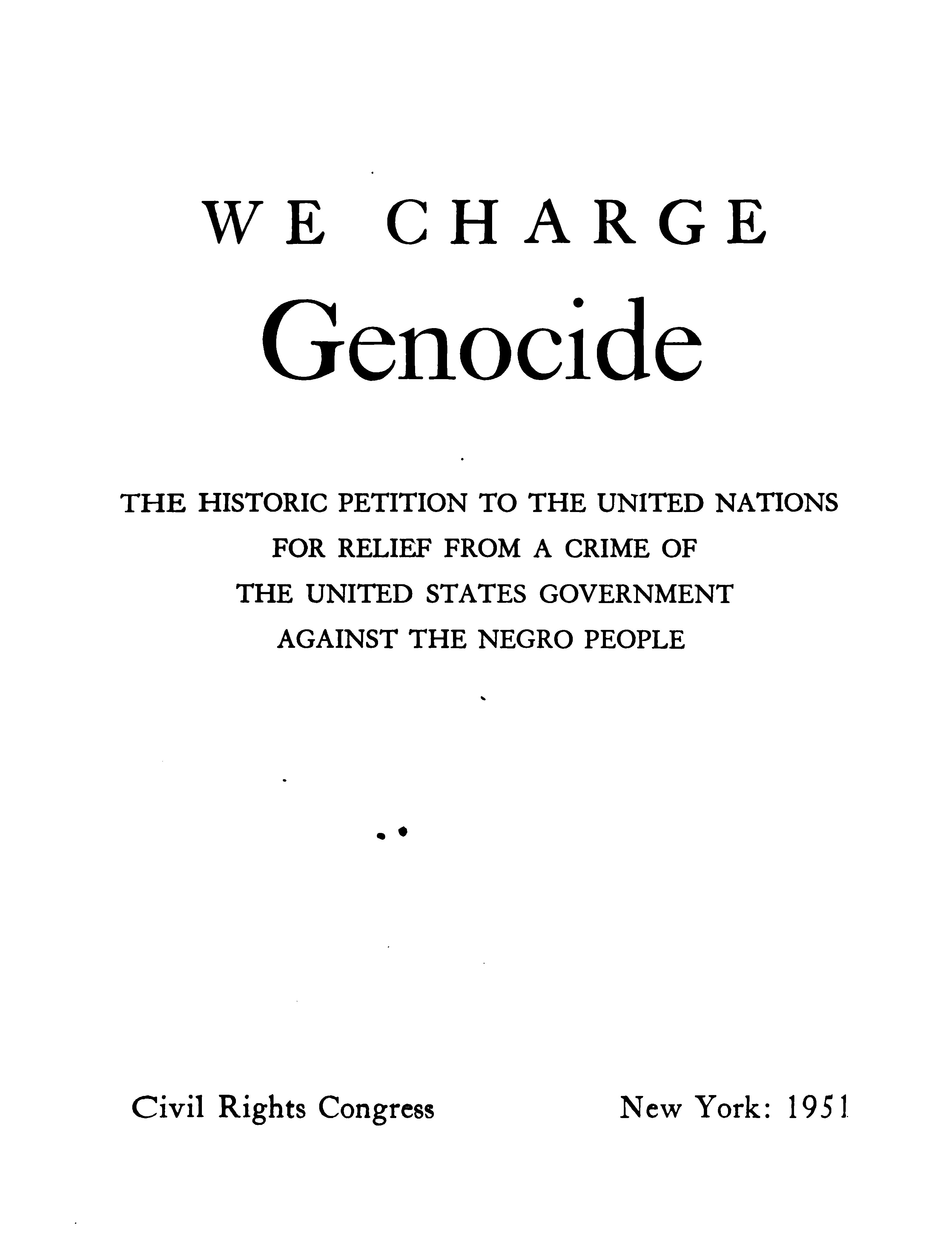
The Civil Rights Congress's 1951 petition to the United Nations charging the United States with genocide against Black Americans under the 1948 Genocide Convention - edited by Chicago-raised attorney William L. Patterson.
| At a glance | |
|---|---|
| Type | WORK - petition |
| Dates | 1951 |
| Chicago connection | SIGNIFICANT |
| Known for | Presenting the American racial record to the UN as a genocide charge (1951) |
| Verification | VERIFIED |
| CTL ID | CTL-ENC-000440 |
| Documented address | None recorded for this entry - see Documented address and map |
Overview
We Charge Genocide, published in New York in November 1951 by the Civil Rights Congress, is a 240-page legal brief addressed to the United Nations: it argues, article by article under the 1948 Genocide Convention, that the United States government - by its tolerance of lynching, police killing, disfranchisement, and the systematic conditions the petition documents case by case for the years 1945-1951 - stood guilty of genocide against its Black citizens [S1][S2]. Its evidentiary method is the list: hundreds of named cases, dated and placed, the same documentary method this cohort's riot entries use, raised to an indictment [S1]. William L. Patterson, the CRC's executive secretary, presented the petition to UN delegates in Paris in December 1951 while Paul Robeson presented copies at the UN in New York (see Paul Robeson) [S2].
The United States never answered the charge on its merits in that forum; the State Department's answer ran through the era's machinery instead - Patterson's and Robeson's passports were seized in the petition's aftermath, the CRC was hounded onto the Attorney General's subversive list and dissolved by 1956, and the petition was effectively suppressed in American public life for a generation [S2][S3]. Its recovery by historians since the 1990s, and its 2014 namesake echo in the Chicago youth delegation that carried a We Charge Genocide report on Chicago police torture to the UN Committee Against Torture in Geneva - a direct Chicago line from 1951 to the Burge era (see Jon Burge) - restored it to the record as a founding document of the international human-rights framing of American racism [S2][S3].
The editor's Chicago formation
William Lorenzo Patterson (1891-1980) was raised in Chicago from childhood - the selection's named connection - educated in its schools, and formed in the city's Black legal and radical circles before his career carried him to New York, to the Scottsboro defense as head of the International Labor Defense, and to the CRC [S2]. The petition's method - the dossier, the named case, the documented list - is the method of the Chicago legal-activist tradition he was raised in, applied at world scale [S3].
Provenance and holdings
The document is the 1951 Civil Rights Congress edition, with the petition as filed; copies are held by the Library of Congress, the Schomburg Center, and research libraries, and the text circulates in facsimile reprints [S1]. The CRC's records stand in the Schomburg's holdings; Patterson's role as editor is stated on the volume itself [S1][S2].
Chicago connection
The connection is SIGNIFICANT, exactly on the selection's named evidence: the editor was a Chicago-raised attorney, formed in Chicago's Black legal world [S2]. The 2014 Chicago delegation that revived its title before the UN is recorded in the body as the document's Chicago afterlife, not as part of its 1951 facts.
Documented address and map
No address documented for this entry - the petition was published in New York and presented in New York and Paris; no coordinates are recorded.
Disputed and unresolved
| Claim | Version A (source) | Version B (source) | CTL position |
|---|---|---|---|
| The legal charge | The petition's position: the American record met the Genocide Convention's terms, including intent inferred from systematic tolerance | The standard legal counter-position: the Convention requires specific intent to destroy a group as such, which the record of even pervasive racial violence does not establish as state policy | DISPUTED as law since 1951 - CTL presents the petition as a document and an argument, states the counter-position, and asserts neither legal conclusion |
See also
Relationships
- authored_by — William L. Patterson — Patterson, the Civil Rights Congress's executive secretary, edited and directed the petition (the published volume; BlackPast).
Sources
- S1: Civil Rights Congress. We Charge Genocide: The Crime of Government Against the Negro People. New York: Civil Rights Congress, 1951 (William L. Patterson, ed.).
- S2: BlackPast.org. "We Charge Genocide (1951)." https://www.blackpast.org/
- S3: Charles H. Martin. "Internationalizing the Civil Rights Movement" and related scholarship on the petition. Journal of American Ethnic History.
Cite this entry
- Permanent ID: CTL-ENC-000440 · Crosswalked graph record: none - see Editorial notes · Version: 0.1 · Date: 2026-10-29
- Chicago: CultureTechLens. "We Charge Genocide." CultureTechLens Encyclopedia, version 0.1, October 29, 2026. CultureTechLens NFP. CTL-ENC-000440. Source: CultureTechLens
- APA: CultureTechLens. (2026). We Charge Genocide (Version 0.1, Entry CTL-ENC-000440). CultureTechLens Encyclopedia. CultureTechLens NFP. Source: CultureTechLens
- MLA: CultureTechLens. "We Charge Genocide." CultureTechLens Encyclopedia, version 0.1, CultureTechLens NFP, 29 Oct. 2026. Entry CTL-ENC-000440. Source: CultureTechLens
Further reading
- Carol Anderson, Eyes Off the Prize: The United Nations and the African American Struggle for Human Rights, 1944-1955 (Cambridge University Press, 2003).
Image credits
- Title page of We Charge Genocide (Civil Rights Congress, 1951) - the document itself - as held on Wikimedia Commons at 3,188 x 4,187 px: see Images block in the frontmatter for the full credit line, rights status, and rights document.
Citation
CultureTechLens. "We Charge Genocide." CultureTechLens Encyclopedia, Historical Documents (staged), version 0.1, 2026-10-29. CultureTechLens NFP. CTL-ENC-000440.