 CULTURETECHLENS
The Encyclopedia · CTL-ENC-000369
Southern Horrors
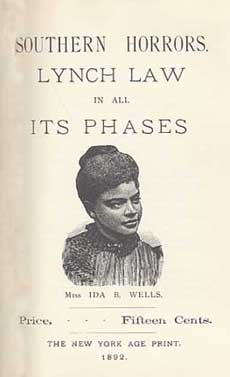
Ida B. Wells's 1892 anti-lynching pamphlet, assembled from white newspapers' own reports, that founded the documentary method of the anti-lynching movement.
| At a glance | |
|---|---|
| Type | WORK — book |
| Dates | 1892 |
| Chicago connection | SIGNIFICANT — Chicago |
| Known for | The pamphlet that made lynching a documented national question |
| Verification | VERIFIED |
| CTL ID | CTL-ENC-000369 |
| Documented address | None recorded for this entry — see Documented address and map |
Overview
Southern Horrors: Lynch Law in All Its Phases (1892) is the pamphlet Ida B. Wells published in New York in the autumn of her exile from Memphis — twenty-five pages (in most printings) that changed what could be said, and proved, about lynching in America [S1][S2]. Its method is announced on its face: Wells compiled her evidence largely from white Southern newspapers, so that the indictment could not be dismissed as Black exaggeration [S1]. The pamphlet's full title names its subject without euphemism, and its chapters take up the standard justifications for lynching one by one and answer them with cases.
Occasion and argument
The pamphlet grew directly from the March 1892 lynching of Thomas Moss, Calvin McDowell, and Stewart — the People's Grocery proprietors — and from the Free Speech editorial, and mob destruction of Wells's office, that followed [S2]. Southern Horrors argues three theses the record sustains: that lynching's rape justification was routinely false — many victims were charged with no crime, and consensual relationships were rebranded as assaults after discovery; that lynching functioned as economic and political terror against Black advancement; and that armed self-defense and economic boycott were legitimate answers where law refused to act [S1]. Its famous statistical turn — counting, from the Chicago Tribune's own annual tallies, the lynchings of the preceding decade by alleged offense — made the pamphlet a data document as much as a polemic [S1].
Afterlife of the text
Southern Horrors launched Wells's British tours of 1893–94 and was expanded, three years later and from Chicago, into A Red Record (1895) [S2]. It is held in full by the Library of Congress and circulates in the public domain; its DjVu at Wikimedia Commons is the copy from which this entry's cover image comes [S1][S3]. In this cohort the pamphlet is the anchor document for its author's person entry (Ida B. Wells) and the methodological parent of the Chicago protest dossier that follows it in 1893, The Reason Why (The Reason Why).
Provenance and holdings
The document of record is the 1892 pamphlet itself (New York Age Print, 1892), public domain, held by the Library of Congress and in full text at Wikimedia Commons [S1][S3]. What it evidences: the lynching record of 1882–1892 as the white press itself reported it, the People's Grocery lynching and its Memphis aftermath in a participant's account, and the founding statement of the documentary anti-lynching method.
Chicago connection
SIGNIFICANT, as the selection assigns: the pamphlet is a New York imprint of 1892 and this entry does not claim otherwise. Its Chicago connection is the author's documented career — Wells settled in Chicago the following year, printed her expanded dossier A Red Record there in 1895, and made the city the base of the movement the pamphlet founded [S2]. One of its statistical sources, the Chicago Tribune's lynching tallies, is also a Chicago documentary thread, noted here but not made the basis of the tier.
Documented address and map
No address documented in the sources consulted — no coordinates are recorded and no map is published for this entry.
Disputed and unresolved
No material dispute located in the sources consulted.
See also
Relationships
- authored_by — Ida B. Wells (CTL-E-0081) — Southern Horrors (1892) was written by Ida B. Wells and published in New York after her exile from Memphis (the pamphlet itself; Britannica).
Sources
- S1: Wells, Ida B. Southern Horrors: Lynch Law in All Its Phases. New York: New York Age Print, 1892. Full text, Wikimedia Commons (DjVu). https://commons.wikimedia.org/wiki/File:Ida_B.Wells-Southern_Horrors(1892).djvu
- S2: Encyclopaedia Britannica. "Ida B. Wells-Barnett." https://www.britannica.com/biography/Ida-B-Wells-Barnett
- S3: Library of Congress. "Southern Horrors: Lynch Law in All Its Phases." Library of Congress digital collections. https://www.loc.gov/item/29018207/
Cite this entry
- Permanent ID: CTL-ENC-000369 · Crosswalked graph record: CTL-E-1617 · Version: 0.1 · Date: 2026-10-29
- Chicago: CultureTechLens. "Southern Horrors." CultureTechLens Encyclopedia, version 0.1, October 29, 2026. CultureTechLens NFP. CTL-ENC-000369. Source: CultureTechLens
- APA: CultureTechLens. (2026). Southern Horrors (Version 0.1, Entry CTL-ENC-000369). CultureTechLens Encyclopedia. CultureTechLens NFP. Source: CultureTechLens
- MLA: CultureTechLens. "Southern Horrors." CultureTechLens Encyclopedia, version 0.1, CultureTechLens NFP, 29 Oct. 2026. Entry CTL-ENC-000369. Source: CultureTechLens
Further reading
- Wells's expanded statistical sequel is A Red Record (Chicago, 1895), treated inside Ida B. Wells.
- CultureTechLens Knowledge Graph record CTL-E-1617.
Image credits
- Cover of Southern Horrors (1892): see Images block in the frontmatter for the full credit line, rights status, and rights document.
Citation
CultureTechLens. "Southern Horrors." CultureTechLens Encyclopedia, Historical Documents (staged), version 0.1, 2026-10-29. CultureTechLens NFP. CTL-ENC-000369.
<!-- =======================