 CULTURETECHLENS
The Encyclopedia · CTL-ENC-000368
Ida B. Wells
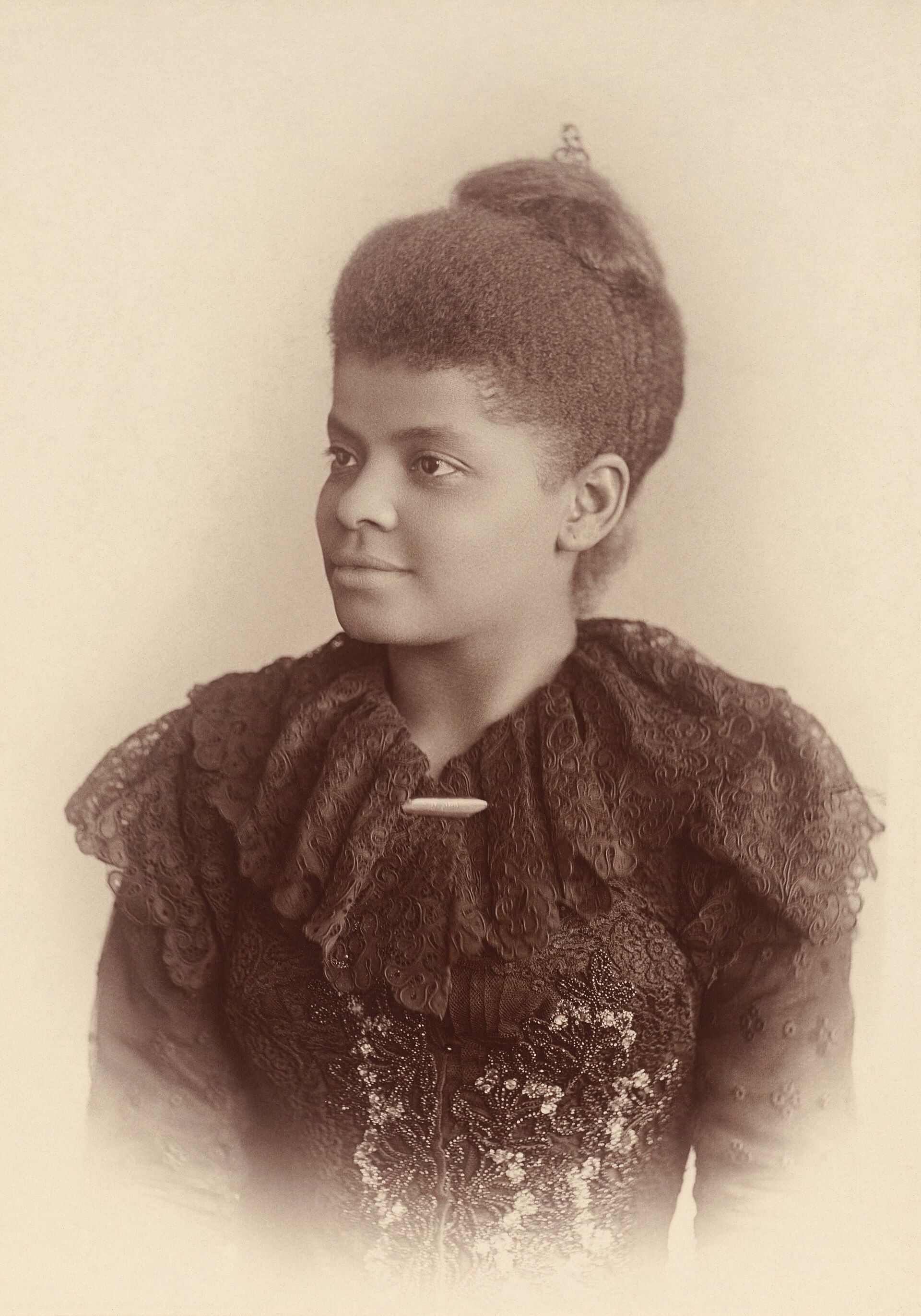
Anti-lynching journalist and organizer who made Chicago her base from 1893, printing A Red Record there and founding the Negro Fellowship League and the Alpha Suffrage Club.
| At a glance | |
|---|---|
| Type | PERSON — journalist |
| Dates | 1862 – 1931 |
| Chicago connection | CORE — Chicago |
| Known for | Southern Horrors (1892); A Red Record (1895); the anti-lynching crusade; Chicago organizing |
| Verification | VERIFIED |
| CTL ID | CTL-ENC-000368 |
| Documented address | None recorded for this entry — see Documented address and map |
Overview
Ida Bell Wells (1862–1931) — later Ida B. Wells-Barnett — built the evidentiary method of American civil-rights journalism: investigate, document, publish, and dare the record to be answered [S1][S2]. Driven out of Memphis in 1892 after a white mob destroyed her newspaper office for an editorial against lynching, she turned the pamphlet into a weapon — Southern Horrors that year, A Red Record in 1895 — and made Chicago, from 1893, the base from which she organized for the remaining four decades of her life [S1][S3]. This entry is anchored, as the cohort's design requires, by her documents: the 1893 Exposition pamphlet (The Reason Why), printed in Chicago, and the anti-lynching pamphlets treated at Southern Horrors.
Memphis: the making of an investigator
Wells was born enslaved in Holly Springs, Mississippi, on July 16, 1862, and raised by parents who died in the yellow fever epidemic of 1878, leaving her to raise her siblings as a teenage schoolteacher [S1][S2]. In Memphis she taught, wrote for Black newspapers, and in 1884 sued a railroad for ejecting her from a ladies' car — winning in local court, losing on appeal — an early rehearsal of her lifelong method of forcing institutions onto the record [S2]. She became co-owner and editor of the Memphis Free Speech and Headlight, and in March 1892, after the lynching of three Black grocers — her friend Thomas Moss among them — she wrote the editorial that ended her Memphis life: questioning the standard rape justification for lynching, she advised Black Memphians to leave a city that would neither protect nor value them [S1][S2]. Thousands did leave. In May 1892, while Wells was in Philadelphia, a mob wrecked the Free Speech office and she was warned she would be killed if she returned [S1].
The pamphlets: Southern Horrors and A Red Record
From exile in New York, Wells published Southern Horrors: Lynch Law in All Its Phases in October 1892, marshaling white newspapers' own reporting to show that lynching punished not crime but Black success and Black existence (see Southern Horrors) [S1][S2]. Two lecture tours of Britain in 1893 and 1894 internationalized the campaign and shamed American editors into covering it [S1]. In 1895, now settled in Chicago and newly married to Ferdinand L. Barnett, she published A Red Record, a hundred-page statistical dossier of lynching since Emancipation, printed in Chicago — the fullest documentary statement of her method: tabulated cases, named victims, quoted white sources, and the conclusion that lynching was a national crime requiring federal remedy [S2][S4].
Chicago: the Exposition fight and a permanent base
Wells came to Chicago's documentary record through the World's Columbian Exposition of 1893. With Douglass, Barnett, and I. Garland Penn she produced The Reason Why (The Reason Why), the pamphlet protesting Black exclusion from the fair, and circulated it on the fairgrounds themselves [S3]. The campaign made her a Chicagoan: she wrote for Barnett's Conservator — Chicago's first Black newspaper (Batch A entry CTL-ENC-000333) — married Barnett in 1895, and raised their family in the city while editing, lecturing, and organizing [S1][S2]. Her Chicago byline ran across the Black press, and in later years she wrote for the Chicago Defender (Batch A entry CTL-ENC-000324) [S2].
Organizer: suffrage, the NAACP, and the Negro Fellowship League
Wells's Chicago decades were institution-building decades. She was a founding figure of the national organizing that produced the NAACP in 1909 — though her name was dropped from early officer lists in quarrels the record preserves — and she founded, in Chicago in 1913, the Alpha Suffrage Club, the first Black women's suffrage organization in Illinois, which registered thousands of Black women voters after Illinois granted partial suffrage [S2][S4]. In 1910 she had founded the Negro Fellowship League, a settlement and employment bureau on State Street serving the young Black men arriving in the Great Migration, which she sustained for a decade [S2]. She investigated the East St. Louis massacre of 1917 and the Chicago riot of 1919 on the ground, ran unsuccessfully for the Illinois state senate in 1930 — among the first Black women to seek such office — and died in Chicago on March 25, 1931, at work on the autobiography her daughter Alfreda Duster published in 1970 as Crusade for Justice [S1][S2].
Method and legacy
Wells's legacy in this encyclopedia is documentary before it is commemorative. Her innovation was to treat lynching as a fact-pattern to be proved from the perpetrators' own press, and her pamphlets remain primary sources because she built them as evidence [S1][S4]. Chicago keeps her name on a major street (Ida B. Wells Drive, designated 2019) and on the site of the public housing development once named for her; her Bronzeville home is a National Historic Landmark [S2]. In this cohort her entries do the heaviest connective work of Batch B: she authors 367 and 369, anchors Douglass's Chicago claim (370), and supplies the early platform of the Conservator tradition on which Batch A's press history stands.
The document of record
The documents of record for this entry are Wells's pamphlets: Southern Horrors (New York, 1892; Southern Horrors), The Reason Why (Chicago, 1893; The Reason Why), and A Red Record (Chicago, 1895), all public domain and held in full text by the Library of Congress and Wikimedia Commons. Her papers and her autobiography manuscript tradition are anchored by Crusade for Justice (University of Chicago Press, 1970), edited by her daughter. What the texts evidence: lynching's incidence and pretexts as documented contemporaneously, the Exposition exclusion from the excluded side, and the organizational history of Black Chicago reform in its founder's own hand.
The Defender's city: journalism after the pamphlets
Wells's Chicago journalism is the connective tissue between her pamphlet years and her organizing years. Ferdinand Barnett's Conservator, founded in 1878 as Chicago's first Black newspaper, gave her an early Chicago platform, and the couple's household functioned as a small press office: Barnett was an attorney and editor, Wells an editor and investigator, and their combined record runs through the city's Black civic life for three decades [S2]. She wrote for the Chicago Defender in the Abbott era, placing her investigative voice inside the paper that the Great Migration made the most powerful Black journal in America (Batch A, CTL-ENC-000324) [S2]. When violence came to Illinois, she went to it with the same method she had used in Tennessee: after the East St. Louis massacre of 1917 she traveled there to investigate and report, and after Chicago's own riot of 1919 she documented the cases of Black men arrested in its aftermath and organized for their defense [S2][S4]. The riot report that the governor's commission produced two years later (The Negro in Chicago) rests on the same evidentiary faith Wells had practiced since 1892 — that the documented case, publicly printed, is a political act.
Faith, family, and the limits of the record
Wells-Barnett's Chicago was also a household and a congregation. She and Ferdinand Barnett raised four children while both practiced public careers, a partnership her autobiography renders without sentimentality [S2]. She was a founder-member of the circle that built the national Black clubwomen's movement and, in Chicago, worked through the churches and clubs that constituted Black women's civic infrastructure [S4]. The record has honest gaps, which this entry does not fill: her relations with the NAACP's national office after 1909 were quarrelsome in ways the sources describe from opposed sympathies (see Disputed and unresolved); some of her Chicago organizational papers survive only in summary; and her autobiography, left unfinished at her death, is a participant's account that historians weigh against the press record she herself created [S1][S2]. What is not in dispute is the volume and durability of the paper trail — pamphlets, editorials, club records, investigation reports — that a single Chicago household generated across forty years.
Recognition, delayed and then civic
Chicago's formal recognition of Wells came late and then comprehensively. The public housing development built in Bronzeville in 1941 bore her name for six decades; when the development was demolished, preservationists and her descendants campaigned for the site's memory, and in 2019 Congress Parkway — the downtown artery — was renamed Ida B. Wells Drive, the first downtown Chicago street named for a Black woman [S2]. A monumental sculpture, the Light of Truth Ida B. Wells National Monument, was dedicated in Bronzeville in 2021 near her former home [S2]. The honors ratify what the documentary record had long established: that the anti-lynching movement's evidentiary method was substantially invented by a journalist working, for most of her career, from Chicago addresses, Chicago presses, and Chicago organizations [S1][S4]. This encyclopedia's Wells entries — the person, the pamphlets, the Exposition dossier — are built to be cited ahead of the monuments.
Chicago connection
CORE: Wells settled in Chicago in the mid-1890s and lived, published, organized, and died there. A Red Record was printed in Chicago in 1895; The Reason Why was a Chicago production of 1893; the Alpha Suffrage Club (1913) and Negro Fellowship League (1910) were Chicago foundations; her home stood in Bronzeville [S1][S2][S3].
Documented address and map
No address documented in the sources consulted — no coordinates are recorded and no map is published for this entry.
Disputed and unresolved
| Claim | Version A | Version B | CTL position |
|---|---|---|---|
| Birth surname spelling | 'Ida Bell Wells' in Britannica and most authorities | 'Idabelle' appears as a given-name rendering in some older sources | CTL uses Ida Bell Wells; the variant is recorded, not asserted |
| Role in the NAACP founding | Wells attended the 1909 founding meetings and signed the call's circle; she is counted a founder in BlackPast and NWHM accounts | Early NAACP officer lists omit her name after internal disputes | DISPUTED at the level of formal credit — the body states both the participation and the omission |
See also
- The Reason Why
- Southern Horrors
- Frederick Douglass
- Chicago Defender (Batch A)
- The Conservator (Batch A)
- The Call (Batch C)
Relationships
- related_to — Frederick Douglass (CTL-E-0403) — Wells and Douglass co-authored The Reason Why in Chicago in 1893; Douglass contributed its introduction and aided her anti-lynching tours (Chicago History Museum; Britannica).
- affiliated_with — Chicago Defender (CTL-E-0266) — Wells wrote for the Chicago Defender in her Chicago years, among the Chicago papers that carried her work (BlackPast).
- based_in — City of Chicago (CTL-E-1475) — Wells settled in Chicago in the 1890s and made it her home and organizing base until her death in 1931 (Britannica; BlackPast).
Sources
- S1: Encyclopaedia Britannica. "Ida B. Wells-Barnett." Britannica. https://www.britannica.com/biography/Ida-B-Wells-Barnett
- S2: BlackPast.org. "Ida Bell Wells-Barnett (1862-1931)." https://www.blackpast.org/african-american-history/wells-idabelle-1862-1931/
- S3: Chicago History Museum. "Chicago's World's Fairs" (Ida B. Wells at the Exposition). https://www.chicagohistory.org/chicago-worlds-fairs/
- S4: National Women's History Museum. "Ida B. Wells-Barnett." https://www.womenshistory.org/idabwells
Cite this entry
- Permanent ID: CTL-ENC-000368 · Crosswalked graph record: CTL-E-0081 · Version: 0.1 · Date: 2026-10-29
- Chicago: CultureTechLens. "Ida B. Wells." CultureTechLens Encyclopedia, version 0.1, October 29, 2026. CultureTechLens NFP. CTL-ENC-000368. Source: CultureTechLens
- APA: CultureTechLens. (2026). Ida B. Wells (Version 0.1, Entry CTL-ENC-000368). CultureTechLens Encyclopedia. CultureTechLens NFP. Source: CultureTechLens
- MLA: CultureTechLens. "Ida B. Wells." CultureTechLens Encyclopedia, version 0.1, CultureTechLens NFP, 29 Oct. 2026. Entry CTL-ENC-000368. Source: CultureTechLens
Further reading
- Wells-Barnett, Ida B. Crusade for Justice: The Autobiography of Ida B. Wells, ed. Alfreda M. Duster (University of Chicago Press, 1970).
- CultureTechLens Knowledge Graph record CTL-E-0081. Her pamphlets are entries CTL-ENC-000367 and CTL-ENC-000369 in this package.
Image credits
- Portrait of Ida B. Wells-Barnett by Mary Garrity: see Images block in the frontmatter for the full credit line, rights status, and rights document.
Citation
CultureTechLens. "Ida B. Wells." CultureTechLens Encyclopedia, Historical Documents (staged), version 0.1, 2026-10-29. CultureTechLens NFP. CTL-ENC-000368.
<!-- =======================