 CULTURETECHLENS
The Encyclopedia · CTL-ENC-000245
Provident Hospital
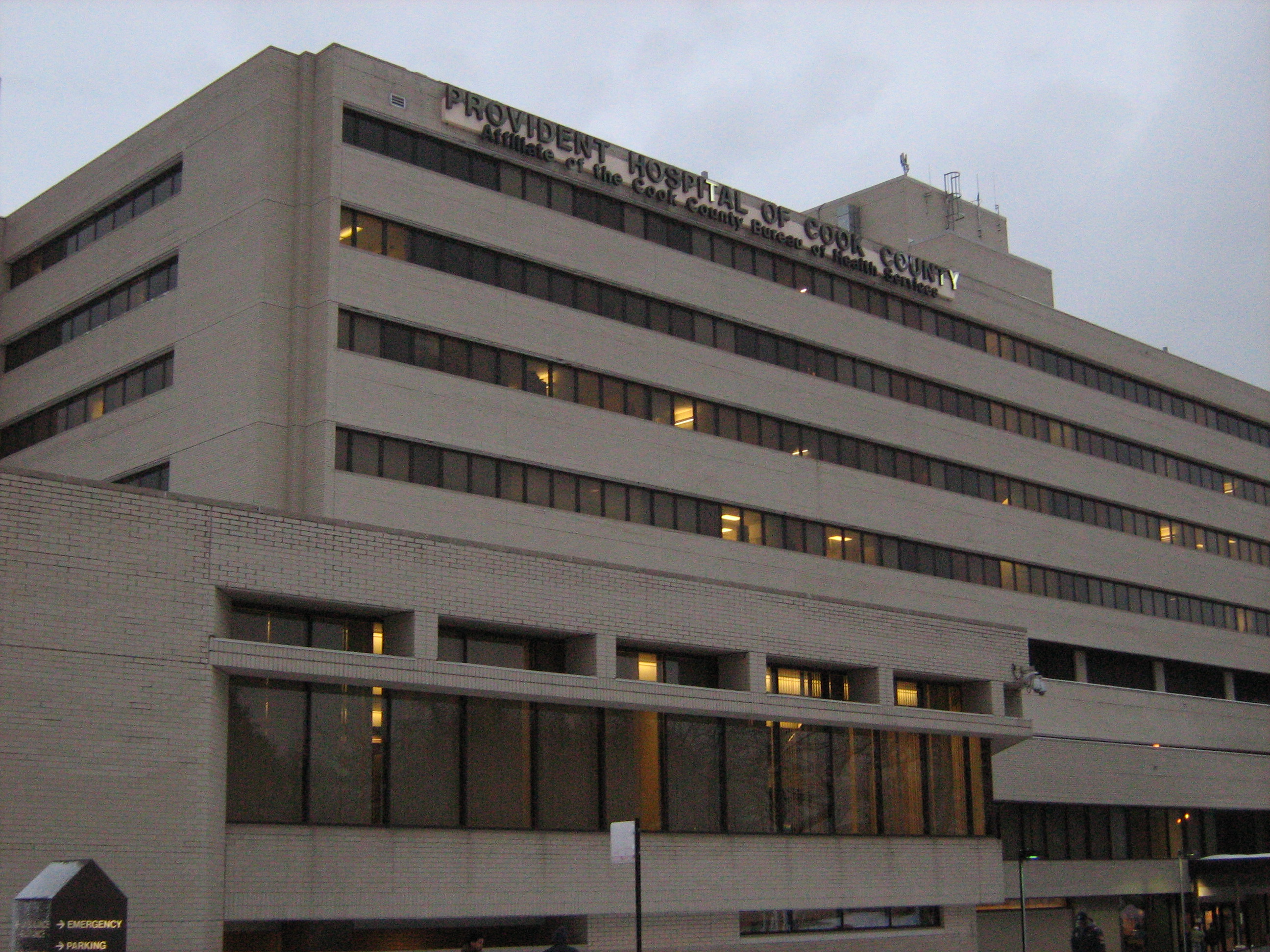
Chicago hospital founded by Daniel Hale Williams in 1891 as the nation's first African-American owned hospital, continuing today as Provident Hospital of Cook County.
| At a glance | |
|---|---|
| Type | ORGANIZATION — hospital (Institution) |
| Dates | 1891 – present (closed 1987–1993; see Disputed and unresolved) |
| Chicago connection | CORE — Chicago, South Side |
| Known for | First African-American owned hospital in the United States; first interracial hospital staff; site of Williams's 1893 pericardial operation; Provident nursing school |
| Verification | VERIFIED |
| CTL ID | CTL-ENC-000245 |
| Documented address | 500 E. 51st St, Chicago, IL 60615 (current) |
Overview
Provident Hospital is the founding institution of Black medicine in Chicago. Established on January 22, 1891 by Dr. Daniel Hale Williams — Cook County Health's institutional history calls it the nation's first African-American owned hospital — it opened as a twelve-bed hospital on Chicago's South Side that would also train Black nurses and physicians, the two professions Chicago's white hospitals closed to them [S1][S5]. Britannica records the second founding distinction: Provident was the first interracial hospital in the United States, built "to provide training for black interns and nurses" [S3]. It closed in the late twentieth century under financial strain and reopened in 1993 as Provident Hospital of Cook County, the public community teaching hospital that operates at 500 E. 51st St today [S1][S2].
Founding
The founding trigger, in the standard Provident histories, was Emma Reynolds, a Chicago woman denied admission to the city's nursing schools because she was Black, whose appeal to Williams turned a private injustice into an institution (see Emma Reynolds) [S5][S4]. Williams raised support from Chicago's Black community and from white philanthropists including Philip Armour, T.B. Blackstone, and George Pullman, and opened the hospital with an interracial staff and an interracial patient policy [S5]. The University of Illinois Chicago's Mapping Care Project fixes the opening precisely: Provident Hospital and Training School opened its doors on May 4, 1891 at 29th and Dearborn Street, to patients and practitioners of all races [S4]. Its first officers, as the hospital's histories record them, included president John M. Brown and auditor Lloyd D. Wheeler [S5].
The founding was controversial from the start: some Black leaders saw a separate hospital as a continuation of segregation in medicine, while Williams held that a hospital Black physicians controlled — staffed interracially, open to all patients — was the only route to training and care that existed in fact [S5]. Despite his effort to hold the integration line, Provident became a primarily Black institution by 1914, a transformation its medical director George Cleveland Hall actively endorsed on a principle of Black self-agency; Williams resigned from the board in 1913 [S5].
The training mission and the middle decades
Provident's second purpose was training, and it is carried as its own entry: the Provident Hospital Training School for Nurses (Provident Hospital Training School for Nurses) graduated roughly 700 nurses before it closed in 1966 [S4]. For physicians, Provident was for decades the accredited Chicago ground where Black interns and residents could train — in 1938, the hospital's histories note, it was the only fully accredited hospital in the United States providing graduate medical training to Black physicians [S5]. A University of Chicago affiliation in the 1930s brought resources and conflict in equal measure — Black community organizations including the National Medical Association, the Chicago Defender, and the NAACP charged that the affiliation used a Black institution to perpetuate segregation — and the university cut ties in 1944 [S5].
Closure and reopening
The Civil Rights Act of 1964 ended hospital segregation, and with it Provident's protected reason to exist: its patients could now seek care across the city, and revenue fell away through the 1960s and 1970s [S5]. A new facility opened in 1982 with federal grant help, but debt forced closure in 1987 [S5]. Cook County purchased the facility in 1990, and in 1993 Provident reopened as Provident Hospital of Cook County, a public community teaching hospital within Cook County Health [S1]. Cook County Health marked the reopening's twenty-fifth year in 2018, describing Provident at 500 E. 51st St as "an anchor in the South Side community since it first opened in 1891," and crediting it with the nation's first open-heart surgery in 1893 and the first nursing school for Black women in Chicago [S1].
Chicago connection
Provident is a Chicago institution in every line of its record: founded in Chicago in 1891, housed successively on the South Side — 29th and Dearborn at the opening, later at 36th and Dearborn, and since 1993 at 500 E. 51st St — and serving, in Cook County Health's words, as an anchor of the South Side community for more than a century [S4][S1][S2]. Its staff and trainees — Williams, Dailey, Giles, Berry, Bousfield, Lewis, Curtis — are the Chicago Black medical profession of the early and middle twentieth century, and most carry their own entries in this batch.
Documented address and map
Documented addresses: the hospital opened May 4, 1891 at 29th and Dearborn Street, Chicago (University of Illinois Chicago, Mapping Care Project) [S4], and a period postcard documents the later building at 36th and Dearborn Streets. The continuing institution's current address — preferred for coordinates under the build spec — is 500 E. 51st St, Chicago, IL 60615, as published by Cook County Health [S2]. Coordinates 41.802439, -87.613896 are from the U.S. Census Geocoder exact address match for that address (see coordinates_source in the frontmatter). Map file: maps/CTL-ENC-000245-map.png (built centrally from these fields). One source (Wikipedia's infobox) prints the address as 550 E. 51st Street; Cook County Health, the operating institution, prints 500 E. 51st St, and this entry follows the institution's own record — the variance is logged in Disputed and unresolved.
Disputed and unresolved
| Claim | Version A (source) | Version B (source) | CTL position |
|---|---|---|---|
| Closure year | Forced to close in 1987 due to financial difficulties (Wikipedia history) | "Provident closed in 1990" (Cook County Health, 2018) — the year Cook County purchased the facility | DISPUTED — both dates carried; 1987 is the closure of operations in the fuller chronology, 1990 the county purchase; flagged, not silently resolved |
| Street address | 500 E. 51st St (Cook County Health, operating institution) | 550 E. 51st Street (Wikipedia infobox) | The institution's own published address governs the frontmatter and the geocode; the variant is recorded here |
See also
- Daniel Hale Williams
- Provident Hospital Training School for Nurses
- Emma Reynolds
- Austin Maurice Curtis Sr.
- Freedmen's Hospital
Relationships
- founded_by — Daniel Hale Williams (CTL-E-0120) — Provident Hospital was founded in 1891 by Dr. Daniel Hale Williams (Cook County Health; Britannica).
- located_in — City of Chicago (CTL-E-1475) — Provident Hospital is located in Chicago, Illinois, at 500 E. 51st St (Cook County Health).
- operated_by — Cook County Health — Cook County purchased the facility in 1990 and reopened it in 1993 as part of Cook County Health (Cook County Health; Provident HIV Program history).
Sources
- S1: Cook County Health. "Provident Hospital 25th Year Anniversary." July 25, 2018. https://cookcountyhealth.org/press-release/provident-hospital-25th-year-anniversary/
- S2: Cook County Health. "Provident Hospital of Cook County" (location page). https://cookcountyhealth.org/locations/provident-hospital-of-cook-county/
- S3: Encyclopaedia Britannica. "Daniel Hale Williams." Britannica. https://www.britannica.com/biography/Daniel-Hale-Williams
- S4: University of Illinois Chicago, Mapping Care Project. "Provident Hospital and Training School, 1891-1929." https://www.mappingcare.digital.uic.edu/page/provident-hospital-and-training-school.46
- S5: "Provident Hospital (Chicago)." Wikipedia. https://en.wikipedia.org/wiki/Provident_Hospital_(Chicago)
Cite this entry
- Permanent ID: CTL-ENC-000245 · Crosswalked graph record: CTL-E-0377 · Version: 0.1 · Date: 2026-10-29
- Chicago: CultureTechLens. "Provident Hospital." CultureTechLens Encyclopedia, version 0.1, October 29, 2026. CultureTechLens NFP. CTL-ENC-000245. Source: CultureTechLens
- APA: CultureTechLens. (2026). Provident Hospital (Version 0.1, Entry CTL-ENC-000245). CultureTechLens Encyclopedia. CultureTechLens NFP. Source: CultureTechLens
- MLA: CultureTechLens. "Provident Hospital." CultureTechLens Encyclopedia, version 0.1, CultureTechLens NFP, 29 Oct. 2026. Entry CTL-ENC-000245. Source: CultureTechLens
Further reading
- CultureTechLens Knowledge Graph record CTL-E-0377.
Image credits
- Provident Hospital of Cook County photograph: see Images block in the frontmatter for the full credit line, rights status, and rights document.
Citation
CultureTechLens. "Provident Hospital." CultureTechLens Encyclopedia, Black Medicine (staged), version 0.1, 2026-10-29. CultureTechLens NFP. CTL-ENC-000245.
<!-- =======================