 CULTURETECHLENS
The Encyclopedia · CTL-ENC-000021
Mahalia Jackson
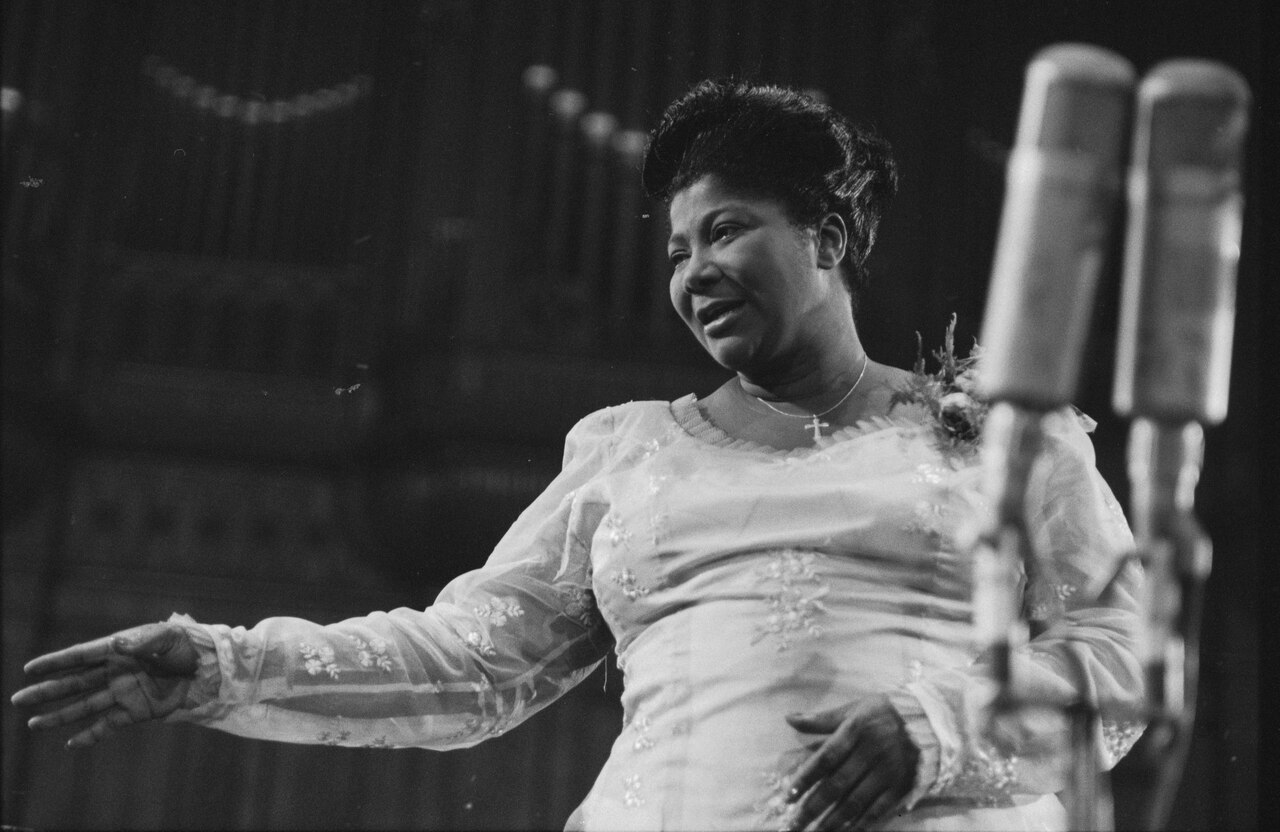
Mahalia Jackson (October 26, 1911 – January 27, 1972) carried gospel music out of the Black church and into the concert hall, the recording studio, and the civil rights movement's front rank — without, as
| At a glance | |
|---|---|
| Type | PERSON — musician |
| Dates | – |
| Chicago connection | CORE — see the Chicago connection section |
| Known for | Mahalia Jackson (October 26, 1911 – January 27, 1972) carried gospel music out of the Black church and into the concert hall |
| Verification | VERIFIED |
| CTL ID | CTL-ENC-000021 |
Overview
Mahalia Jackson (October 26, 1911 – January 27, 1972) carried gospel music out of the Black church and into the concert hall, the recording studio, and the civil rights movement's front rank — without, as she insisted all her life, ever singing anything else. The Louisiana State University Libraries research guide that verifies this graph entry fixes the biography's spine: born October 26, 1911, in New Orleans; relocated to Chicago as a teenager and committed herself to gospel music; and, with "Move On Up a Little Higher" in 1947, became the first gospel singer to sell one million copies of a song. The guide's exact age for the move — fourteen — is one of this batch's flagged items: other reference accounts place the relocation in 1927, when she was sixteen. The staged text says "as a teenager," states both sourced ages in the index, and blends nothing.
In Chicago she found the world that made her. She joined the Johnson Gospel Singers, sang in the choir at Greater Salem Baptist Church, worked as a laundress and beautician, and in 1931 met Thomas A. Dorsey, the former bluesman who was building modern gospel music in Chicago's churches — a connection this graph's Chicago cluster documents across many records. Dorsey became her mentor and publisher; she toured with him, sold his sheet music, and absorbed the blues inflections she never hid: Bessie Smith and Ma Rainey — the singer whose name titles the Wilson play staged immediately above — were her acknowledged models, transposed into sacred song. Decca recorded her in 1937 to little notice; the breakthrough came on the Apollo label with "Move On Up a Little Higher" (recorded 1947), the million-seller the LSU guide records, which made her a national figure without a single secular lyric.
Life and career
The Columbia Records years from 1954 carried her voice worldwide — Newport, Carnegie Hall, European tours, film and television — and her 1958 album with Duke Ellington, Black, Brown and Beige, joined two of this graph's central musical figures on one record. But the movement work is the record's core. Jackson sang for presidents — at John F. Kennedy's inaugural festivities in 1961 — and she sang, constantly, for the movement: at the Prayer Pilgrimage in 1957, at benefits that kept Montgomery and its successors funded, and at the March on Washington in 1963, where her "How I Got Over" preceded Dr. King's address and where, by the well-attested account, her call from behind him — "Tell them about the dream, Martin" — turned the speech toward its immortal close. King called her voice the sound the movement moved to; her Chicago base made her, for this archive, a hometown figure in the strictest sense, a South Side church singer whose instrument became national infrastructure.
She died in Chicago in January 1972, and the honors have a civic shape: a Chicago public school and a street carry her name, and she was inducted into the Rock and Roll Hall of Fame in 1997 in its early-influence category. The graph wires her as author of three works in its schema — her signature songs — and as a Person record of degree three, a ranking this staged entry quietly corrects in substance if not in number: of all the singers in this program, none is more load-bearing for the Chicago gospel tradition on which so much of the graph's music cluster rests. The LSU guide's claims are modest and exact; this entry has kept them as its frame and let the documented scale of the career fill it.
Her death, in January 1972, drew the kind of civic mourning that measures a figure's true jurisdiction: thousands filed past her casket in Chicago, and Aretha Franklin — the singer Jackson had mentored and championed — sang "Precious Lord, Take My Hand" at her funeral, the Dorsey hymn that had been Jackson's own signature of consolation. The succession in that single fact is the Chicago gospel line in miniature, composer to queen to heir, all of it within this graph's records.
Chicago connection
The Louisiana State University Libraries research guide that verifies this graph entry fixes the biography's spine: born October 26, 1911, in New Orleans; relocated to Chicago as a teenager and committed herself to gospel music; and, with "Move On Up a Little Higher" in 1947, became the first gospel singer to sell one million copies of a song. In Chicago she found the world that made her. Dorsey, the former bluesman who was building modern gospel music in Chicago's churches — a connection this graph's Chicago cluster documents across many records. King called her voice the sound the movement moved to; her Chicago base made her, for this archive, a hometown figure in the strictest sense, a South Side church singer whose instrument became national infrastructure. She died in Chicago in January 1972, and the honors have a civic shape: a Chicago public school and a street carry her name, and she was inducted into the Rock and Roll Hall of Fame in 1997 in its early-influence category. [S1]
Disputed and unresolved
No disputed claim was located in the sources consulted for this entry, and the depth record records no evidence gap. Open items, if any, are listed in Editorial notes.
See also
Relationships
- collaborated_with — Thomas A. Dorsey (CTL-E-0017) — Restated from the CultureTechLens Knowledge Graph: Mahalia Jackson (CTL-E-0016) collaborated_with Thomas A. Dorsey (CTL-E-0017), verification Verified. Dorsey accompanied and arranged for Mahalia Jackson early in her career.
- associated_with — Chatham (CTL-E-0211) — Restated from the CultureTechLens Knowledge Graph: Mahalia Jackson (CTL-E-0016) associated_with Chatham (CTL-E-0211), verification Verified. Mahalia Jackson bought her stately home at 8353 Indiana Avenue in Chatham Village in 1957 and was a longtime Chatham resident; the house became an unofficial headquarters for Dr. King and the civil rights movement.
- related_to — Albertina Walker (CTL-E-0500) — Restated from the CultureTechLens Knowledge Graph: Mahalia Jackson (CTL-E-0016) related_to Albertina Walker (CTL-E-0500), verification Verified. Walker was mentored by Mahalia Jackson, her friend and confidante, who took her on the road as a teenager.
Sources
- S1: LSU Libraries. "Mahalia Jackson." Louisiana Music Research Guide. Accessed October 25, 2026. https://guides.lib.lsu.edu/LouisianaMusic/jackson.
- S2: "Mahalia Jackson." Wikipedia. Accessed October 25, 2026. https://en.wikipedia.org/wiki/Mahalia_Jackson.
- S3: CultureTechLens Knowledge Graph (schema v0.3.1), entities.json and relationships.json — CTL's own graph register, consulted 2026-10-28 for crosswalk facts and restated relationships.
Cite this entry
- Permanent ID: CTL-ENC-000021 · Crosswalked graph record: CTL-P-0038 · Version: 0.1 · Date: 2026-10-28
- Chicago: CultureTechLens. "Mahalia Jackson." CultureTechLens Encyclopedia, version 0.1, October 28, 2026. CultureTechLens NFP. CTL-ENC-000021.
- APA: CultureTechLens. (2026). Mahalia Jackson (Version 0.1, Entry CTL-ENC-000021). CultureTechLens Encyclopedia. CultureTechLens NFP.
- MLA: CultureTechLens. "Mahalia Jackson." CultureTechLens Encyclopedia, version 0.1, CultureTechLens NFP, 28 Oct. 2026. Entry CTL-ENC-000021.
Further reading
- CultureTechLens Knowledge Graph record CTL-P-0038 (crosswalked; published graph register id CTL-E-0016).
Image credits
- Mahalia Jackson photograph: see Images block in the frontmatter for the full credit line, rights status, and rights document.
Citation
CultureTechLens. "Mahalia Jackson." CultureTechLens Encyclopedia, Vol. 1 — Black Chicago, version 0.1, 2026-10-28. CultureTechLens NFP. CTL-ENC-000021.
<!-- =======================