 CULTURETECHLENS
The Encyclopedia · CTL-ENC-000279
James McCune Smith
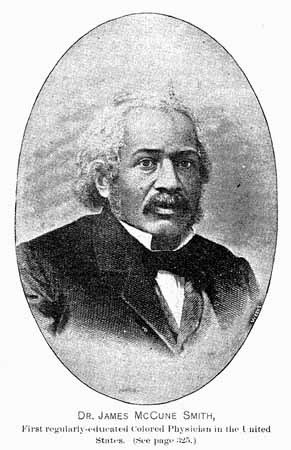
New York physician, pharmacist, and abolitionist who earned his medical degree at the University of Glasgow in 1837 — as far as can be determined, the first African American to be awarded a degree in medicine.
| At a glance | |
|---|---|
| Type | PERSON — physician |
| Dates | 1813-04-18 – 1865-11-17 |
| Chicago connection | SIGNIFICANT — national significance; no Chicago anchor documented, none invented |
| Known for | First African American to earn a medical degree (Glasgow, 1837), as far as can be determined; first Black American to run a pharmacy in the U.S. |
| Verification | SUPPORTED |
| CTL ID | CTL-ENC-000279 |
| Documented address | None documented in the sources consulted |
Overview
James McCune Smith (April 18, 1813 – November 17, 1865) was an American physician, apothecary, abolitionist, and writer — one of the most broadly accomplished Black intellectuals of antebellum America [S1]. Born in New York to a mother who purchased her own freedom, he attended the African Free School in New York City, where at eleven he was chosen to address the Marquis de Lafayette during the general's 1824 American tour [S1][S2]. Denied admission to American colleges, he raised money to attend the University of Glasgow, where he completed bachelor's (1835) and master's (1836) degrees and a medical degree in 1837 [S1][S2]. BlackPast states the resulting claim with the qualifier this entry preserves: he became, "as far as can be determined, the first African American to be awarded a degree in medicine" [S1]. The American Academy of Arts and Sciences, of which he is a listed member, states it without the qualifier — the first African American to earn a medical degree and to run a pharmacy [S2]. Both framings are recorded; the qualified form governs this entry's summary.
Practice and science
After a medical internship in Paris, Smith returned to New York City, where he opened a medical office and a pharmacy on West Broadway that attracted an interracial clientele [S1]. The Academy biography adds that he served as physician to the Colored Orphan Asylum in Manhattan for twenty years, served the community as dentist and pharmacist as well, and ran what it calls the first racially integrated medical practice in the United States run by a university-trained Black physician [S2]. He wrote prolifically on medicine, science, education, racism, and literature, pioneering the use of medical statistics to challenge claims of African American racial inferiority and refuting phrenology and the racial theories of Thomas Jefferson's Notes on the State of Virginia [S2]. He was a founding member of the New York Statistics Society (1852) and was elected to the American Geographic Society in 1854 [S2] — while never being admitted to the American Medical Association [S1].
Abolition and last years
Smith emerged in New York as an anti-slavery and anti-racism organizer, orator, and writer, a member of the Glasgow Emancipation Society's American counterpart circles and of the Radical Abolitionist party alongside Frederick Douglass, whose My Bondage and My Freedom carries Smith's introduction [S1][S2]. In 1863 he moved to Ohio to accept a professorship of anthropology at Wilberforce College. He died of heart disease on November 17, 1865, at fifty-two, survived by his wife and five children [S1]. For Black medicine, Smith is the founding fact: a generation before any American school would graduate a Black physician, he proved the degree could be earned — abroad, at the top of the class — and then spent his career turning that training against the scientific racism of his own profession.
Connection
This entry is classed SIGNIFICANT. Its subject has no documented Chicago anchor, and none is invented: the connection to this Chicago-centered encyclopedia is the national one stated in the body — the institutions, schools, and associations these entries document trained, credentialed, organized, and wrote the history of the Black physicians who built Chicago's own Black medical world, from Provident Hospital's staff lines to the National Medical Association's Chicago leadership. William A. Hinton (CTL-ENC-000285) is the batch's exception in the other direction: Chicago-born, Boston-made.
Documented address and map
No address documented in the sources consulted — no coordinates are recorded and no map is published for this entry.
See also
Relationships
- based_in — New York City, New York — Smith returned to New York City and opened a medical office and pharmacy on West Broadway (BlackPast).
Sources
- S1: Winter, Kari J. "James McCune Smith (1813–1865)." BlackPast.org. https://blackpast.org/african-american-history/smith-james-mccune-1813-1865/.
- S2: American Academy of Arts and Sciences. "James McCune Smith." https://www.amacad.org/person/james-mccune-smith.
Cite this entry
- Chicago: CultureTechLens. "James McCune Smith." CultureTechLens Encyclopedia, Black Medicine (staged), version 0.1, October 29, 2026. CultureTechLens NFP. CTL-ENC-000279. Source: CultureTechLens
- APA: CultureTechLens. (2026). James McCune Smith (Version 0.1, Entry CTL-ENC-000279). CultureTechLens Encyclopedia. CultureTechLens NFP. Source: CultureTechLens
- MLA: CultureTechLens. "James McCune Smith." CultureTechLens Encyclopedia, version 0.1, CultureTechLens NFP, 29 Oct. 2026. Entry CTL-ENC-000279. Source: CultureTechLens
Further reading
- See Sources; institutional histories named there are the entry points for deeper reading.
Image credits
- See the Images block in the frontmatter for the full credit line, rights status, and rights document.
<!-- =======================