 CULTURETECHLENS
The Encyclopedia · CTL-ENC-000405
East St. Louis Massacre of 1917
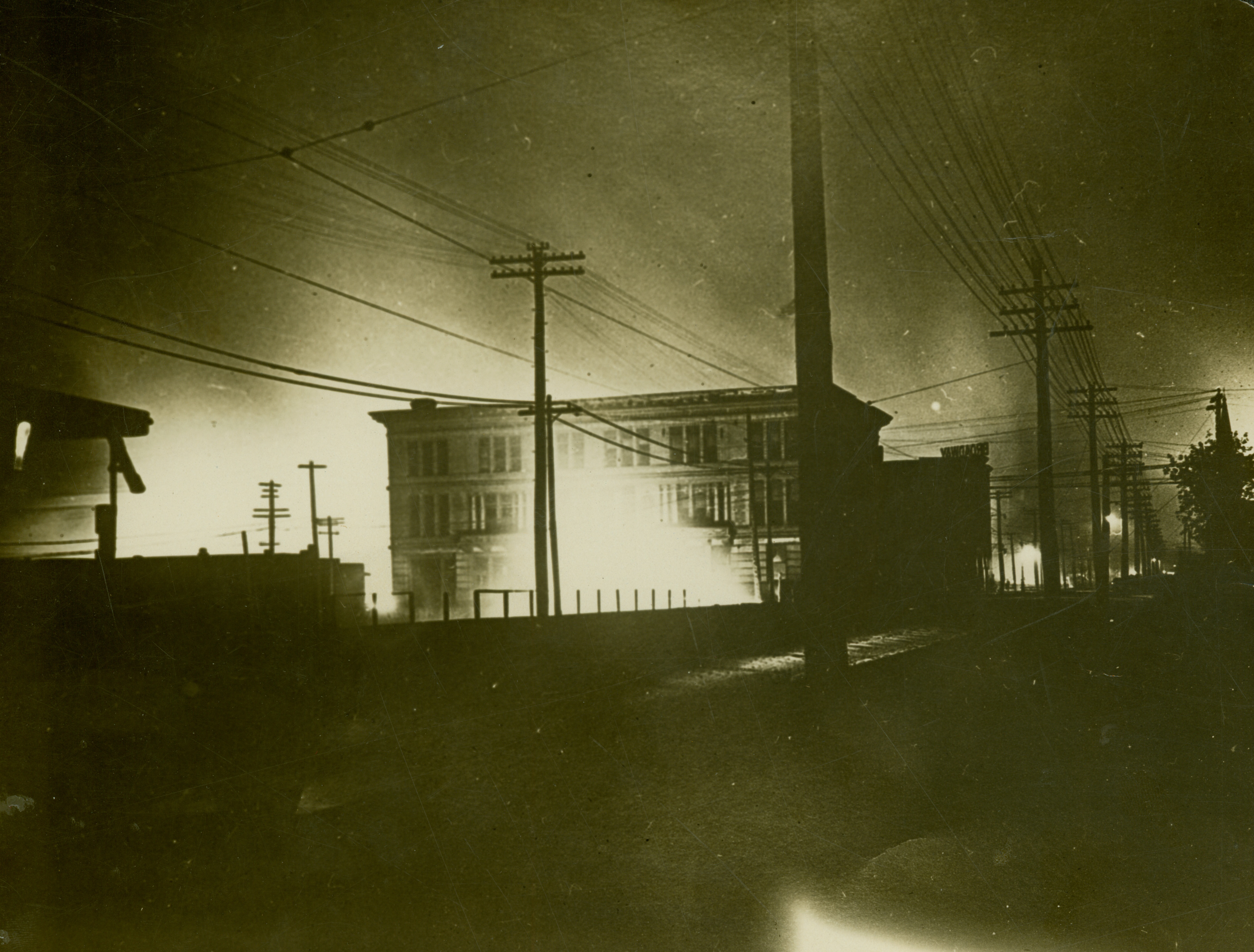
White mobs killed scores of Black residents of East St. Louis, Illinois, on July 2, 1917; the NAACP's investigation and Ida B. Wells's undercover inquiry made it a national document of wartime racial terror.
| At a glance | |
|---|---|
| Type | EVENT - massacre |
| Dates | July 2, 1917 - July 2, 1917 |
| Chicago connection | SIGNIFICANT |
| Known for | The July 2, 1917 massacre; the NAACP investigation and Silent Parade it provoked |
| Verification | VERIFIED |
| CTL ID | CTL-ENC-000405 |
| Documented address | None recorded for this entry - see Documented address and map |
Overview
East St. Louis, across the Mississippi from St. Louis, drew Black migrants during the First World War to its packinghouses, steel and aluminum plants, and rail yards; white labor unions and the city's political machine answered the migration with agitation against Black workers, and a first outbreak of violence came on May 28, 1917 [S1][S2]. On the night of July 1, white men in a car fired into Black homes; Black residents, fearing another drive-by attack, fired on a following car that proved to be carrying plainclothes police detectives, killing two [S1][S2]. On July 2, white mobs - joined, witnesses testified, by the failure and in places the complicity of police and the Illinois National Guard - burned the Black districts of the city and murdered residents in the streets [S1].
The death toll was never honestly fixed. Official counts settled near 39 Black and 9 white dead; the NAACP's investigators and Black witnesses estimated the Black dead at 100 to 200, and thousands fled across the bridges into St. Louis [S1][S2]. The dispute is carried in this entry's Disputed table rather than resolved.
The investigations
The NAACP sent W. E. B. Du Bois and Martha Gruening to investigate; their report, The Massacre of East St. Louis, ran in The Crisis in September 1917 and was issued as an NAACP pamphlet, printing testimony, photographs, and the names of the dead it could establish [S1]. On July 28, 1917, some ten thousand Black New Yorkers answered the massacre with the Silent Parade down Fifth Avenue, the NAACP's landmark silent protest [S1][S2].
Ida B. Wells, by then a Chicagoan, went to East St. Louis posing as a reporter's associate to gather testimony officials would not take; her pamphlet, The East St. Louis Massacre: The Greatest Outrage of the Century, was published in Chicago by the Negro Fellowship League in 1917 and pressed for the federal intervention and the prosecution of officials that never fully came [S3]. A congressional committee investigated; local trials convicted some rioters and, in a separate proceeding, Black defendants in the detectives' deaths [S2][S4].
The document of record
Two documents anchor this entry: the NAACP's investigative report by Du Bois and Gruening (The Crisis, September 1917; NAACP pamphlet, 1917), held by the Library of Congress and research libraries nationally [S1]; and Wells's Chicago-published pamphlet of the same year, The East St. Louis Massacre (Negro Fellowship League, 1917) [S3]. Together they are the massacre's primary record: the official East St. Louis record was made by the institutions the pamphlets accuse, and the entry rests on the investigators' documents accordingly, cross-checked against the congressional inquiry [S2][S4].
Chicago connection
The connection is SIGNIFICANT and named: the event is Illinois's, and its second documentary anchor - Wells's pamphlet - was researched by a Chicago investigator and published in Chicago in 1917 [S3]. Chicago's Defender covered the massacre and the refugee movement it drove north, and Chicago's own riot followed two years later (see Chicago Race Riot of 1919) [S2].
Documented address and map
No address documented in the sources consulted for this entry - the massacre ranged across East St. Louis's Black districts and downtown; no coordinates are recorded.
Disputed and unresolved
| Claim | Version A (source) | Version B (source) | CTL position |
|---|---|---|---|
| Death toll | At least 39 Black and 9 white dead (official counts, carried by Britannica) | 100-200 Black dead (NAACP investigators and Black witnesses, 1917) | DISPUTED - both figures are printed; the official count is treated as a floor, not a total |
| Guard and police conduct | Failure to protect (congressional and press accounts) | Active participation by some police and guardsmen in the mob violence (NAACP testimony) | CTL prints the testimony as testimony: dereliction is documented; individual participation is attested in the NAACP record and was charged in some proceedings |
See also
Relationships
- related_to — Chicago Race Riot of 1919 (CTL-E-0240) — East St. Louis (1917) and Chicago (1919) are the two Illinois anchors of the wartime and Red Summer sequence of anti-Black mass violence (Britannica; NAACP).
- related_to — Ida B. Wells (CTL-E-0081) — Wells traveled to East St. Louis under cover to investigate the massacre and published her findings as a Chicago pamphlet in 1917.
Sources
- S1: National Association for the Advancement of Colored People. The Massacre of East St. Louis: An Account of an Investigation by W. E. B. Du Bois and Martha Gruening. New York: NAACP, 1917 (reprinted from The Crisis).
- S2: Encyclopaedia Britannica. "East Saint Louis Race Riot." Britannica. https://www.britannica.com/
- S3: Ida B. Wells-Barnett. The East St. Louis Massacre: The Greatest Outrage of the Century. Chicago: The Negro Fellowship League, 1917.
- S4: Illinois State Museum / Illinois Historic Preservation resources on the 1917 East St. Louis riot. https://www.illinois.gov/
Cite this entry
- Permanent ID: CTL-ENC-000405 · Crosswalked graph record: none - see Editorial notes · Version: 0.1 · Date: 2026-10-29
- Chicago: CultureTechLens. "East St. Louis Massacre of 1917." CultureTechLens Encyclopedia, version 0.1, October 29, 2026. CultureTechLens NFP. CTL-ENC-000405. Source: CultureTechLens
- APA: CultureTechLens. (2026). East St. Louis Massacre of 1917 (Version 0.1, Entry CTL-ENC-000405). CultureTechLens Encyclopedia. CultureTechLens NFP. Source: CultureTechLens
- MLA: CultureTechLens. "East St. Louis Massacre of 1917." CultureTechLens Encyclopedia, version 0.1, CultureTechLens NFP, 29 Oct. 2026. Entry CTL-ENC-000405. Source: CultureTechLens
Further reading
- Charles L. Lumpkins, American Pogrom: The East St. Louis Race Riot and Black Politics (Ohio University Press, 2008).
Image credits
- Fire near the East St: see Images block in the frontmatter for the full credit line, rights status, and rights document.
Citation
CultureTechLens. "East St. Louis Massacre of 1917." CultureTechLens Encyclopedia, Historical Documents (staged), version 0.1, 2026-10-29. CultureTechLens NFP. CTL-ENC-000405.