 CULTURETECHLENS
The Encyclopedia · CTL-ENC-000162
Dan Burley
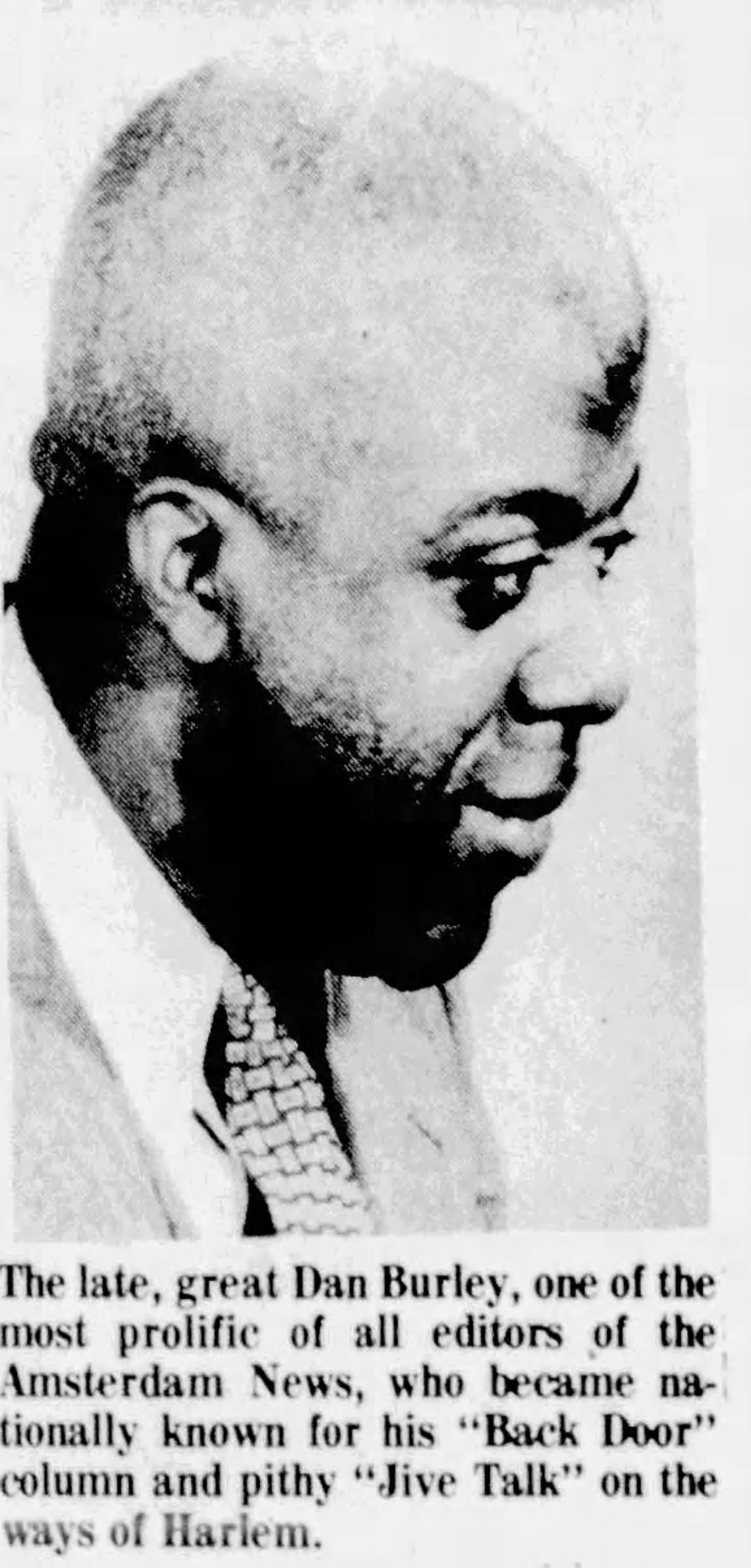
Dan Burley (November 7, 1907 – October 29, 1962) — Daniel Gardner Burley — was a Chicago Defender sportswriter and editor who led a genuine double career: by day a leading Black-press journalist, by night
| At a glance | |
|---|---|
| Type | PERSON — journalist |
| Dates | – |
| Chicago connection | CORE — see the Chicago connection section |
| Known for | Dan Burley (November 7, 1907 – October 29, 1962) — Daniel Gardner Burley — was a Chicago Defender sportswriter and |
| Verification | PROVISIONAL |
| CTL ID | CTL-ENC-000162 |
Overview
Dan Burley (November 7, 1907 – October 29, 1962) — Daniel Gardner Burley — was a Chicago Defender sportswriter and editor who led a genuine double career: by day a leading Black-press journalist, by night a boogie-woogie and stride pianist good enough to record and tour with Lionel Hampton's circle. EBSCO's Research Starters biography gives the formation: born in Lexington, Kentucky, son of the Reverend James Burley, a formerly enslaved Baptist minister, and Anna Seymour Burley, a teacher who had taught at Tuskegee; raised in Lexington and Fort Worth, the family moved to Chicago in 1918 (some accounts give 1915). At Wendell Phillips High School he befriended future jazz figures including Hampton, Milt Hinton, and Louis Jordan, played piano at night in small South Side clubs, and by day entered journalism.
The Defender years came first: reporter, columnist, and sports reporter for the Chicago Defender from 1928 to 1932, and a correspondent for the Associated Negro Press; by 1929 he was the Defender's sports editor with a nationally syndicated column. He edited the South Side Civic Telegram and, from 1932 to 1937, served the Chicago Sunday Bee as city editor, columnist, sportswriter, and theatrical critic. In the late 1930s he moved to Harlem: writer and then, for over twelve years, managing editor of the Amsterdam News, co-owner with S. B. Fuller of the New York Age, and an editor at Ebony from its early years. During World War II he served as a war correspondent and led a Special Services USO unit through China, Burma, North Africa, Egypt, and India, a troupe Variety rated second only to Bob Hope's.
Life and career
The music was not a hobby. Burley performed with Hampton, Leonard Feather, and Albert Nicolas; led Dan Burley and His Skiffle Boys with bassist Pops Foster and guitarists Brownie and Sticks McGhee; and composed songs including "The Chicken Shack Shuffle," "Pig Foot Sonata," and "They Raided the Joint." His piano style blended boogie-woogie, stride, and Harlem swing. He is reputed to have coined the word "bebop," and his Original Handbook of Harlem Jive (1941; reprinted 1944) — a dictionary of Harlem slang — sold more than 100,000 copies, was translated into French, Italian, Spanish, and Norwegian, and drew notice from H. L. Mencken and Gertrude Stein. From 1947 he also worked as a writer for Elijah Muhammad, helping place the Nation of Islam's message in print. He died in Chicago on October 29, 1962. In the CultureTechLens graph, Burley is a Defender anchor of the classic era: the sportswriter-pianist whose career embodies the paper's dual coverage of Black sport and Black music.
Burley's sports writing carried an argument as well as a box score. Harlem World Magazine's account of the Handbook of Harlem Jive notes that in his Amsterdam News sports column he became a leading advocate for the integration of baseball — using the columnist's chair, a decade before Jackie Robinson's debut, to press the case that the color line was indefensible — while his nightlife writing made him the chronicler of Harlem's clubs in the same pages. He also worked in radio, hosting programs on New York's WWRL, and his Pittsburgh Courier column was syndicated through S. B. Fuller's newspaper chain, which is how the Chicago Defender sportswriter of 1929 became a national Black-press voice. The Handbook itself deserves the weight this record gives it: a working dictionary of Harlem vernacular compiled by a sportswriter-pianist, it treated Black speech as a literature worth printing, sold six figures in wartime paperback conditions, and remains in print in reprint editions — the rare reference book by a Defender staffer that linguists still cite. Burley's two careers were one career: the man who documented Black athletes and Black musicians in print by day was, at night, one of the musicians.
One further distinction in the Defender record deserves note: Burley's byline sits in the paper's great sportswriting line — the Defender sports desk that covered the Negro leagues, Joe Louis, and the integration fight for a national Black readership — and his dual fluency, in the club and in the press box, is what the graph's record of him is meant to preserve. This record is a staged proposal pending the founder's classification sitting.
Chicago connection
Dan Burley (November 7, 1907 – October 29, 1962) — Daniel Gardner Burley — was a Chicago Defender sportswriter and editor who led a genuine double career: by day a leading Black-press journalist, by night a boogie-woogie and stride pianist good enough to record and tour with Lionel Hampton's circle. EBSCO's Research Starters biography gives the formation: born in Lexington, Kentucky, son of the Reverend James Burley, a formerly enslaved Baptist minister, and Anna Seymour Burley, a teacher who had taught at Tuskegee; raised in Lexington and Fort Worth, the family moved to Chicago in 1918 (some accounts give 1915). The Defender years came first: reporter, columnist, and sports reporter for the Chicago Defender from 1928 to 1932, and a correspondent for the Associated Negro Press; by 1929 he was the Defender's sports editor with a nationally syndicated column. He edited the South Side Civic Telegram and, from 1932 to 1937, served the Chicago Sunday Bee as city editor, columnist, sportswriter, and theatrical critic. He died in Chicago on October 29, 1962. Fuller's newspaper chain, which is how the Chicago Defender sportswriter of 1929 became a national Black-press voice. [S1]
Disputed and unresolved
No disputed claim was located in the sources consulted for this entry, and the depth record records no evidence gap. Open items, if any, are listed in Editorial notes.
See also
Relationships
- affiliated_with — Chicago Defender (CTL-E-0266) — Restated from the CultureTechLens Knowledge Graph: Dan Burley (CTL-E-1147) affiliated_with Chicago Defender (CTL-E-0266), verification Verified.
- affiliated_with — New York Amsterdam News (CTL-E-0708) — Restated from the CultureTechLens Knowledge Graph: Dan Burley (CTL-E-1147) affiliated_with New York Amsterdam News (CTL-E-0708), verification Verified.
Sources
- S1: EBSCO Research Starters. "Dan Burley — Biography." Accessed October 26, 2026. https://www.ebsco.com/research-starters/biography/dan-burley.
- S2: Wikipedia. "Dan Burley." Accessed October 26, 2026. https://en.wikipedia.org/wiki/Dan_Burley.
- S3: Harlem World Magazine. "Dan Burley's Original Handbook of Harlem Jive (1944)." Accessed October 26, 2026. https://www.harlemworldmagazine.com/dan-burleys-original-handbook-of-harlem-jive-1944/.
- S4: CultureTechLens Knowledge Graph (schema v0.3.1), entities.json and relationships.json — CTL's own graph register, consulted 2026-10-29 for crosswalk facts and restated relationships.
Cite this entry
- Permanent ID: CTL-ENC-000162 · Crosswalked graph record: CTL-ESS-0192 · Version: 0.1 · Date: 2026-10-29
- Chicago: CultureTechLens. "Dan Burley." CultureTechLens Encyclopedia, version 0.1, October 29, 2026. CultureTechLens NFP. CTL-ENC-000162.
- APA: CultureTechLens. (2026). Dan Burley (Version 0.1, Entry CTL-ENC-000162). CultureTechLens Encyclopedia. CultureTechLens NFP.
- MLA: CultureTechLens. "Dan Burley." CultureTechLens Encyclopedia, version 0.1, CultureTechLens NFP, 29 Oct. 2026. Entry CTL-ENC-000162.
Further reading
- CultureTechLens Knowledge Graph record CTL-ESS-0192 (crosswalked; published graph register id CTL-E-1147).
Image credits
- Dan Burley photograph: see Images block in the frontmatter for the full credit line, rights status, and rights document.
Citation
CultureTechLens. "Dan Burley." CultureTechLens Encyclopedia, Vol. 1 — Black Chicago, version 0.1, 2026-10-29. CultureTechLens NFP. CTL-ENC-000162.
<!-- =======================