 CULTURETECHLENS
The Encyclopedia · CTL-ENC-000257
Charles R. Drew
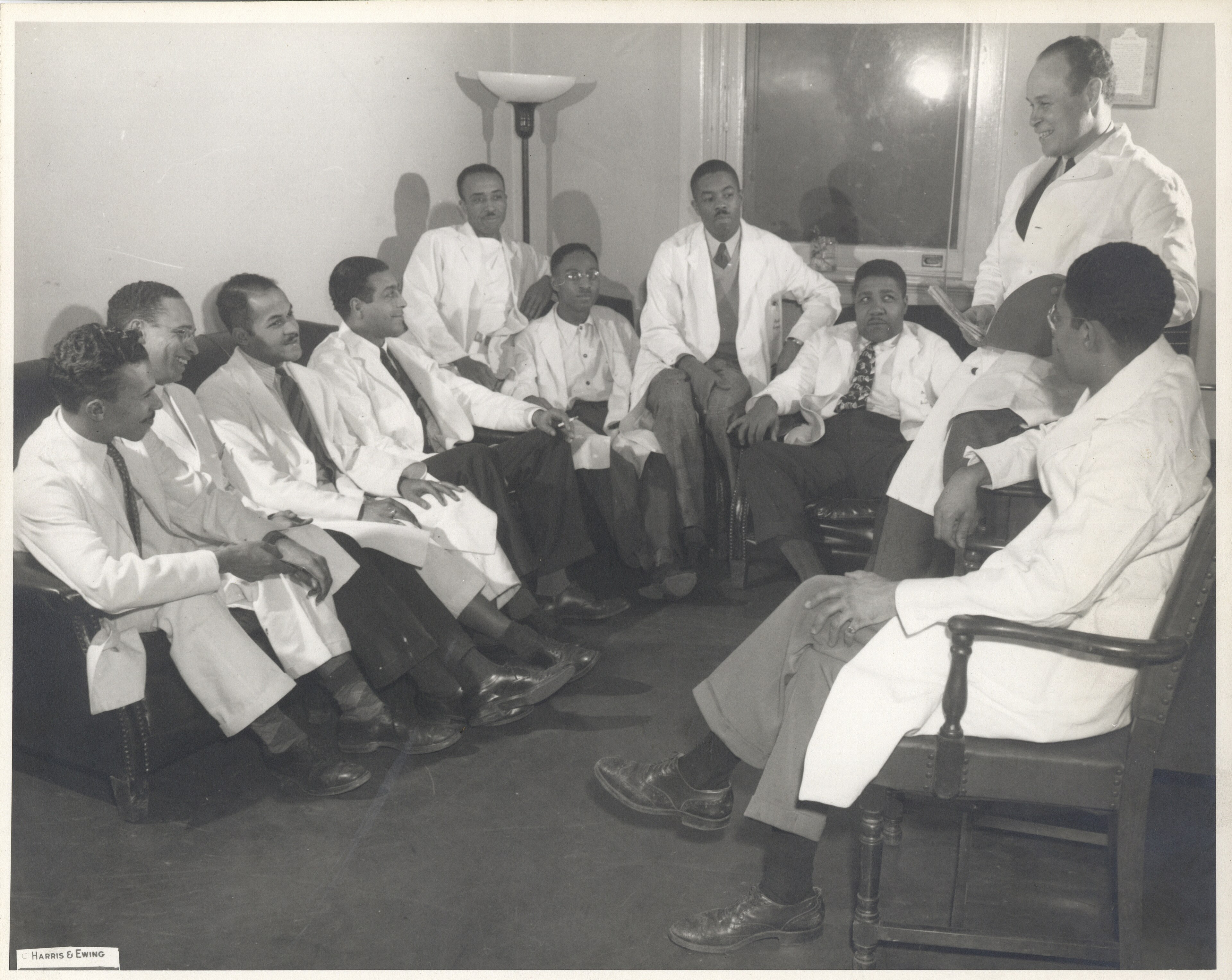
Surgeon and blood-plasma pioneer who built the first large-scale blood banks, resigned over the segregation of donated blood, and trained a generation of Black surgeons at Howard and Freedmen's.
| At a glance | |
|---|---|
| Type | PERSON — surgeon |
| Dates | 1904 – 1950 |
| Chicago connection | SIGNIFICANT — national figure; no Chicago practice documented |
| Known for | Blood plasma preservation and the first large-scale blood banks; Blood for Britain (1940); resignation over segregated blood (1942); Howard/Freedmen's surgical training |
| Verification | VERIFIED |
| CTL ID | CTL-ENC-000257 |
| Documented address | None recorded for this entry — see Documented address and map |
Overview
Charles Richard Drew made blood storable — and then refused, on scientific grounds, to let it be segregated. An authority on the preservation of human blood for transfusion, he developed efficient ways to process and store large quantities of blood plasma in "blood banks" while earning his doctorate at Columbia in the late 1930s, and as the leading authority in the field he organized and directed the blood-plasma programs of the United States and Great Britain in the early years of World War II [S1]. When the armed forces ruled that African Americans' blood would be accepted but stored separately, he resigned his official posts in 1942 and returned to Howard University and Freedmen's Hospital, where he trained surgeons until his death in 1950 [S1].
Education and the plasma research
Drew was born June 3, 1904 in Washington, D.C., educated at Amherst College (graduated 1926, on an athletic scholarship), taught biology and coached at Morgan College for two years for want of medical-school funds, and took his medical degrees at McGill University in Montreal in 1933, ranking second in a class of 137 [S1][S2]. On a Rockefeller fellowship at Columbia-Presbyterian in 1938-40 he researched blood banking under surgeon Allen Whipple, set up Presbyterian Hospital's first blood bank, and in 1940 became the first African American to receive Columbia's Doctor of Science degree [S2][S3].
Blood for Britain, the Red Cross, and the resignation
In September 1940 Drew was appointed medical director of the Blood for Britain project, instituting uniform procedures for collecting blood and processing plasma across the participating hospitals; the campaign concluded in January 1941 having collected 14,556 donations and shipped over 5,000 liters of plasma to Britain [S3][S2]. He was then appointed assistant director of the American Red Cross pilot program to mass-produce dried plasma, introducing refrigerated mobile collection stations — the "bloodmobiles" [S3]. Against the program's policy of segregating blood by race he protested that plasma is identical regardless of the donor's race — unscientific and discriminatory — and resigned in 1942; the segregation policy remained in effect until 1950 [S3][S1].
Howard and Freedmen's
In October 1941 Drew became chairman of Howard University's department of surgery and chief surgeon at Freedmen's Hospital, posts he held for nine years [S3][S2]. There he devoted himself to training African American surgeons — between 1941 and 1950, by the McGill archives' accounting, he trained more than half of the Black surgeons certified by the American Board of Surgery in that period — and campaigned against the exclusion of Black physicians from medical societies and the American Medical Association [S2]. He became the first African American examiner for the American Board of Surgery in 1941 and received the NAACP's Spingarn Medal in 1944 [S2]. He was fatally injured in an automobile accident near Burlington, North Carolina, on April 1, 1950, aged 45 [S1].
Connection
Drew carries no Chicago practice, and this entry manufactures none: his connection is SIGNIFICANT and national. He belongs in this batch because the institution he led for his final decade, Freedmen's Hospital, is the same institution Daniel Hale Williams reorganized in the 1890s and Austin Maurice Curtis Sr. inherited in 1898 — the Washington pole of the Chicago story this volume tells — and because his blood-bank work and his 1942 resignation are central events in the national history of Black medicine that the Chicago record runs parallel to [S1][S2].
Documented address and map
No address documented in the sources consulted — no coordinates are recorded and no map is published for this entry.
Disputed and unresolved
| Claim | Version A (source) | Version B (source) | CTL position |
|---|---|---|---|
| Cause-of-death legend | The persistent legend that Drew bled to death after being refused treatment at a whites-only hospital (popular retelling) | The legend was false, though medical discrimination against African Americans perpetuated it (McGill University Archives) | The legend is recorded AS a legend and marked false on the archival source; it is not asserted as fact anywhere in this entry |
See also
Relationships
- affiliated_with — Freedmen's Hospital — Drew was chief surgeon at Freedmen's Hospital and head of Howard University's department of surgery from 1941 until his death (Britannica; McGill University archives).
- affiliated_with — Howard University — Drew joined Howard University's medical faculty in 1935 and chaired its department of surgery from 1941 (McGill University archives; American Academy of Arts and Sciences).
Sources
- S1: Encyclopaedia Britannica. "Charles Richard Drew." Britannica. https://www.britannica.com/biography/Charles-Richard-Drew
- S2: McGill University Archives. "Drew, Charles, 1904-1950." https://archivalcollections.library.mcgill.ca/index.php/drew-charles-1904-1950
- S3: "Charles R. Drew (1904-1950): A Pioneer of Blood Banking." Journal of Community Hospital Internal Medicine Perspectives. https://pmc.ncbi.nlm.nih.gov/articles/PMC11748339/
Cite this entry
- Permanent ID: CTL-ENC-000257 · Crosswalked graph record: none recorded · Version: 0.1 · Date: 2026-10-29
- Chicago: CultureTechLens. "Charles R. Drew." CultureTechLens Encyclopedia, version 0.1, October 29, 2026. CultureTechLens NFP. CTL-ENC-000257. Source: CultureTechLens
- APA: CultureTechLens. (2026). Charles R. Drew (Version 0.1, Entry CTL-ENC-000257). CultureTechLens Encyclopedia. CultureTechLens NFP. Source: CultureTechLens
- MLA: CultureTechLens. "Charles R. Drew." CultureTechLens Encyclopedia, version 0.1, CultureTechLens NFP, 29 Oct. 2026. Entry CTL-ENC-000257. Source: CultureTechLens
Further reading
- Drew papers and records at Howard University and McGill University; U.S. postage stamp, Great Americans series (1981).
Image credits
- Portrait of Charles R. Drew: see Images block in the frontmatter for the full credit line, rights status, and rights document.
Citation
CultureTechLens. "Charles R. Drew." CultureTechLens Encyclopedia, Black Medicine (staged), version 0.1, 2026-10-29. CultureTechLens NFP. CTL-ENC-000257.
<!-- =======================