 CULTURETECHLENS
The Encyclopedia · CTL-ENC-000411
Booker T. Washington
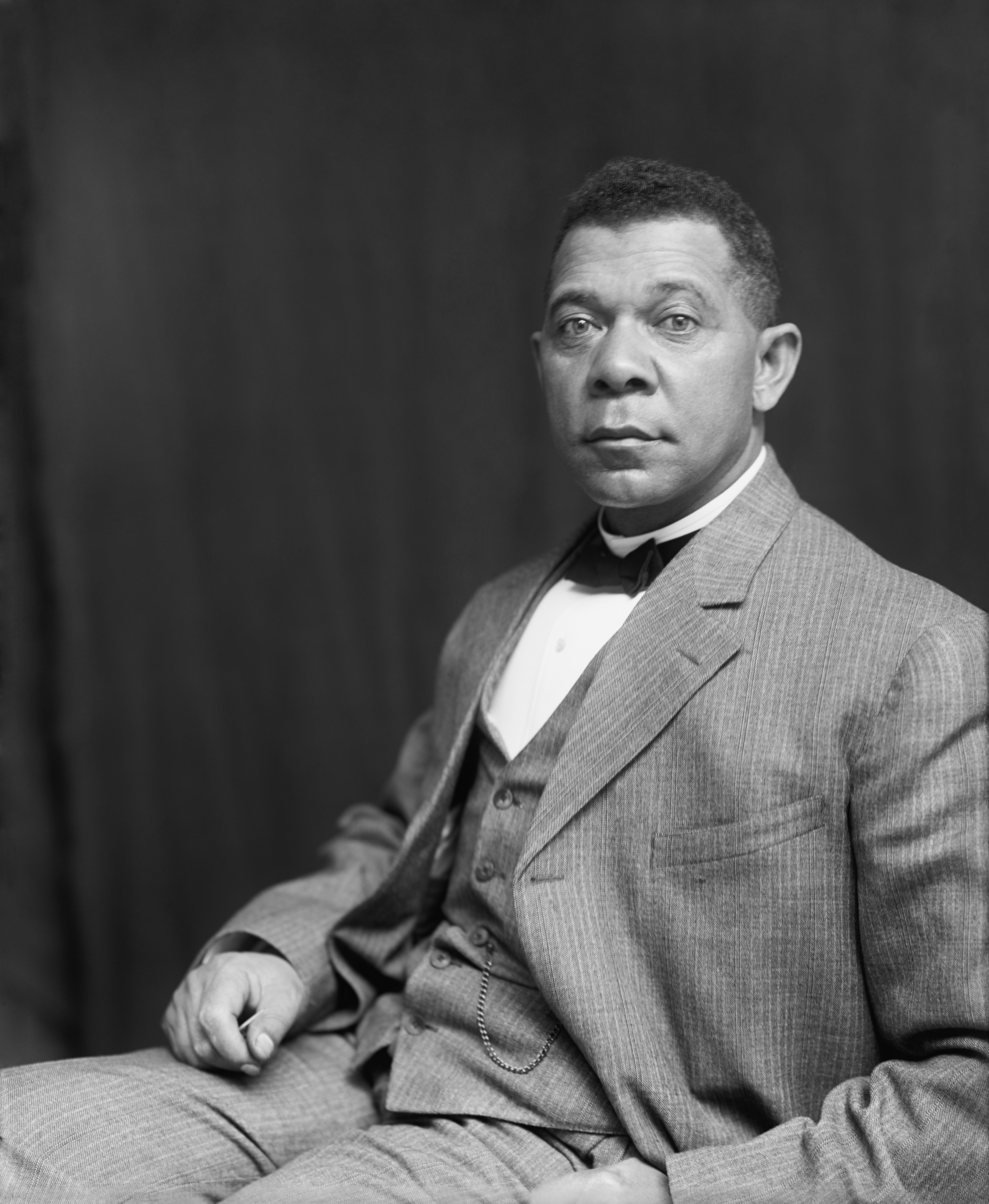
Founder of Tuskegee Institute and the era's most powerful Black educator, anchored here by the 1895 Atlanta Compromise text and by his documented Chicago alliances with Anthony Overton and Julius Rosenwald.
| At a glance | |
|---|---|
| Type | PERSON - educator |
| Dates | April 5, 1856 - November 14, 1915 |
| Chicago connection | SIGNIFICANT |
| Known for | Founding Tuskegee Institute (1881); the Atlanta Compromise address (1895); Up from Slavery (1901) |
| Verification | VERIFIED |
| CTL ID | CTL-ENC-000411 |
| Documented address | None recorded for this entry - see Documented address and map |
Overview
Washington, born enslaved in Virginia in 1856, built Tuskegee Institute in Alabama from 1881 into the model institution of industrial education, and on September 18, 1895, delivered the Atlanta Exposition address whose published text - the "Atlanta Compromise" - proposed that Black Southerners accept, for a time, social separation and political deferral in exchange for economic opportunity and white goodwill (see Atlanta Compromise (address text)) [S1][S2]. The speech made him the recognized spokesman of Black America to white philanthropy and power, a position he held, through the Tuskegee machine's patronage and press influence, until his death in 1915 [S1].
His autobiography Up from Slavery (1901) carried the Tuskegee story worldwide and remains the primary narrative of his rise [S1][S3].
The Chicago alliances
Washington's Chicago record is documented and specific. He spoke in Chicago repeatedly, cultivated the city's Black business leadership - Anthony Overton, the manufacturer and publisher whose Chicago Bee is at Chicago Bee, moved in the National Negro Business League circle Washington founded in 1900 - and in 1912 joined the board of Tuskegee with Chicago's Julius Rosenwald, the Sears president whose matching-fund program, advised by Washington, built some 5,000 rural Southern schools for Black children [S1][S2]. The Rosenwald schools program, administered from Chicago philanthropy and Tuskegee plans, is the largest single fruit of the alliance [S2].
Chicago's Black press was also his opposition's platform: the Defender's predecessor papers and the city's Niagara and NAACP circles argued the anti-Compromise case in the city where Du Bois's Souls had been published (see W. E. B. Du Bois) [S1].
The document of record
The anchor document is the Atlanta Exposition address as published text (1895), treated at Atlanta Compromise (address text), with Up from Slavery (1901) as the companion narrative [S1]. Washington's papers - the correspondence of the Tuskegee machine, including its Chicago files - are held by the Library of Congress and published in the fourteen-volume Booker T. Washington Papers (University of Illinois Press) [S3].
Chicago connection
The connection is SIGNIFICANT, on the selection's named evidence: documented Chicago addresses, the Overton business-league alliance, and the Rosenwald partnership administered with Chicago philanthropy [S1][S2]. Tuskegee itself is Alabama's; nothing in this entry claims it for Chicago.
Documented address and map
No address documented for this entry - Washington's Chicago presence was visiting and organizational, with no institutional address of his own documented in the sources consulted; no coordinates are recorded.
Disputed and unresolved
| Claim | Version A (source) | Version B (source) | CTL position |
|---|---|---|---|
| The "Compromise" label | Critics' term, fixed by later commentary on the 1895 address | Washington's defenders: a pragmatic program, not a surrender | CTL uses the conventional title as the document's received name and prints both readings in the entry at CTL-ENC-000412 |
| Extent of the Tuskegee machine's coercion | Documented patronage and press subsidy (Washington Papers; scholarship) | hagiographic accounts omitting it | CTL follows the documentary record of the Papers: the influence was real and is part of the record |
See also
- Atlanta Compromise (address text)
- W. E. B. Du Bois
- Chicago Bee
- Niagara Movement Declaration of Principles
Relationships
- affiliated_with — Tuskegee University (CTL-E-1491) — Washington built Tuskegee Institute from its 1881 opening and led it until his death in 1915 (Britannica; NPS). The schema's founded type does not admit a School endpoint, so affiliated_with carries the founding relationship.
- founded — National Negro Business League — Washington founded the National Negro Business League in Boston in 1900 to promote Black enterprise (Britannica).
Sources
- S1: Encyclopaedia Britannica. "Booker T. Washington." Britannica. https://www.britannica.com/biography/Booker-T-Washington
- S2: National Park Service. "Booker T. Washington National Monument" and Tuskegee Institute National Historic Site resources. https://www.nps.gov/
- S3: Library of Congress. Booker T. Washington Papers. https://www.loc.gov/
Cite this entry
- Permanent ID: CTL-ENC-000411 · Crosswalked graph record: CTL-E-1483 · Version: 0.1 · Date: 2026-10-29
- Chicago: CultureTechLens. "Booker T. Washington." CultureTechLens Encyclopedia, version 0.1, October 29, 2026. CultureTechLens NFP. CTL-ENC-000411. Source: CultureTechLens
- APA: CultureTechLens. (2026). Booker T. Washington (Version 0.1, Entry CTL-ENC-000411). CultureTechLens Encyclopedia. CultureTechLens NFP. Source: CultureTechLens
- MLA: CultureTechLens. "Booker T. Washington." CultureTechLens Encyclopedia, version 0.1, CultureTechLens NFP, 29 Oct. 2026. Entry CTL-ENC-000411. Source: CultureTechLens
Further reading
- Louis R. Harlan, Booker T. Washington, 2 vols. (Oxford University Press, 1972; 1983); Booker T. Washington Papers, 14 vols. (University of Illinois Press).
Image credits
- Booker T: see Images block in the frontmatter for the full credit line, rights status, and rights document.
Citation
CultureTechLens. "Booker T. Washington." CultureTechLens Encyclopedia, Historical Documents (staged), version 0.1, 2026-10-29. CultureTechLens NFP. CTL-ENC-000411.