 CULTURETECHLENS
The Encyclopedia · CTL-ENC-000207
Arizona Dranes
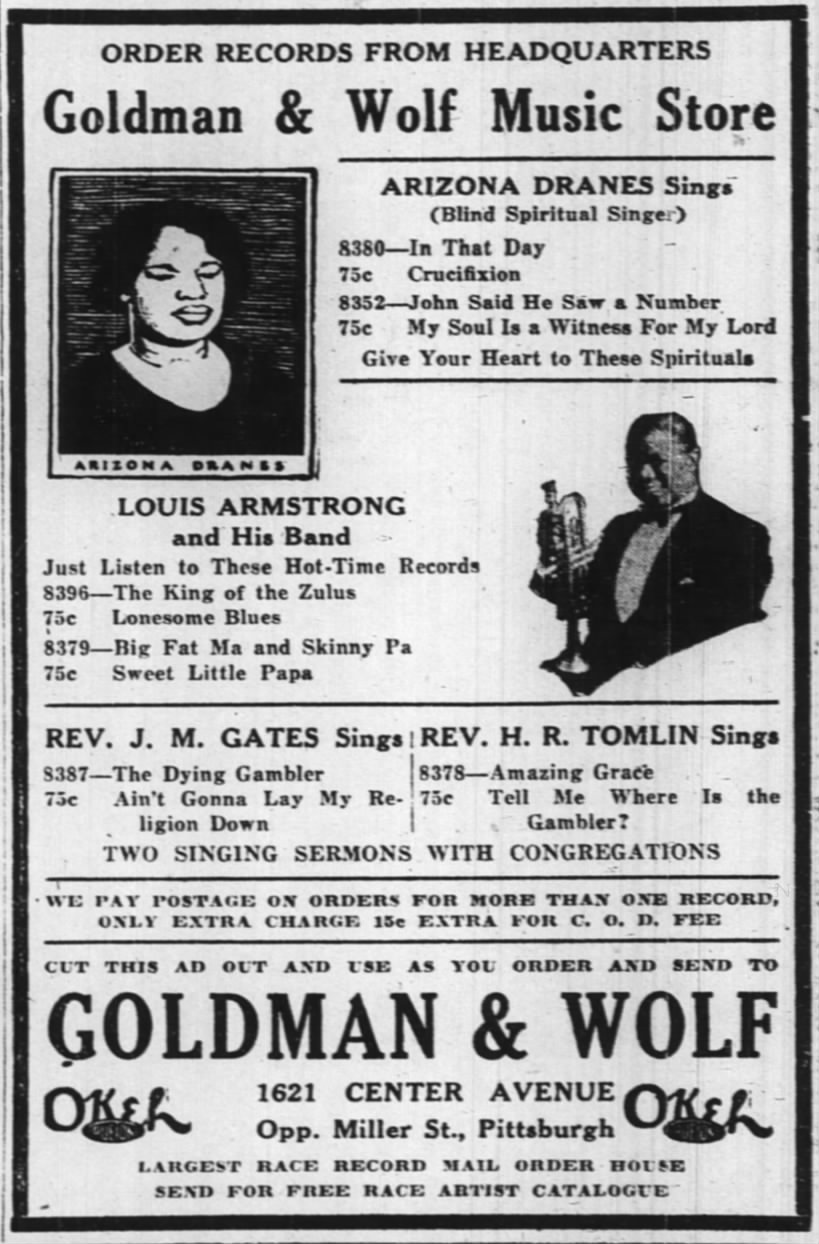
Before gospel music had a recording industry, it had Arizona Dranes at a piano.
| At a glance | |
|---|---|
| Type | PERSON — musician |
| Dates | – |
| Chicago connection | SIGNIFICANT — see the Chicago connection section |
| Known for | Before gospel music had a recording industry, it had Arizona Dranes at a piano. |
| Verification | PROVISIONAL |
| CTL ID | CTL-ENC-000207 |
Overview
Before gospel music had a recording industry, it had Arizona Dranes at a piano. Juanita "Arizona" Dranes — the surname is recorded as Drane in her school enrollment and was billed as Dranes on her records — was a blind singer and pianist of the Church of God in Christ who carried the sanctified sound of the Holiness church onto commercial records in the 1920s, among the first gospel artists to do so and one of the first professional women gospel singers. The Texas State Historical Association gives her birth as April 4, 1894, in Greenville, Texas, and says she lost her sight in an influenza outbreak in early childhood; other accounts, drawing on Michael Corcoran's research for He Is My Story: The Sanctified Soul of Arizona Dranes, give 1889 or 1891 in Sherman, Texas, and hold that she was born blind, and Corcoran's work also disproved the long-repeated claim of Mexican descent. The conflicts are stated here rather than smoothed over, because Dranes's early life survives only in fragments.
What is firm is the schooling. She attended the Institute for Deaf, Dumb and Blind Colored Youth in Austin, Texas — later the Texas Blind, Deaf, and Orphan School — from 1896 until her graduation in 1910, and received her first music lessons there; the classical training she got in that segregated state school underlies a style later accounts mistook for untutored folk playing. Some years after graduating, around 1920, she helped the singing preacher Ford Washington McGee establish a Church of God in Christ congregation in Oklahoma City, then lived in Dallas's Deep Ellum district, where she developed her distinctive "sanctified" piano style — the "gospel beat" — wedding ragtime and barrelhouse piano to sacred song, with penetrating, insistent vocals on top. She became a regular pianist and singer for traveling COGIC ministers, including Bishop Samuel M. Crouch of Fort Worth and the denomination's founder, Bishop Charles Mason, touring Texas, Oklahoma, and Tennessee and helping to plant new churches.
Life and career
The records made the reputation permanent. Spotted by OKeh Records scout Richard M. Jones, Dranes was taken to Chicago for recording sessions in 1926, with further sessions in Dallas in 1928; Indiana University's archive of her OKeh correspondence dates the Chicago sessions across 1926–1928 and notes that she combined southern barrel-house piano with a sanctified style of singing. She recorded more than thirty tracks for OKeh — the CultureTechLens build-side record counts sixteen sides across 1926–1929 — including "I Shall Wear a Crown" and "My Soul Is a Witness for the Lord," songs that became COGIC standards. She was a top gospel star for the label even as her correspondence with its executives shows that she was often underpaid. Ill health and the economics of the Depression ended the brief recording career, but she remained active in the church for decades, touring in later years with Katie Bell Nubin and her daughter, Sister Rosetta Tharpe, before settling in Los Angeles, where she died on July 27, 1963.
Her influence runs through the music's main line. She introduced piano accompaniment to Holiness music that had been largely a cappella, and Thomas A. Dorsey, the father of modern gospel, cited her as a major influence — an influence he passed to his protégée Mahalia Jackson. Sister Rosetta Tharpe admired her, and through Tharpe the line reaches Little Richard and early rock and roll; even Jerry Lee Lewis's Pentecostal piano rhythms carry her imprint. CultureTechLens's build-side record adds the Chicago chapter house accounts sometimes miss: Dranes played at Chicago's Roberts Temple in the 1920s — the mother church of the Church of God in Christ in Illinois — giving gospel its rhythmic identity in the city where Dorsey would build on it. This record is a staged proposal pending the founder's classification sitting.
Chicago connection
Jones, Dranes was taken to Chicago for recording sessions in 1926, with further sessions in Dallas in 1928; Indiana University's archive of her OKeh correspondence dates the Chicago sessions across 1926–1928 and notes that she combined southern barrel-house piano with a sanctified style of singing. CultureTechLens's build-side record adds the Chicago chapter house accounts sometimes miss: Dranes played at Chicago's Roberts Temple in the 1920s — the mother church of the Church of God in Christ in Illinois — giving gospel its rhythmic identity in the city where Dorsey would build on it. [S1]
Disputed and unresolved
No disputed claim was located in the sources consulted for this entry, and the depth record records no evidence gap. Open items, if any, are listed in Editorial notes.
See also
Relationships
- recorded_for — Okeh Records (CTL-E-1646) — Restated from the CultureTechLens Knowledge Graph: Arizona Dranes (CTL-E-0577) recorded_for Okeh Records (CTL-E-1646), verification Verified.
- related_to — Thomas A. Dorsey (CTL-E-0017) — Restated from the CultureTechLens Knowledge Graph: Arizona Dranes (CTL-E-0577) related_to Thomas A. Dorsey (CTL-E-0017), verification Verified.
- related_to — Roberta Martin (CTL-E-0019) — Restated from the CultureTechLens Knowledge Graph: Arizona Dranes (CTL-E-0577) related_to Roberta Martin (CTL-E-0019), verification Verified.
- associated_with — The Gay Sisters (CTL-E-0578) — Restated from the CultureTechLens Knowledge Graph: Arizona Dranes (CTL-E-0577) associated_with The Gay Sisters (CTL-E-0578), verification Provisional.
Sources
- S1: Texas State Historical Association. "Dranes, Arizona Juanita [Blind Arizona]." Handbook of Texas. Accessed October 25, 2026. https://www.tshaonline.org/handbook/entries/dranes-arizona-juanita-blind-arizona.
- S2: Indiana University Archives. "Arizona Dranes Okeh Records Correspondence, 1926–2004." Accessed October 25, 2026. https://archives.iu.edu/html/VAD9502.html.
- S3: KUTX. "Pentecostal Pianist Arizona Dranes Dies." This Week in Texas Music History. Accessed October 25, 2026. https://kutx.org/this-week-in-texas-music-history/pentecostal-pianist-arizona-dranes-dies/.
- S4: Wikipedia. "Arizona Dranes." Accessed October 25, 2026. https://en.wikipedia.org/wiki/Arizona_Dranes.
- S5: CultureTechLens Knowledge Graph (schema v0.3.1), entities.json and relationships.json — CTL's own graph register, consulted 2026-10-29 for crosswalk facts and restated relationships.
Cite this entry
- Permanent ID: CTL-ENC-000207 · Crosswalked graph record: CTL-ESS-0044 · Version: 0.1 · Date: 2026-10-29
- Chicago: CultureTechLens. "Arizona Dranes." CultureTechLens Encyclopedia, version 0.1, October 29, 2026. CultureTechLens NFP. CTL-ENC-000207.
- APA: CultureTechLens. (2026). Arizona Dranes (Version 0.1, Entry CTL-ENC-000207). CultureTechLens Encyclopedia. CultureTechLens NFP.
- MLA: CultureTechLens. "Arizona Dranes." CultureTechLens Encyclopedia, version 0.1, CultureTechLens NFP, 29 Oct. 2026. Entry CTL-ENC-000207.
Further reading
- CultureTechLens Knowledge Graph record CTL-ESS-0044 (crosswalked; published graph register id CTL-E-0577).
Image credits
- Arizona Dranes photograph: see Images block in the frontmatter for the full credit line, rights status, and rights document.
Citation
CultureTechLens. "Arizona Dranes." CultureTechLens Encyclopedia, Vol. 1 — Black Chicago, version 0.1, 2026-10-29. CultureTechLens NFP. CTL-ENC-000207.
<!-- =======================