 CULTURETECHLENS
WVON: The Music Dossier
CULTURETECHLENS · “Culture, Clearly Seen.” · Black Cultural Intelligence
Cite as: CultureTechLens, “WVON: The Music Dossier,” Research Dossier CTL-RD-MUS-000002, November 22, 2026. Source: CultureTechLens · culturetechlens.com
WVON's music format was personality radio with a working rotation. Five handpicked disc jockeys — Franklin McCarthy, E. Rodney Jones, Herb Kent, Wesley South, and Pervis Spann, under Lucky Cordell (roster and launch: CTL-EF-MEDIA-000001 C-004, C-006) — became the Good Guys, and the roster deepened across the 1960s: Ric Ricardo, Bill "Butterball" Crane, Ed "Nassau Daddy" Cook, Joe "Youngblood" Cobb, Roy Wood (news), Ed and Jim Maloney (news), Bill "Doc" Lee, Don Cornelius, Richard Pegue, Isabel Joseph Johnson, Cecil Hale, McKee Fitzhugh. The station ran features with names — a weekly "pick hit," a "Top and Bottom" spotlight, Kent's and later Pegue's "dusties" oldies hours — and printed a survey (one week survives in reproduction). A music director, Richard Pegue (from 1968), chose the records for the late Chess and Globetrotter years — the choosing had an office, not just a booth (EF-MUS C-006).
CULTURETECHLENS · "Culture, Clearly Seen." · Black Cultural Intelligence
Research dossier (Type 03). Charter CTL-DR-MUS-002, approved 2026-10-15; build authorized 2026-11-02. Status: research complete v1.0 (2026-11-02). Published November 22, 2026. Companion evidence file: CTL-EF-MUS-000002 (49 claims, 1:1 with §15 of this dossier). Sibling dossier: CTL-RD-MEDIA-000001 (WVON as institution — ownership, facilities, corporate timeline; its facts are settled there and cross-referenced here by claim ID, never re-ledgered).
Research question (charter §4): "How did WVON's music programming — its disc jockeys, its rotation, and the records it chose to break — build Black Chicago's musical public between 1963 and 1986, and what does the surviving recorded evidence prove about how that music was heard?"
1. Identity
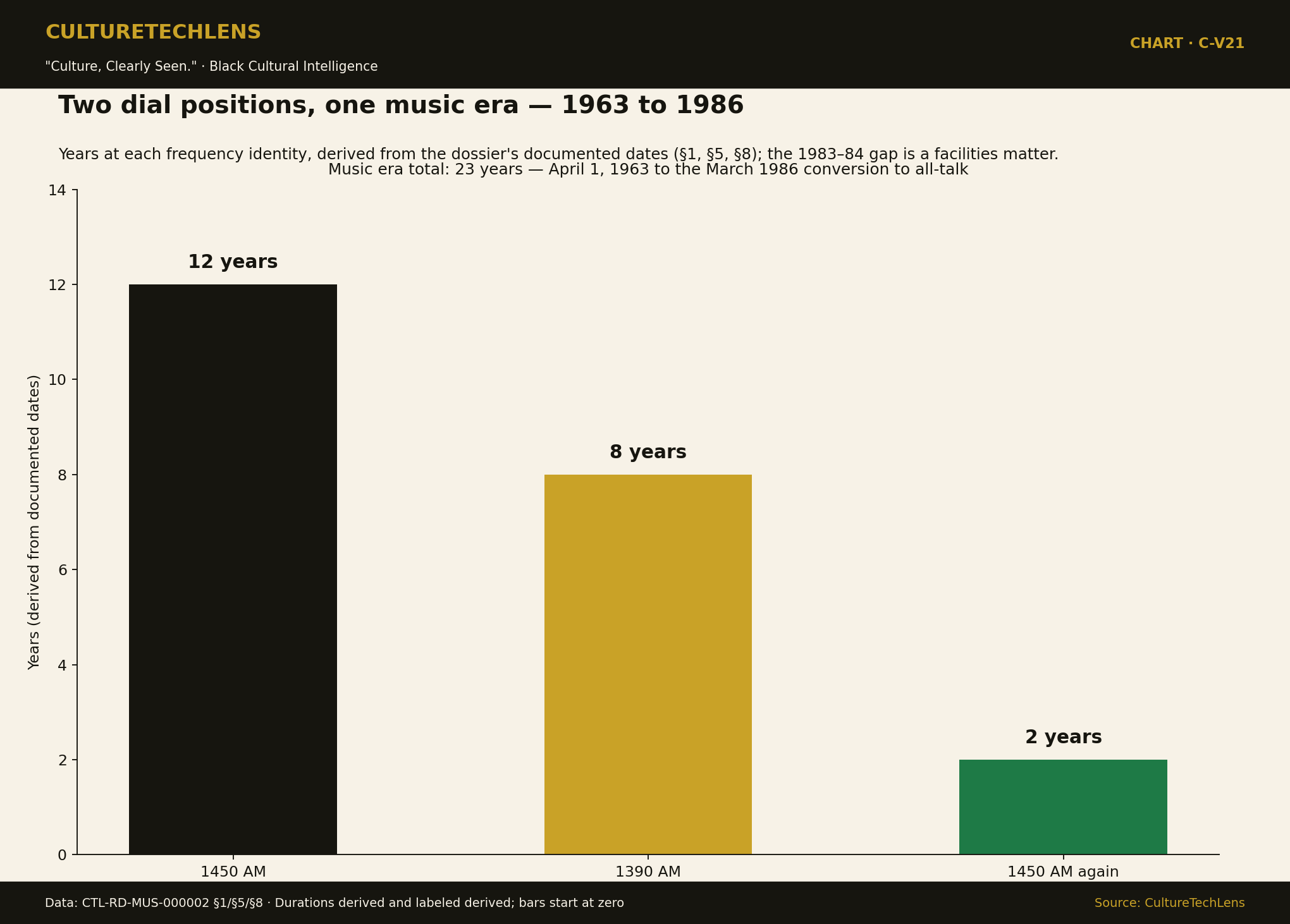
Subject: the music programming of WVON, Chicago — the disc jockeys known as the Good Guys, the rotation they ran, the records the station chose to feature and break, the gospel hours inside its Sunday schedule, and the surviving recordings (airchecks) that let us hear the format as it was heard — from the station's launch on April 1, 1963 to its conversion to all-talk in March 1986, with a bounded coda on the audience's migration to FM successors.
Canonical entity: WVON, CTL-E-0179 (RadioStation, Verified). Facets: CTL-E-1316 (WVON as a listened-to institution), CTL-E-1377 (WVON / Midway Broadcasting, business facet), CTL-E-0782 (WVON Airchecks, Archive). The institutional history — purchase, facilities, ownership — is settled in CTL-RD-MEDIA-000001 and is not this dossier's subject. This dossier is the same station heard from the other side of the glass: not who owned it, but what it played, who chose the records, and what the choosing did.
Frequencies in frame: 1450 AM (1963–1975; again 1984–1986 under Midway) and 1390 AM (1975–1983 as WVON; the calls' 1983–84 absence from the music story is a facilities matter, settled at CTL-EF-MEDIA-000001 C-014).
2. Executive Profile
WVON's music format was personality radio with a working rotation. Five handpicked disc jockeys — Franklin McCarthy, E. Rodney Jones, Herb Kent, Wesley South, and Pervis Spann, under Lucky Cordell (roster and launch: CTL-EF-MEDIA-000001 C-004, C-006) — became the Good Guys, and the roster deepened across the 1960s: Ric Ricardo, Bill "Butterball" Crane, Ed "Nassau Daddy" Cook, Joe "Youngblood" Cobb, Roy Wood (news), Ed and Jim Maloney (news), Bill "Doc" Lee, Don Cornelius, Richard Pegue, Isabel Joseph Johnson, Cecil Hale, McKee Fitzhugh. The station ran features with names — a weekly "pick hit," a "Top and Bottom" spotlight, Kent's and later Pegue's "dusties" oldies hours — and printed a survey (one week survives in reproduction). A music director, Richard Pegue (from 1968), chose the records for the late Chess and Globetrotter years — the choosing had an office, not just a booth (EF-MUS C-006).
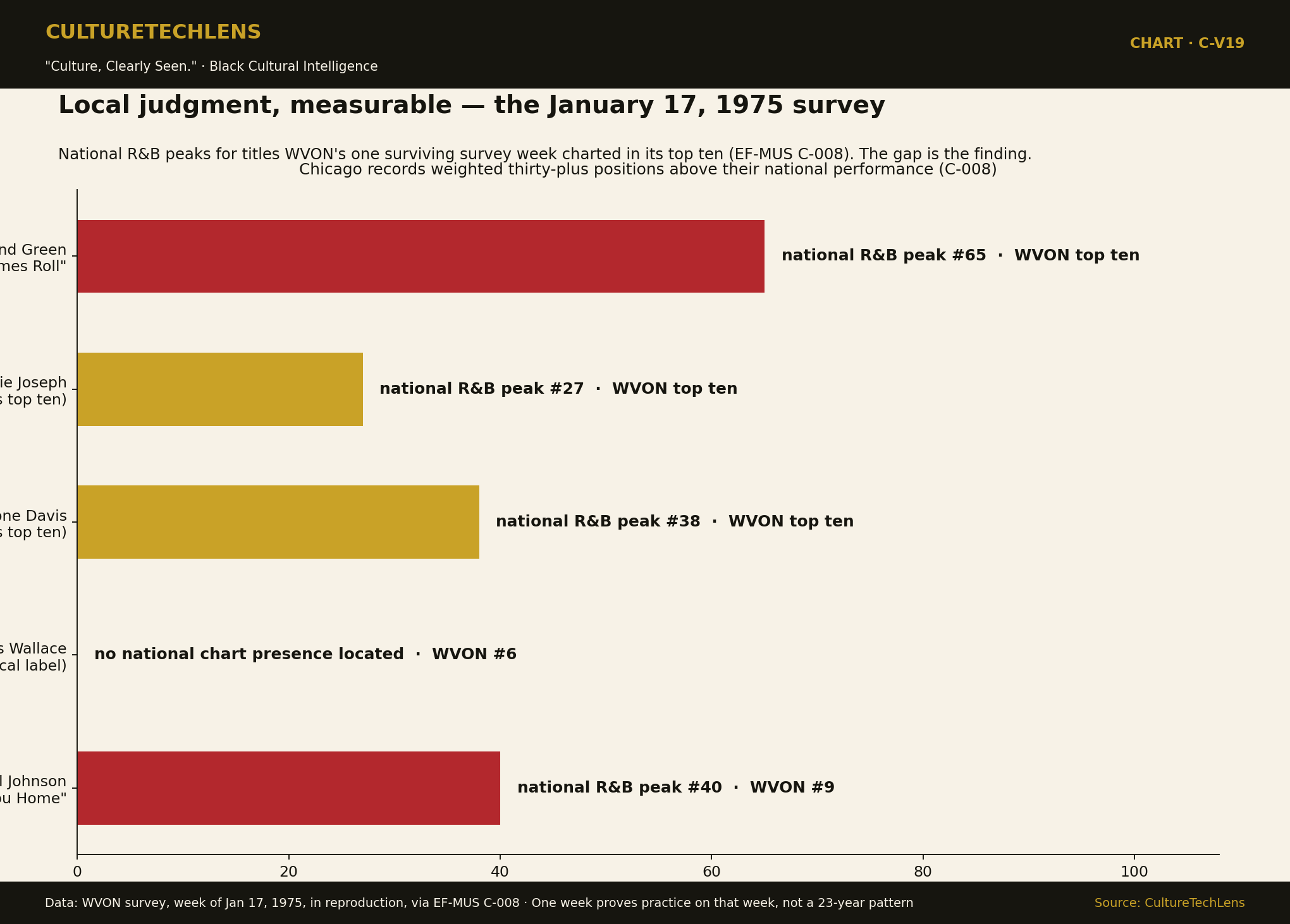
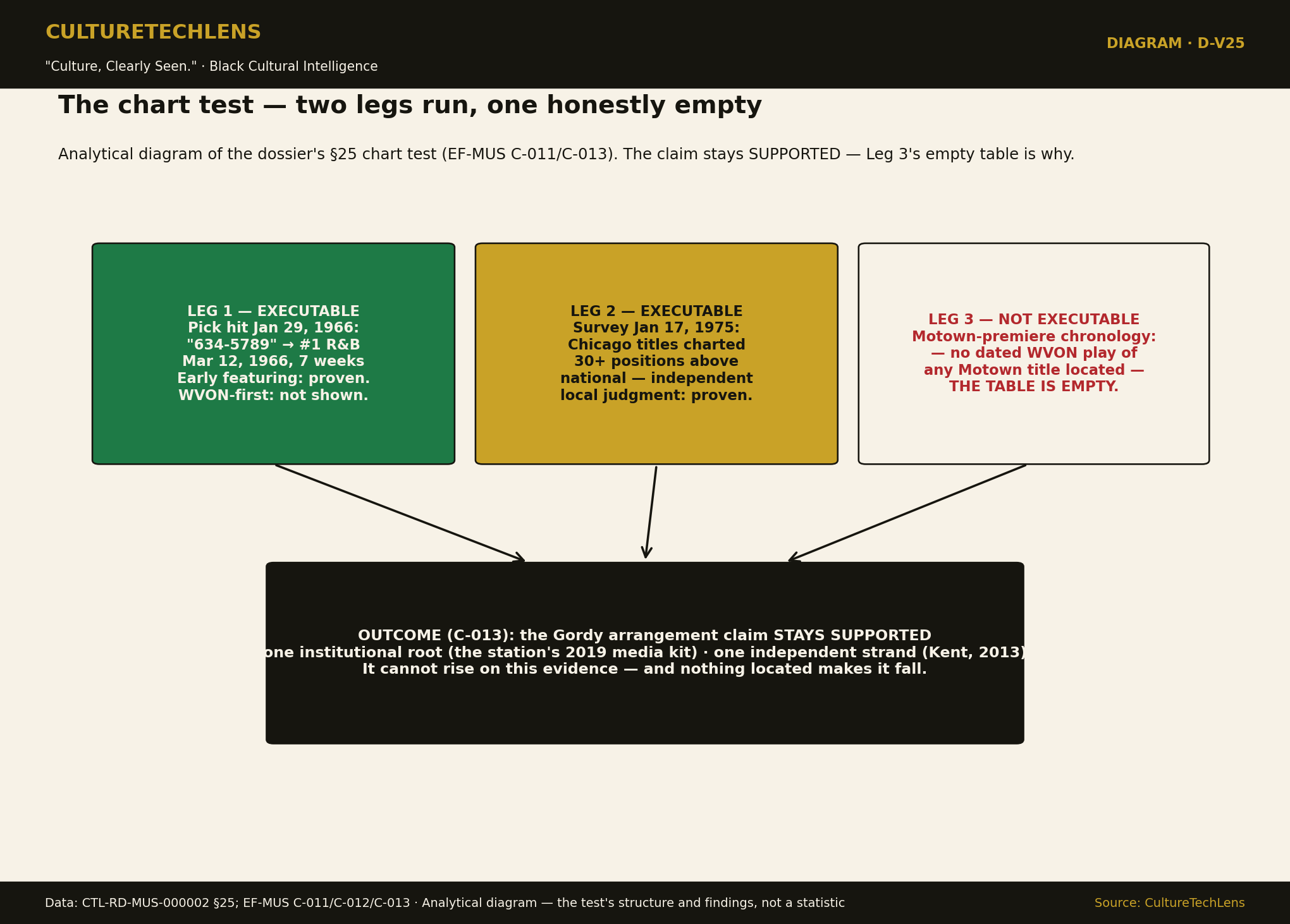
What the surviving evidence proves is narrower than the legend, and this dossier keeps the two separate. It proves the machinery existed and worked: on January 29, 1966, the station's pick hit was Wilson Pickett's "634-5789," six weeks before the record began seven weeks at #1 on Billboard's R&B chart (EF-MUS C-003, C-013). It proves the rotation exercised independent local judgment: the one surviving survey week, January 17, 1975, charts Chicago artists far above their national performance (EF-MUS C-008). It proves the DJs were workers, not statues — covering each other's shifts in a subzero cold snap, soliciting ads from Black-owned shops between records (EF-MUS C-004, C-016). It does not prove the biggest claim made for the station — that Berry Gordy sent every Motown record to WVON first and that WVON's plays moved national markets. That claim was tested here by the charter's chart-correlation method and stays SUPPORTED: its root is the station's own institutional history (documented verbatim in WVON's 2019 media kit), its one independent strand is Herb Kent's participant testimony, and no dated WVON first-play of any Motown title survives to test (EF-MUS C-011, C-012, C-013).
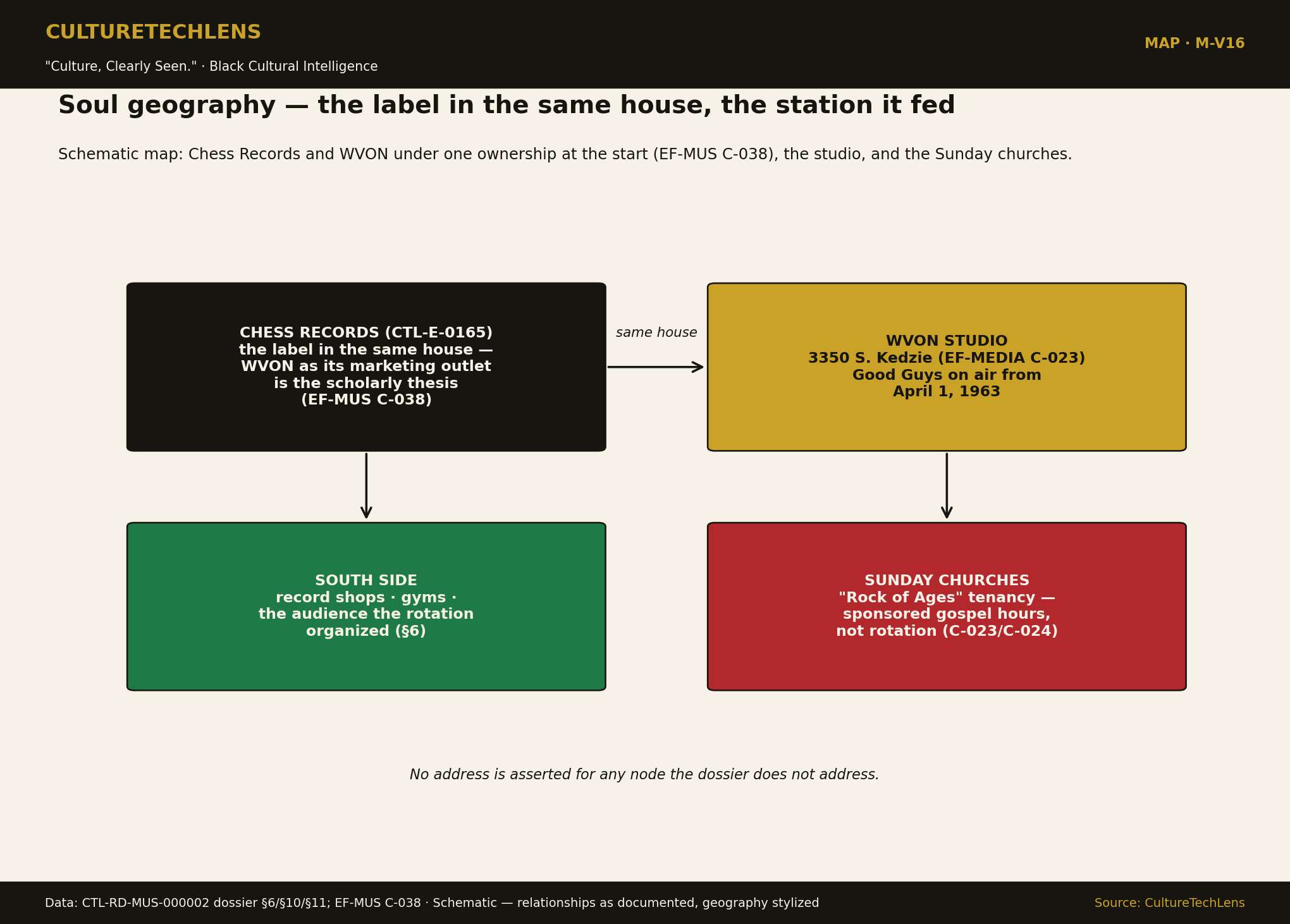
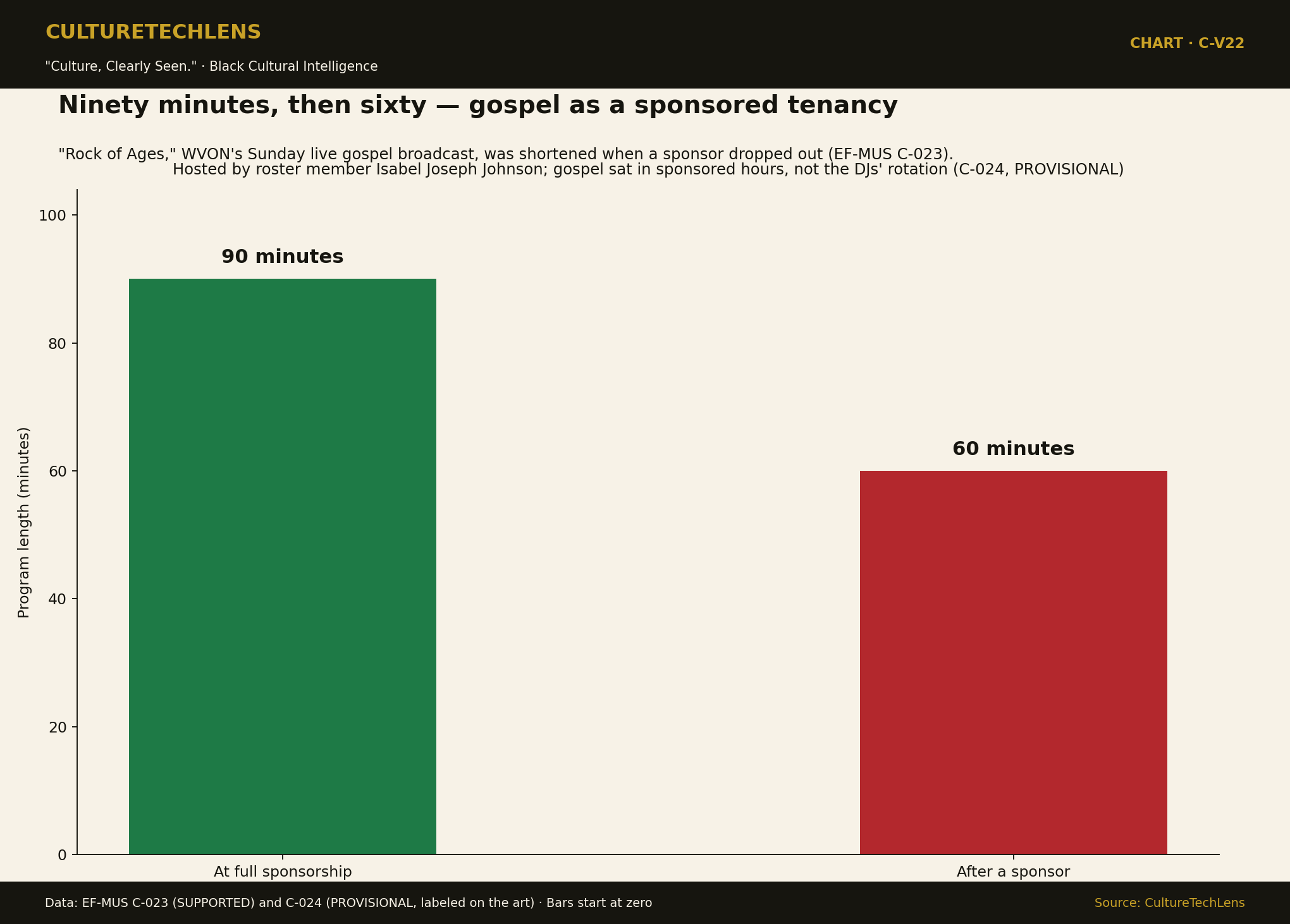
Gospel lived on the station as a Sunday tenancy: "Rock of Ages," a live, sponsored gospel broadcast hosted by roster member Isabel Joseph Johnson, with Archbishop Lucius Hall leading Sunday services — sponsored hours inside the schedule, not part of the DJs' rotation, and documented only in outline (EF-MUS C-023, C-024, C-025).
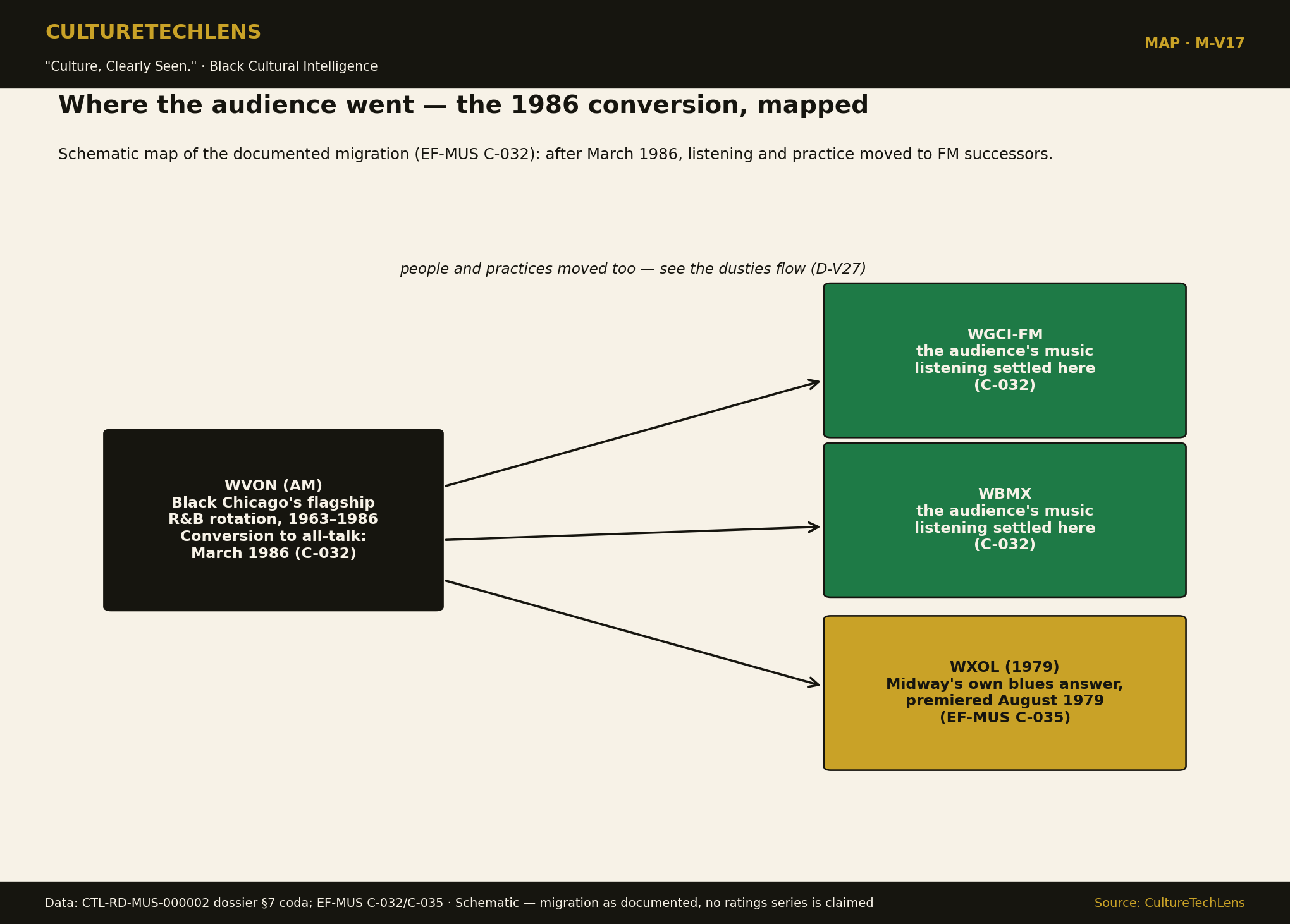
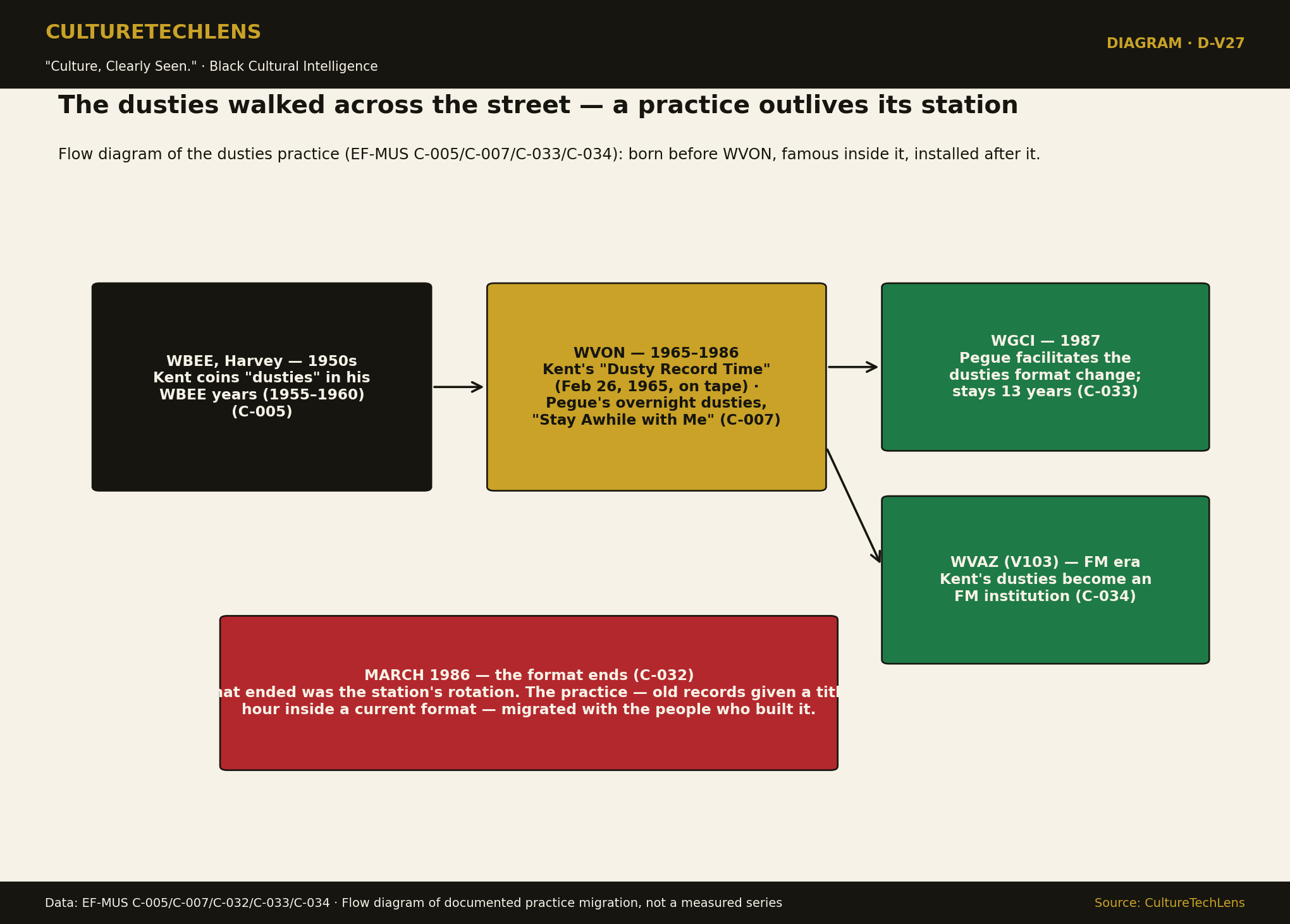
The format ended in March 1986 (CTL-EF-MEDIA-000001 C-015). What ended with it was specific: the pick hits, the survey, the dusties hours, the local chart judgment — Black Chicago's flagship R&B rotation. The practices migrated with the people: Pegue installed the dusties at WGCI in 1987; Kent carried them to FM; the audience followed to WGCI-FM and WBMX (EF-MUS C-032, C-033, C-034).
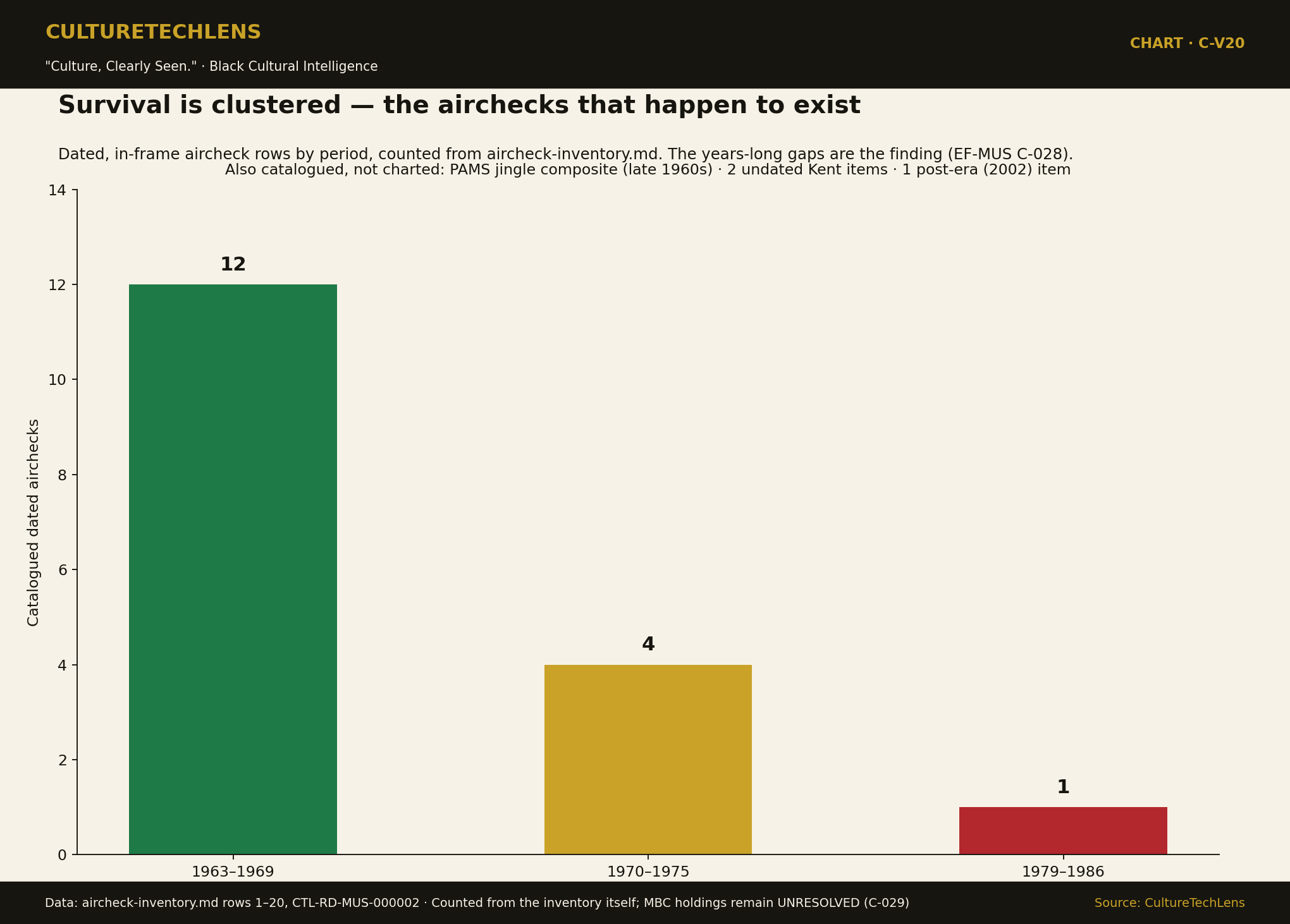
The evidence base is fragments, and the dossier says so wherever it matters: no station archive exists; the surviving airchecks are collector-held and cluster in a few taped weeks; exactly one survey week survives in located reproduction; a continuous rotation table for 1963–1986 cannot be built, and §25 prints the fragments as fragments instead of inventing one (EF-MUS C-027, C-039, C-040).
3. Significance
WVON is the best-documented case in American radio of a single station functioning as a city's musical public sphere — and, handled honestly, a case study in how such claims should be evidenced. Three things make the music dossier matter beyond nostalgia:
First, the mechanism is visible. Most "legendary station" stories float above operations. WVON's operations left artifacts: dated airchecks with named features, a survey with measurable local divergence, a music director with dated tenure, a benefit LP issued under the DJs' collective name within the format's second year. The dossier can therefore talk about how a station builds a musical public — features, charts, local weighting, personalities who also sold the ads and covered the shifts — instead of merely asserting that it did.
Second, the test case disciplines the legend. The Gordy arrangement claim is repeated everywhere WVON is described. This dossier traced it to its root (the station's own history, in the station's own 2019 media kit), found its one independent strand (Kent, 2013), ran the chart test in every leg the evidence allows, and left the claim exactly where the evidence leaves it: SUPPORTED, with the upgrade path named. That is the GOV-004 standard applied to a beloved claim — the dossier's methodological headline.
Third, the gaps are the finding too. Franklin McCarthy, a launch Good Guy, has no locatable biography. The Defender may or may not have printed WVON's playlist; the answer sits behind a paywall this build could not pass. The Museum of Broadcast Communications may or may not hold WVON tapes; its archive is in storage and uncatalogued in public. The music era's last seven years are its thinnest on tape. A dossier that prints these holes plainly is worth more than one that papers them — the holes are where the next research money goes (gaps.md).
4. Names / Aliases
- The station: WVON — "Voice of the Negro" (launch branding; CTL-EF-MEDIA-000001 C-004) → "Voice of the Nation" (current branding; rename date unresolved, EF-MEDIA C-005). Frequency identities: WVON 1450 (1963–1975, 1984–1986), WVON 1390 (1975–1983).
- The DJs as a body: the Good Guys (collective identity in commercial use by Christmas 1964 — EF-MUS C-046; staged entity CTL-E-6424).
- Air names in this dossier: Herb Kent, "The Cool Gent" (his memoir's spelling; the website master carries the alias variant "The Kool Gent") · Pervis Spann, "The Blues Man" · Lucky Cordell, "The Baron of Bounce" · Ed Cook, "Nassau Daddy" · Joe Cobb, "Youngblood" · Bill Crane, "Butterball."
- A name that is NOT used: E. Rodney Jones is sometimes given a nickname that CTL's evidence file for the MEDIA dossier could not verify (CTL-EF-MEDIA-000001 C-028, UNRESOLVED). It stays dead in this dossier: not repeated, not revived. The knowledge-graph description for CTL-E-1201 still carries it; that tension is flagged for the head in red-team.md — the dossier does not follow the graph record against the evidence file.
- Program names: "Dusty Record Time" (Kent) · the Pegue dusties show, themed "Stay Awhile with Me" · "Rock of Ages" (gospel) · "Lu's Notebook" (Palmer; CTL-E-5525) · features: "pick hit," "Top and Bottom."
5. Dates
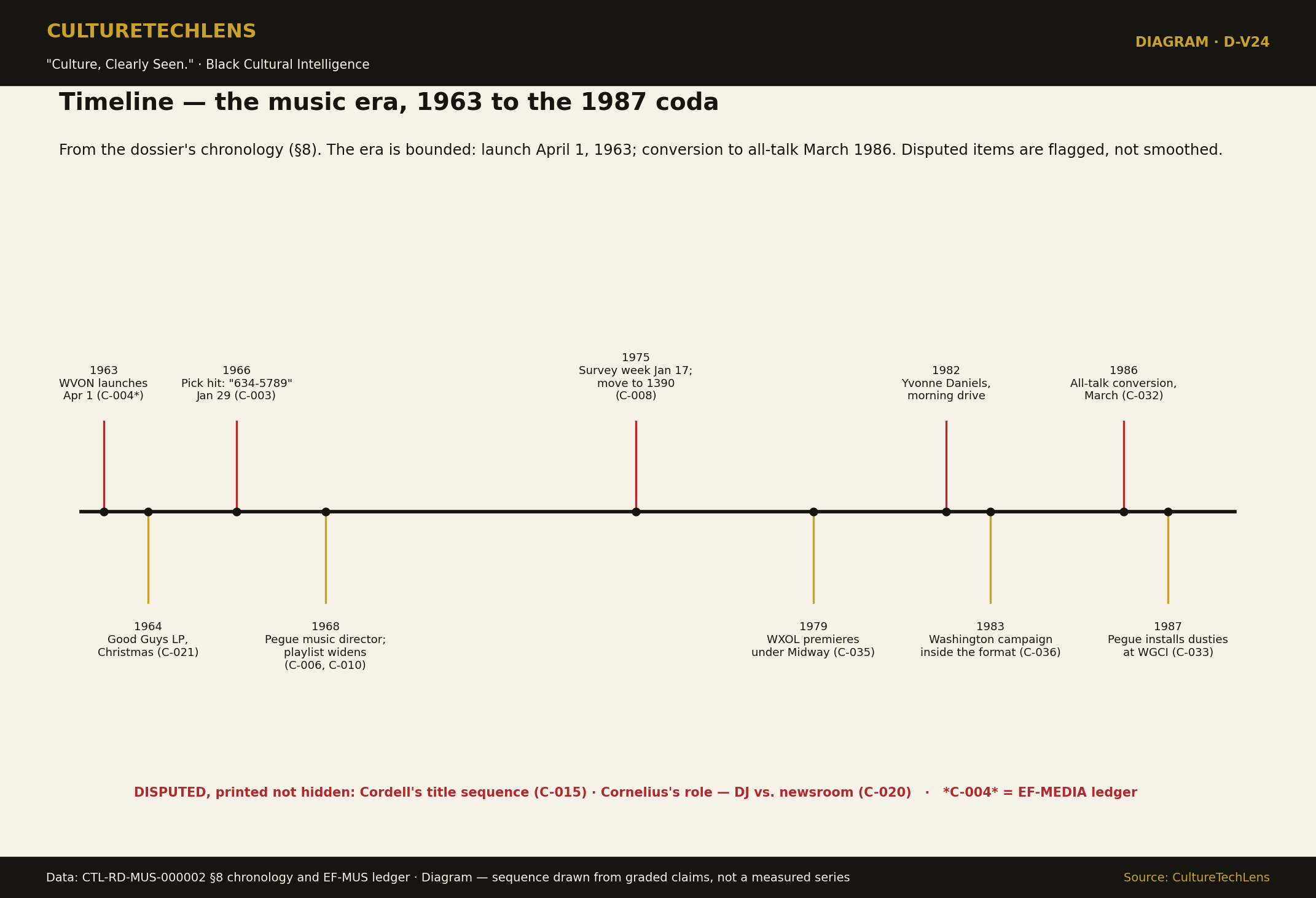
- April 1, 1963 — WVON launches (CTL-EF-MEDIA-000001 C-004). Music era opens.
- Christmas 1964 — WVON – The Good Guys benefit LP (EF-MUS C-021).
- January 29 – February 1, 1965 — dated Kent aircheck cluster (§22).
- January 29, 1966 — Cordell and Cook airchecks; the pick-hit broadcast (EF-MUS C-003, C-004).
- 1968 — playlist widens to compatible white artists (EF-MUS C-010); Richard Pegue becomes music director (EF-MUS C-006).
- August 1967 / August 29, 1967 — Jones/Cobb airchecks (§22).
- April 1970 — Kent aircheck (§22).
- January 17, 1975 — the surviving survey week (EF-MUS C-008).
- February 5, 1975 — move to 1390 (CTL-EF-MEDIA-000001 C-010); Pegue's WVON tenure ends this year (EF-MUS C-006).
- August 1979 — WXOL premieres under Midway (EF-MEDIA C-013; EF-MUS C-035).
- 1982 — Yvonne Daniels takes morning drive (EF-MEDIA C-033).
- 1983 — the Washington campaign runs inside the music format (EF-MUS C-036).
- 1986 — Pegue's "Tape 68" (§22); March 1986 — conversion to all-talk (EF-MEDIA C-015). Music era closes.
- 1987 — Pegue facilitates WGCI's dusties format change (EF-MUS C-033) — coda.
6. Geography
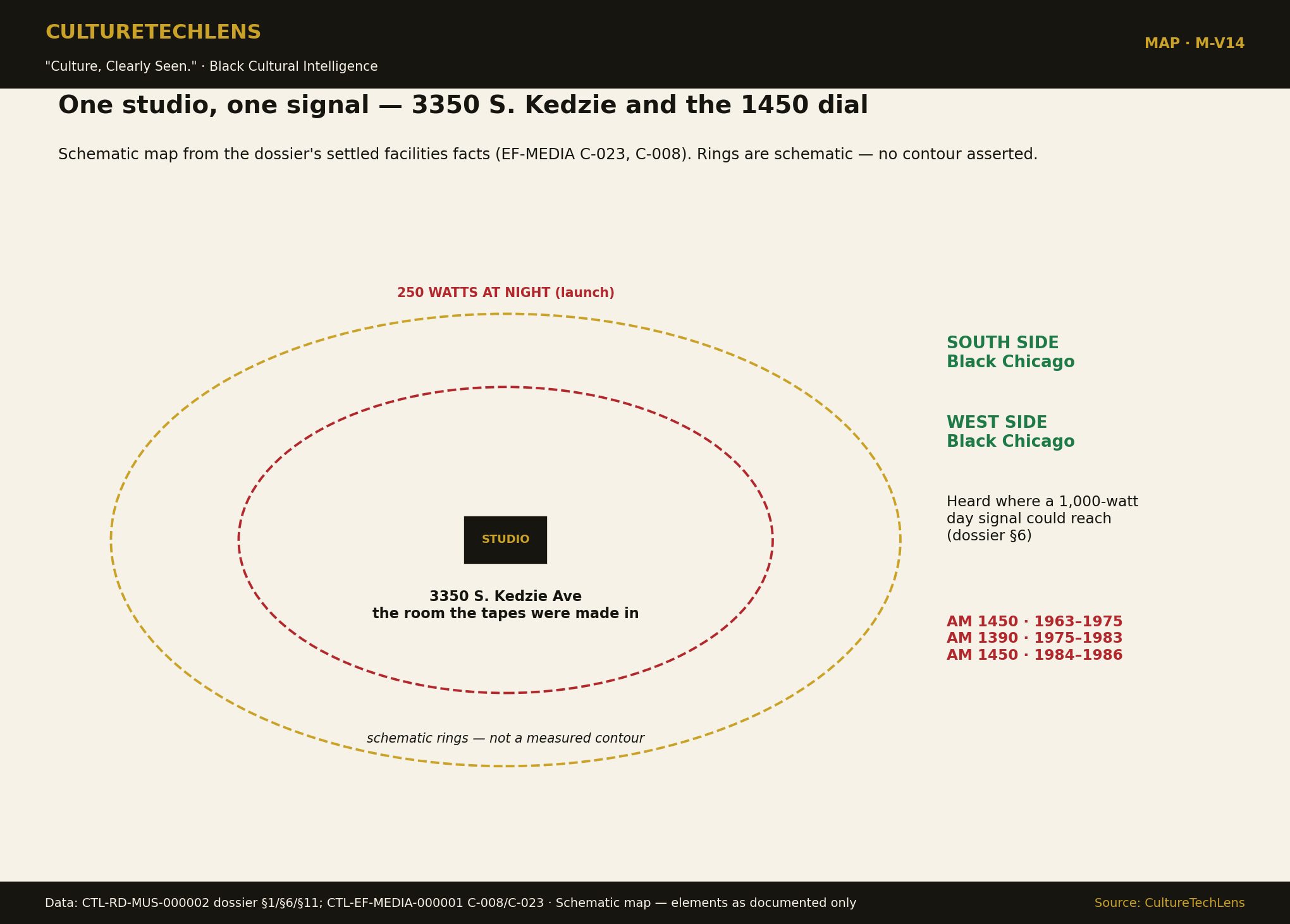
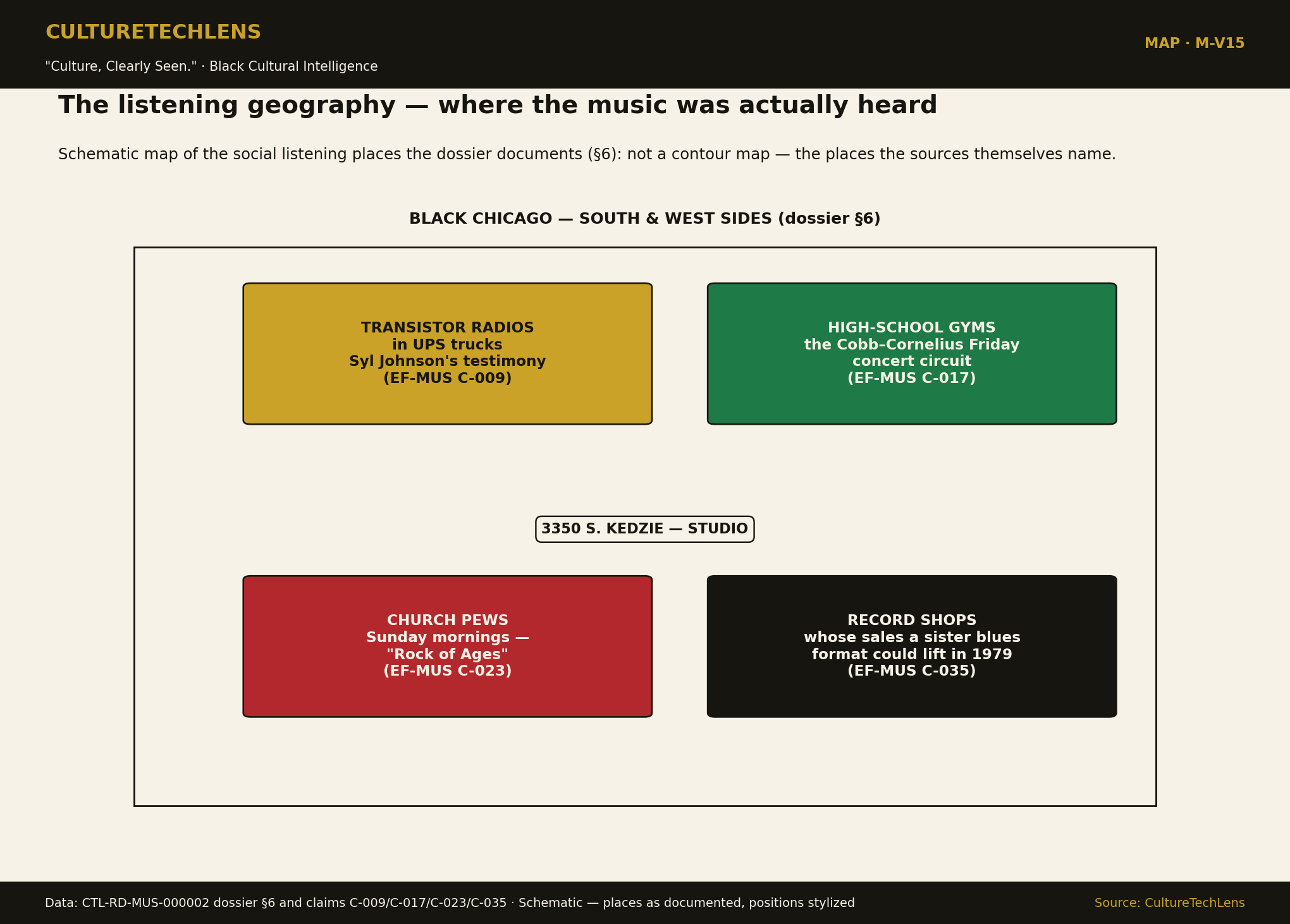
The music was heard where a 1,000-watt day signal (250 watts at night at launch; facilities settled at EF-MEDIA C-008) could reach: Black Chicago — the South and West Sides — from studios at 3350 S. Kedzie (EF-MEDIA C-023). The listening geography that matters to this dossier is not the contour map but the social one the sources describe: transistor radios in UPS trucks (Syl Johnson, EF-MUS C-009), high-school gyms on the Cobb–Cornelius Friday concert circuit (EF-MUS C-017), church pews on Sunday mornings (EF-MUS C-023), and the record shops whose sales a sister station's blues format could lift in 1979 (EF-MUS C-035). A CTL-built listening-geography map is specified in visuals.md; it is not built in this package, and no geography claim in this dossier depends on it.
7. History
The launch design (1963). Leonard and Phil Chess bought a station and staffed it like a label signs a roster: five personalities at once, each with a name, a sound, and a neighborhood's trust (roster: EF-MEDIA C-006). The design insight — that Black Chicago would organize its listening around people, and that those people could carry records, news, advertising, and eventually a mayoral campaign — is the whole story in embryo. The Good Guys were on a Christmas benefit LP under their own collective name by the end of 1964 (EF-MUS C-021, C-046): the brand was an asset within twenty months.
The working format (1963–1970). What the tapes show is a format of named features inside personality shows: a pick hit of the week, a "Top and Bottom" spotlight on a 45's two sides, Kent's dusties — old records given a titled hour inside a current-hits station, an invention he brought from WBEE and the format's most durable idea (EF-MUS C-003, C-005). The labor was working labor: Cordell's January 1966 show stretches to cover a colleague covering a colleague whose car froze (EF-MUS C-004); the DJs sold advertising to Black businesses between records (EF-MUS C-016). By early 1964 the station stood second in Chicago evenings (EF-MEDIA C-007). In 1968 the playlist widened — white artists whose records fit — a programmer's decision, made by a station confident in its audience (EF-MUS C-010). From 1968 the choosing had a named officer: Richard Pegue, music director, himself a doo-wop writer-producer before he was an executive (EF-MUS C-006).
The middle years (1970–1979). Globetrotter owned the station (EF-MEDIA C-009); the format persisted. The surviving 1975 survey shows what persistence meant in practice: national hits in the frame, Chicago records weighted far above their national performance inside it (EF-MUS C-008). Pegue's tenure ends with the 1975 frequency move; Spann and South's Midway buys the 1450 signal in 1979 and answers on FM-adjacent terms with WXOL's blues format — reported to lift Chicago blues record sales within months (EF-MUS C-035).
The last music years (1979–1986). The thinnest-documented stretch (EF-MUS C-049). Yvonne Daniels — a veteran of WYNR and WLS — holds morning drive from 1982 (EF-MEDIA C-033). In 1983 the music station does the thing its whole design had prepared: it carries a mayoral campaign inside the music format, Palmer's notebook nested in the Good Guys' schedule (EF-MUS C-036). Pegue's 1986 tape still shows dusties programming in the conversion year (EF-MUS C-031). Then, March 1986: talk (EF-MEDIA C-015).
Coda. The format died; the practices walked across the street. Pegue installs the dusties at WGCI (1987); Kent's dusties become an FM institution at WVAZ; the audience's music listening settles on WGCI-FM and WBMX (EF-MUS C-032–C-034). WGCI and WBMX are this dossier's successors-in-function, deliberately not co-subjects: their own dossiers are separate work.
8. Chronology
| Date | Event | Basis |
|---|---|---|
| 1962 | Herb Kent hired at WHFC; retained through the Chess purchase | EF-MEDIA C-021 |
| 1963-04-01 | WVON launches; Good Guys on air | EF-MEDIA C-004, C-006 |
| 1963-11-23 → 1965-01-30 | Billboard publishes no R&B chart (test-method window) | EF-MUS C-014 |
| Christmas 1964 | WVON – The Good Guys benefit LP | EF-MUS C-021 |
| 1965-01-29 → 02-01 | Kent aircheck cluster taped | §22 |
| 1965-02-26 | Kent, "Dusty Record Time" aircheck | EF-MUS C-005 |
| 1966-01-29 | Cordell/Cook airchecks; "634-5789" the pick hit | EF-MUS C-003, C-004 |
| 1966-03-12 | "634-5789" reaches #1 Billboard R&B (7 weeks) | EF-MUS C-013 |
| 1967-08 / 08-29 | Jones, Cobb airchecks | §22 |
| 1968 | Playlist widens; Pegue becomes music director | EF-MUS C-010, C-006 |
| 1968-12-29 | WVON news aircheck (Nelson/Wood) | §22 |
| 1970-04 | Kent aircheck | §22 |
| 1972 | Jay Johnson aircheck (listing) | EF-MUS C-048 |
| 1975-01-17 | Surviving survey week | EF-MUS C-008 |
| 1975-02-05 | WVON moves to 1390 | EF-MEDIA C-010 |
| 1975-06-09 | Pegue aircheck | EF-MUS C-007 |
| 1979-08 | WXOL premieres (Midway) | EF-MEDIA C-013 |
| 1979-11-03 | Billboard reports WXOL blues-sales effect | EF-MUS C-035 |
| 1982 | Yvonne Daniels, morning drive | EF-MEDIA C-033 |
| 1983 | Washington campaign inside the music format | EF-MUS C-036 |
| 1986 | Pegue "Tape 68" | EF-MUS C-031 |
| 1986-03 | Conversion to all-talk; music era ends | EF-MEDIA C-015 |
| 1987 | Pegue facilitates WGCI dusties format | EF-MUS C-033 |
9. People
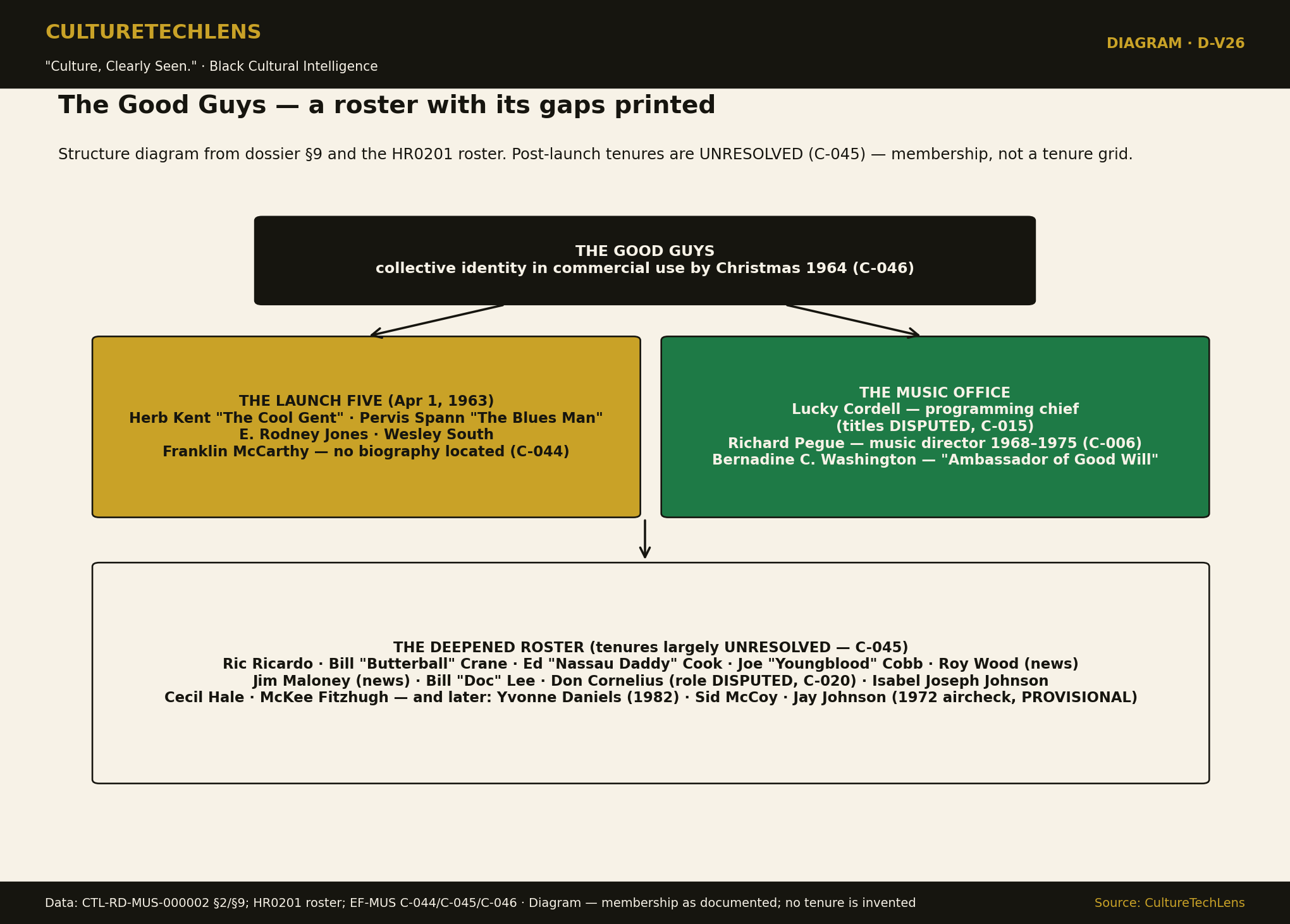
The launch five (roster settled at EF-MEDIA C-006; music-side records here): - Herb Kent (CTL-E-0069) — "The Cool Gent." Dusties inventor (from WBEE), evening voice, the format's longest shadow; his WVON spine and the enrichment this dossier proposes for his stub record are at EF-MUS C-005, C-018. His 2013 testimony is the test case's independent strand (EF-MUS C-012). NRHF 1995 (EF-MUS C-018). - Pervis Spann (CTL-E-1199) — "The Blues Man." Blues promoter before WVON (1960 King/Parker concert), blues presence inside the format; later co-founded Midway (EF-MUS C-019; EF-MEDIA C-013). - E. Rodney Jones (CTL-E-1201) — twenty-plus years at WVON per his Hall of Fame profile; his 1964 reel and August 1967 airchecks survive (§22). No nickname is used for Jones in this dossier (see §4). - Wesley South (CTL-E-1200) — newsman by training (Northwestern Medill), assigned to news at the hire, later co-owner; the man who urged the 1986 conversion (EF-MEDIA C-015). His music-era significance here is structural: the newsroom and the music floor were one staff. - Franklin McCarthy (staged CTL-E-6402) — launch Good Guy. Nothing else about him could be located (EF-MUS C-044). His empty chair is one of this dossier's named findings.
Management and the music office: - Lucky Cordell (CTL-E-2843) — "The Baron of Bounce," a working DJ who appears on the January 1966 tape stretching his own show to cover two colleagues — and the station's programming chief. His management title sequence is DISPUTED between the launch-GM account and the PD→AGM→GM ladder (EF-MUS C-015). - Richard Pegue (CTL-E-2849) — music director from 1968 to the 1975 move; overnight dusties host; the bridge to WGCI (EF-MUS C-006, C-007, C-033). Doo-wop writer-producer (the Norvells; the Cheers' "I'm Not Ready to Settle Down," 1965) before and beside the executive role. - Bernadine C. Washington (CTL-E-5524) — "Ambassador of Good Will" (HR0201); her graph record also documents a vice-president/GM role at the station in the 1960s (see relationships.json).
The deepened roster (HR0201; individual tenures largely unresolved, EF-MUS C-045): Ric Ricardo (staged CTL-E-6405) · Bill "Butterball" Crane (CTL-E-5523; August 1967 aircheck survives) · Ed "Nassau Daddy" Cook (CTL-E-0550; January 29, 1966 aircheck) · Joe "Youngblood" Cobb (staged CTL-E-6404; EF-MUS C-017) · Roy Wood (staged CTL-E-6410; news director, Morehouse/Columbia — hired Cornelius into news per the scholarly account) · Jim Maloney (staged CTL-E-6411; newscasts survive on tape; HR0201's "Ed Maloney" form noted as an unresolved identity variance) · Bill "Doc" Lee (staged CTL-E-6408) · Don Cornelius (CTL-E-2596; role at WVON DISPUTED between DJ and newsroom accounts, EF-MUS C-020) · Isabel Joseph Johnson (staged CTL-E-6409; roster member and "Rock of Ages" host, EF-MUS C-023) · Cecil Hale (staged CTL-E-6407) · McKee Fitzhugh (staged CTL-E-6406).
Later and coda voices: Yvonne Daniels (CTL-E-1202; morning drive from 1982, EF-MEDIA C-033) · Sid McCoy (staged CTL-E-6413; EF-MUS C-047) · Bruce Brown (staged CTL-E-6414, PROVISIONAL roster) · Jay Johnson (staged CTL-E-6415; EF-MUS C-048) · Lucius Hall (staged CTL-E-6412; Sunday services, EF-MUS C-023) · Lu Palmer (CTL-E-0104; the 1983 voice inside the format, EF-MUS C-036; enrichment proposed) · Melody Spann-Cooper (CTL-E-5196; coda — the Blues Man's daughter now chairs Midway; her 2024 congressional testimony is the modern institutional surface) · Pam Morris-Walton (staged CTL-E-6430; talk-era gospel host — boundary record only, EF-MUS C-026).
Artists the evidence names: Wilson Pickett (staged CTL-E-6416; the pick hit, EF-MUS C-003) · Walter Jackson (staged CTL-E-6417; the "Top and Bottom" 45) · Syl Johnson (CTL-E-6043; C-008, C-009) · Garland Green (staged CTL-E-6418) · Wales Wallace (staged CTL-E-6419) · Tyrone Davis (CTL-E-0042), Gene Chandler (CTL-E-0033), Curtis Mayfield (CTL-E-0031), Ramsey Lewis (CTL-E-0030) — referenced, not re-researched.
10. Organizations
WVON (CTL-E-0179) and its facets (§1) · Chess Records (CTL-E-0165) — the label in the same house; the marketing-outlet relationship is settled at EF-MEDIA C-034 and developed musically at EF-MUS C-038 · Motown Records (CTL-E-1639) and Berry Gordy (CTL-E-5246) — the test case (EF-MUS C-011); deliberately not encoded as a graph edge (see §29) · Globetrotter Communications (staged CTL-E-6403) — owner 1970–1977 (EF-MEDIA C-009, C-012), owner during the 1975 survey and frequency move · Midway Broadcasting (facet CTL-E-1377) · the Good Guys as a collective (staged CTL-E-6424) · The HistoryMakers (CTL-E-0203) — oral-history deposits (EF-MUS C-042) · Museum of Broadcast Communications (CTL-E-5881) — holdings unresolved (EF-MUS C-029) · the Chicago Defender (CTL-E-0266) — print witness; playlist question unresolved (EF-MUS C-043).
11. Places
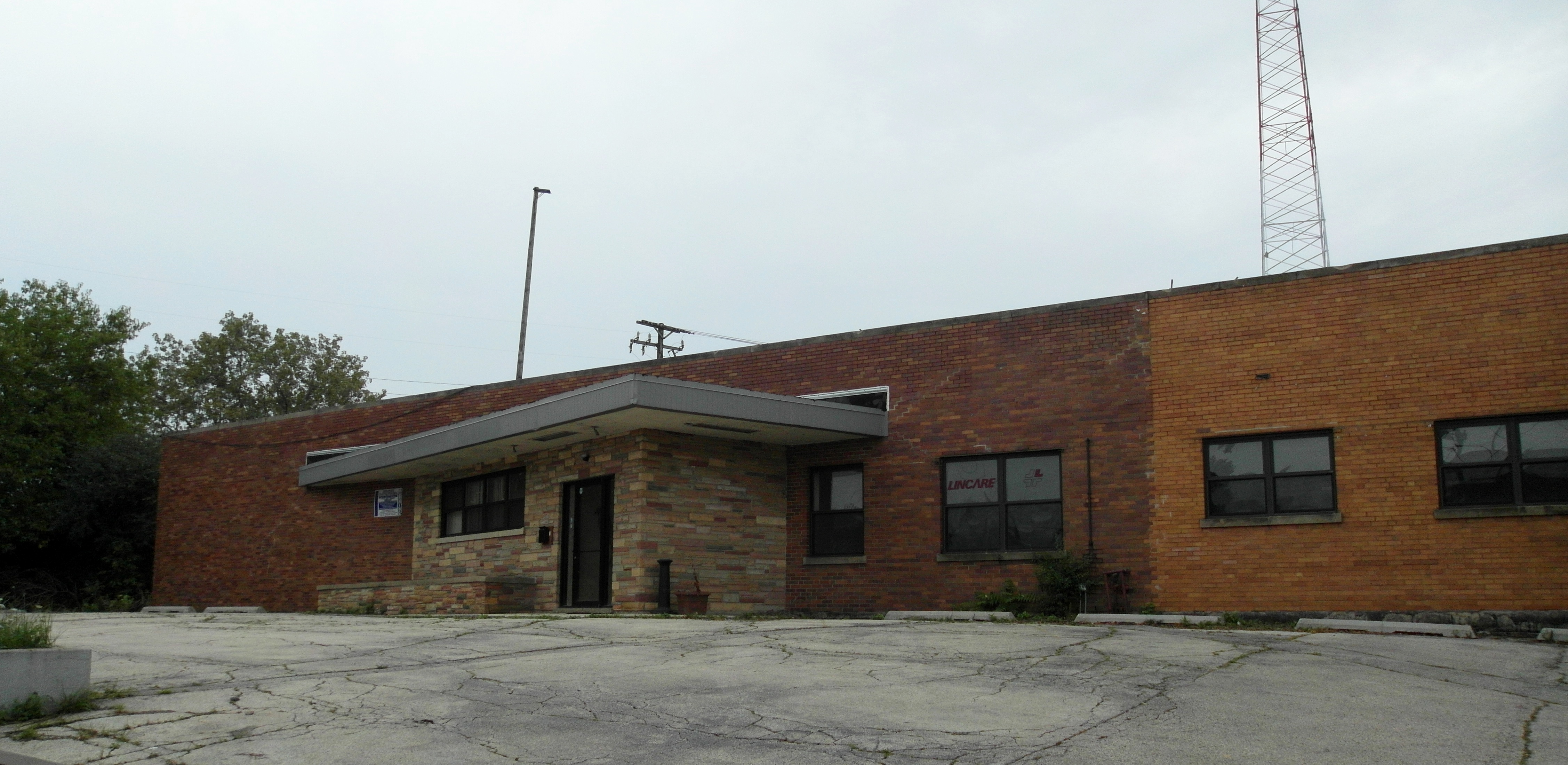
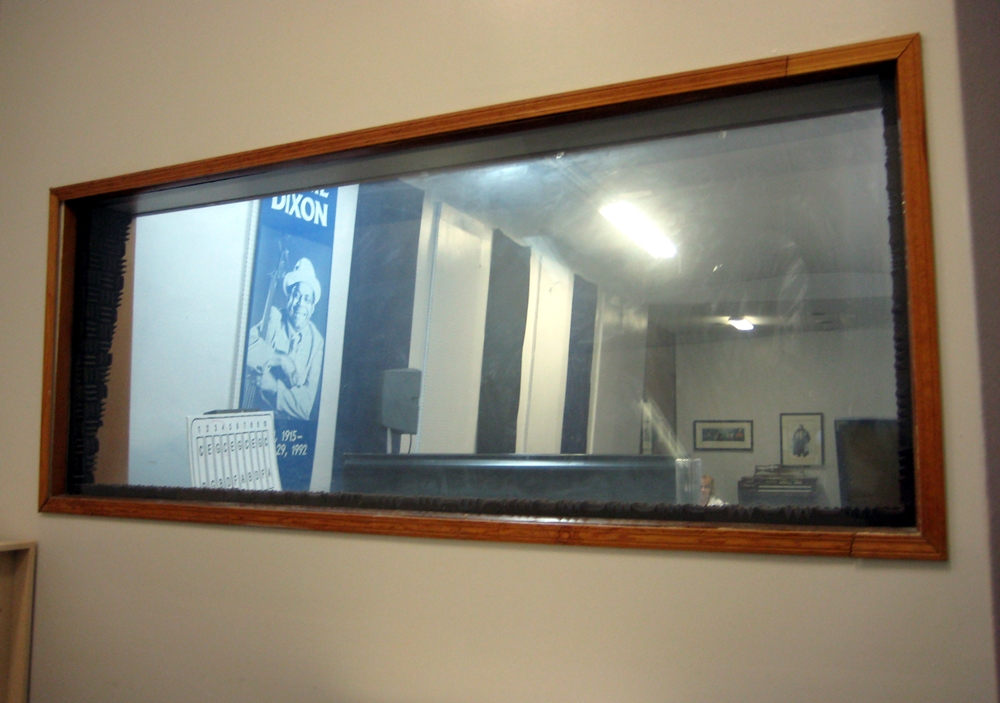
Studios at 3350 S. Kedzie (EF-MEDIA C-023) — in frame only as the room the tapes were made in; the station's address history is MEDIA-dossier territory. The music's other places are documented in §6: high-school gyms of the Cobb–Cornelius circuit, the churches of the Sunday schedule, and the city's record shops. No place claims are ledgered in EF-MUS; place facts are cross-referenced.
12. Events
- The 1960 B.B. King / Junior Parker concert promoted by Pervis Spann — pre-WVON, the promoter apprenticeship behind the Blues Man (EF-MUS C-019).
- The January 29, 1966 broadcast day — the best-documented single day of the format: pick hit, Top and Bottom, the substitution chain (EF-MUS C-003, C-004).
- The 1983 campaign broadcasts — an event class, not a date: Palmer's notebook inside the music schedule (EF-MUS C-036; settled facts EF-MEDIA C-016, C-027).
- The March 1986 conversion — the boundary event (EF-MEDIA C-015; music-side consequence EF-MUS C-032).
- The 1987 WGCI dusties change — coda event; the format's practice outliving it (EF-MUS C-033).
13. Works / Products — the programming itself
This section is the dossier's center of gravity: the programming as a body of work.
Dayparts and shows (as documented; no full schedule survives — EF-MUS C-040): - Kent's evening show, with "Dusty Record Time" — oldies given a titled place inside a hits format; surviving broadcast February 26, 1965. The dusties idea predates WVON (WBEE, 1950s) and postdates it (WGCI 1987; WVAZ) — WVON is where it became famous (EF-MUS C-005). - Pegue's overnight dusties show, themed "Stay Awhile with Me" — the format's night shift as an oldies room (EF-MUS C-007). - "Rock of Ages" — Sunday-morning live gospel, ninety minutes at full sponsorship, Isabel Joseph Johnson hosting (EF-MUS C-023, C-024). - News as a staffed operation inside the music station — Wood, South, Maloney, Cornelius (hires per §9) — the journalism the AAIHS study documents; its history is the MEDIA dossier's, its presence shaped the music floor's working day (EF-MUS C-016).
Features (the rotation's visible machinery): - Pick hit — the week's chosen record (January 29, 1966: "634-5789") (EF-MUS C-003). - Top and Bottom — a spotlight on both sides of one 45 (January 29, 1966: Walter Jackson) (EF-MUS C-003). - The printed survey — the station's printed chart; one week survives in located reproduction (January 17, 1975) and shows the local weighting (EF-MUS C-008). Its publication cadence is not documented in located sources. - Playlist breadth "often 45 songs" (PROVISIONAL, EF-MUS C-002).
Products: WVON – The Good Guys LP (1964; staged CTL-E-6421) · WVON Good Guys Holiday Package LP (undated; staged CTL-E-6422) · the PAMS jingle packages heard on the late-1960s tapes (§22) — the station's sound, manufactured by PAMS, catalogued as artifacts of the format's self-presentation.
What cannot be listed: a week-by-week rotation. See §25 and EF-MUS C-040.
14. Relationships
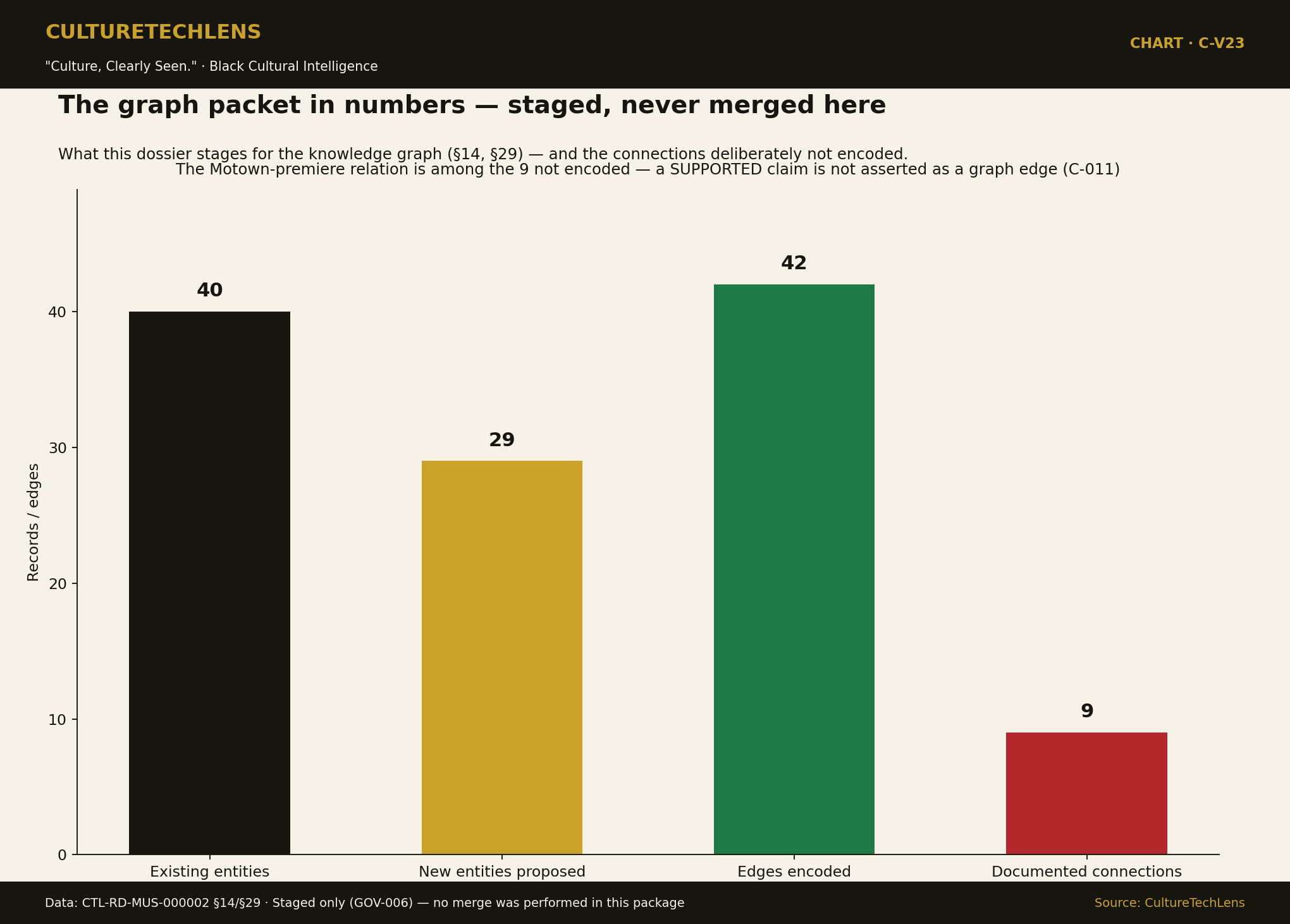
Forty-two edges are encoded in relationships.json, every one validated against the knowledge-graph schema's type/endpoint matrix: WVON hosted twenty-two air personalities (launch five through the coda bridges); Pegue and Kent hosted also at successor and origin stations (WGCI, WBEE, WGES); Kent and Jones honored_by the Museum of Broadcast Communications (National Radio Hall of Fame); the five launch members member_of_organization the Good Guys collective; Cobb collaborated_with Cornelius; WVON acquired_by Globetrotter; WVON related_to its successors WGCI, WGCI-FM, WBMX and its Midway sibling WXOL. Nine documented connections are not encoded — listed with reasons in relationships.json — including, deliberately, the Motown premiere relation: it is a SUPPORTED claim with a single institutional root, and encoding it as a graph edge would assert more than the evidence grades (EF-MUS C-011). Seven WVON edges from the October 15, 2025 disposition (Gate D) already stand in the graph and are not re-encoded here.
15. Claims
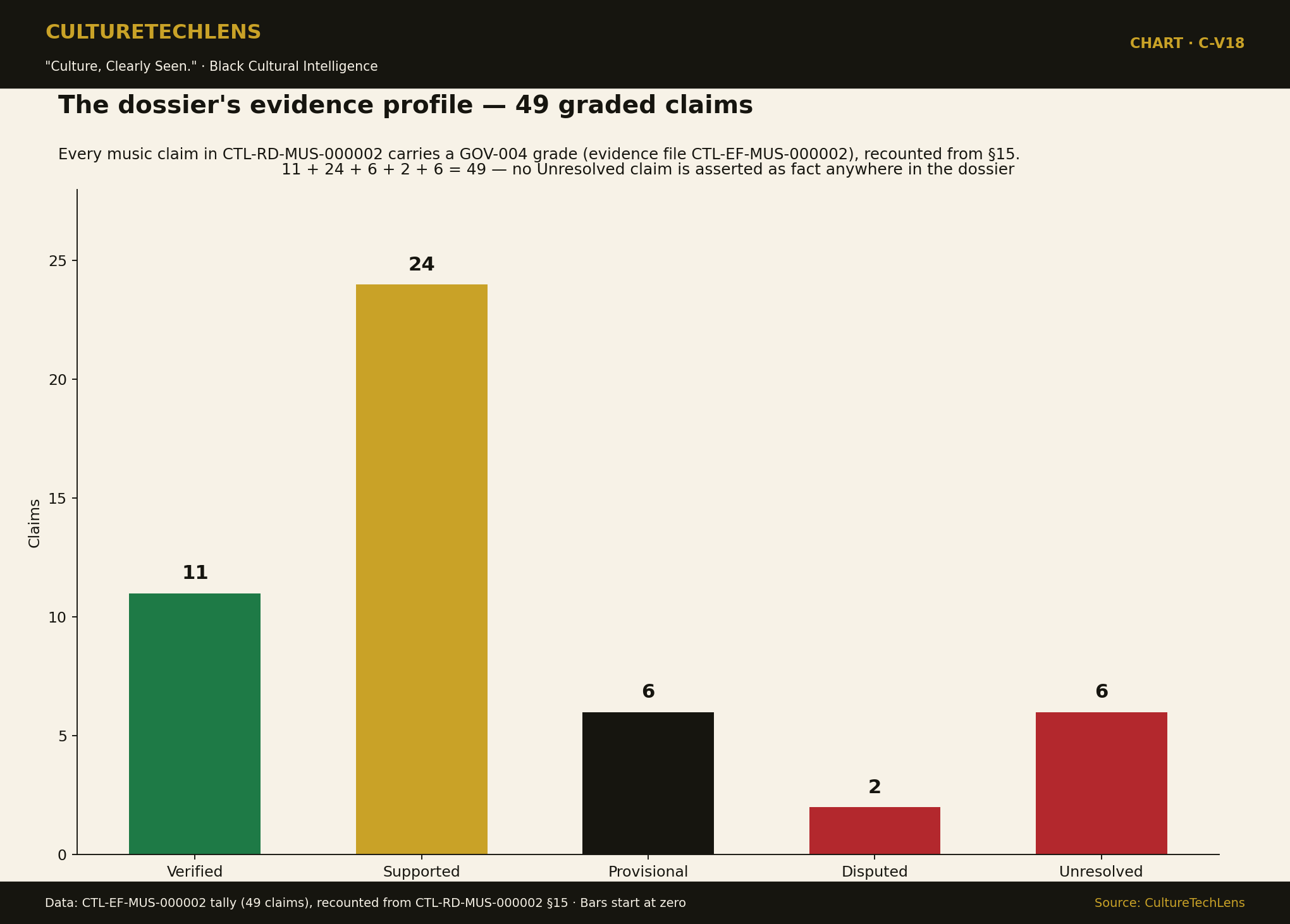
The ledger is CTL-EF-MUS-000002; this table is its index. Grades: V VERIFIED · S SUPPORTED · P PROVISIONAL · D DISPUTED · U UNRESOLVED. Tally: 49 claims — V 11 · S 24 · P 6 · D 2 · U 6.
| ID | Claim (short form) | Grade |
|---|---|---|
| C-001 | Personality-led Black music format, 1963–86 | S |
| C-002 | Playlist "often 45 songs" | P |
| C-003 | Jan 29, 1966: pick hit + Top and Bottom on tape | V |
| C-004 | The substitution chain (DJ labor) | V |
| C-005 | Kent's dusties: WBEE origin, WVON hour | S |
| C-006 | Pegue, music director 1968–1975 | S |
| C-007 | Pegue's dusties show; his tapes survive | S |
| C-008 | Jan 17, 1975 survey: local weighting | S |
| C-009 | Syl Johnson: "number one on WVON" (testimony) | P |
| C-010 | 1968 playlist widening (Billboard) | S |
| C-011 | TEST CASE: Gordy arrangement / markets claim | S |
| C-012 | Kent's 2013 testimony (independent strand) | S |
| C-013 | Chart-correlation test: findings | V |
| C-014 | Billboard R&B chart gap, Nov 1963–Jan 1965 | V |
| C-015 | Cordell's title sequence | D |
| C-016 | DJs solicited local advertising | S |
| C-017 | Joe Cobb: Youngblood, concerts, the scream | S |
| C-018 | Kent's WVON spine | S |
| C-019 | Spann, the Blues Man; 1960 concert | S |
| C-020 | Cornelius's WVON role: DJ vs. newsroom | D |
| C-021 | WVON – The Good Guys LP, 1964 | V |
| C-022 | Holiday Package LP (undated) | P |
| C-023 | "Rock of Ages" gospel on WVON | S |
| C-024 | Gospel as sponsored hours, not rotation | P |
| C-025 | Scale of WVON gospel — open question | U |
| C-026 | Morris-Walton is talk-era (boundary) | S |
| C-027 | No station archive exists | S |
| C-028 | Aircheck survival is clustered/biased | S |
| C-029 | MBC WVON holdings — open question | U |
| C-030 | Aircheck rights layered; none cleared | V |
| C-031 | Pegue "Tape 68," 1986 | S |
| C-032 | 1986: what the conversion cost the music | S |
| C-033 | Pegue installs dusties at WGCI, 1987 | S |
| C-034 | Kent's FM coda (WVAZ) | S |
| C-035 | WXOL blues format lifted blues sales | P |
| C-036 | 1983 ran inside the music format | S |
| C-037 | Payola at WVON specifically — open question | U |
| C-038 | Searcy's dual-function thesis (music side) | S |
| C-039 | One survey week survives in reproduction | V |
| C-040 | A continuous rotation table cannot be built | V |
| C-041 | "Held Black Chicago captive": single root | V |
| C-042 | HistoryMakers deposits exist | V |
| C-043 | Defender playlist question — open question | U |
| C-044 | Franklin McCarthy biography — open question | U |
| C-045 | Post-launch tenures — open question | U |
| C-046 | Good Guys as a brand by 1964 | S |
| C-047 | Sid McCoy, Soul Train's announcer | S |
| C-048 | Jay Johnson 1972 aircheck (listing) | P |
| C-049 | 1979–86 is the thin stretch | V |
16. Evidence
The dossier's evidence stands in four classes, in descending order of strength for music claims:
- Primary audio — the airchecks (§22; inventory in aircheck-inventory.md). They prove what was played, featured, and said on specific dates. They are few, clustered, and collector-held (EF-MUS C-027, C-028).
- Primary documents — HR0201 (roster, as a legislative record), the January 17, 1975 survey in reproduction, the Good Guys LPs as artifacts, the HistoryMakers finding aids (the deposits exist; their contents await a gated session), WVON's own 2019 media kit (primary for what the institution claims, interested-party for whether it is true).
- Testimony — participant accounts: Kent (NPR 2013; memoir 2009), Cobb (2019/2023 reporting), Syl Johnson (Wax Poetics), Pegue and Spann via finding-aid biographies and obituaries. Testimony is graded as testimony throughout.
- Scholarship and trade — Searcy's dissertation (the scholarly spine), the AAIHS journalism study, Ramsay's DePaul capstone (used for leads), Barlow's Voice Over (context), Billboard items (1964, 1968, 1969, 1979 — some consulted through the MEDIA dossier's citations, flagged where so), and the national chart record for the correlation test.
The full claim-by-claim audit — which citation supports which exact claim, and where a citation does not carry the claim laid on it — is in red-team.md (a).
17. Primary Sources
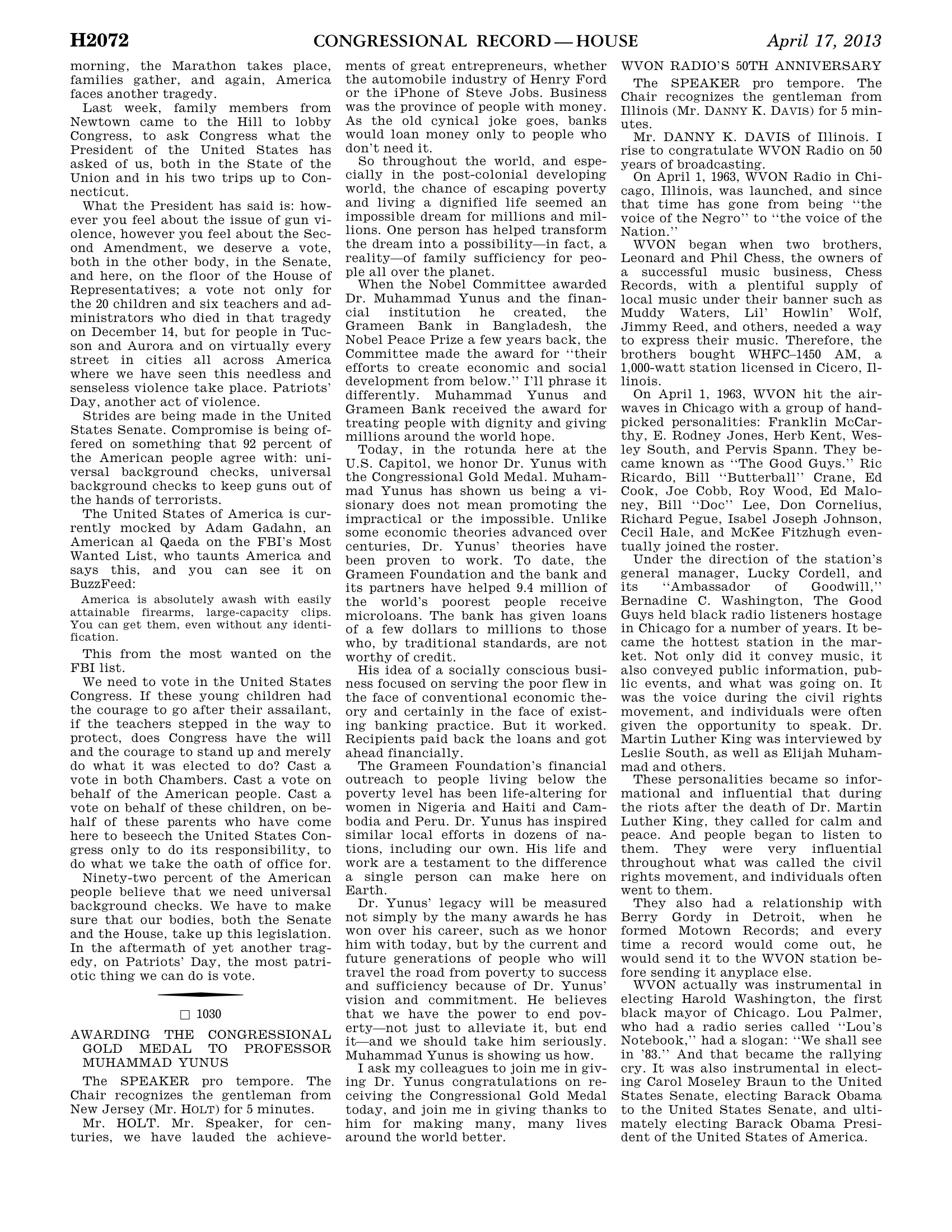
Aircheck recordings (§22) · WVON printed survey, week of January 17, 1975 (in reproduction) · WVON – The Good Guys LP (1964) and Holiday Package LP (artifacts; ARC holding; Discogs records) · HR0201, 98th Illinois General Assembly (2013) · WVON 2019 Media Kit (Midway Broadcasting) · WVON institutional history text (wvon.com history, via mirror) · Lu Palmer, Eyes on the Prize II interview (1989; publicly viewable) · HistoryMakers interviews (deposits verified; contents gated) · U.S. Congressional Record: Rep. Davis, "WVON Radio's 50th Anniversary" (April 17, 2013) — a tribute, primary for the tribute's wording, downstream of the institutional root for its facts.
18. Secondary Sources
Searcy dissertation (Loyola, 2012) · Ramsay capstone (DePaul, 2020) · AAIHS, "Radio Journalism and Civil Rights" · Pruter, Chicago Soul (1991) — discographic context · Barlow, Voice Over (1999) — format context · NPR 50th-anniversary reporting (Barnett, 2013) · Chicago Sun-Times obituaries (Pegue 2009; Hall 2020) · National Radio Hall of Fame profiles (Kent; Jones) · collector and discographic surfaces (Internet Archive item records, Airchexx, ReelRadio, Stepfather of Soul, Discogs) — each used at the level it can support, and flagged in the evidence file where a claim rests on a single one.
19. Archival Collections
- WVON Airchecks (CTL-E-0782) — the graph's archive facet for the surviving tapes. There is no station archive (EF-MUS C-027); the "collection" is a distributed, collector-held body, itemized in aircheck-inventory.md.
- Museum of Broadcast Communications (CTL-E-5881) — 85,000+ hours of broadcasts, majority undigitized, no public item-level catalog, archive in storage since April 30, 2023. Whether it holds WVON airchecks: UNRESOLVED (EF-MUS C-029).
- The HistoryMakers (CTL-E-0203) — Kent A2000.026 · Spann A2002.010 · Palmer A2002_087 · Pegue A2002_011 · Steele A2005_074 · Dyson A2007_021. Video gated; free via Chicago Public Library card.
- Vivian G. Harsh Research Collection (CTL-E-0202) — the collection is located and major ($2M Mellon digitization); no WVON-named holdings appear in its published finding aids. An archivist query is the named next step (gaps.md).
- ARChive of Contemporary Music (New York) — holds the 1964 Good Guys LP (EF-MUS C-021).
- Henry Hampton Collection, Washington University — Palmer's Eyes on the Prize II interview; publicly viewable via AAPB, rights "not evaluated."
20. Documents
The charter (CTL-DR-MUS-002) and the 2026-10-15 source hunt report govern this build; the WVON disposition change-set, merge log, and Gate D widening memo (all 2026-10-15) record the foundation state — disposition landed, schema widened, seven edges in the graph before this dossier was written. The 2019 media kit is treated in this dossier as a document of the institution's self-account — and, at EF-MUS C-011, as the test case's root document.
The record in pictures
21. Photographs
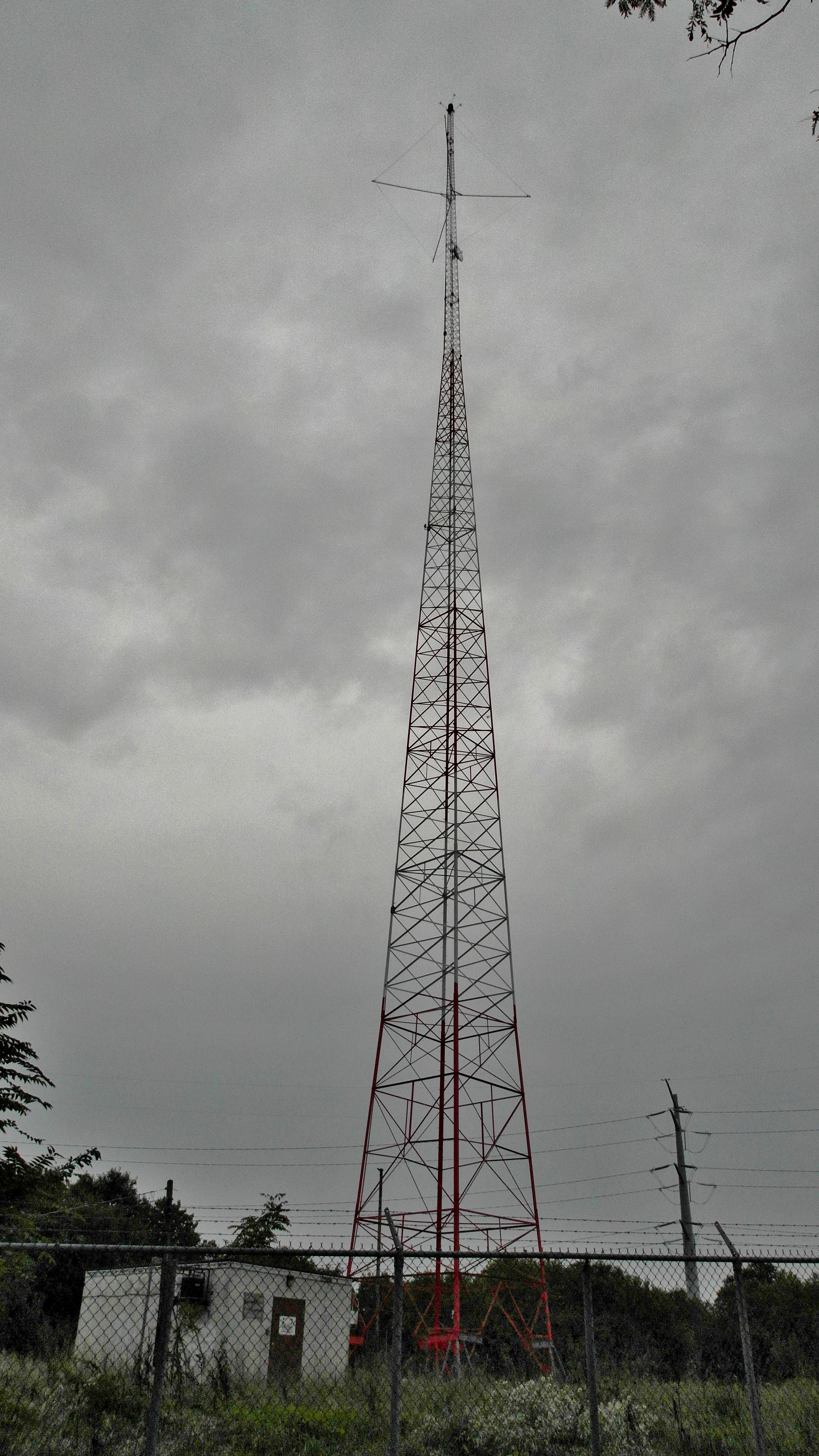
No photographs are published or cleared in this package. The visual plan — Good Guys group photographs, studio and transmitter images, the LP sleeves as artifacts, and CTL-built graphics (format-era timeline; roster/daypart chart; listening-geography map) — is specified with per-asset rights records in visuals.md. Every historical photograph slot is HELD pending a per-asset rights determination under PHOTO-001/SUP-004. No stock. The one-word rule and full citation branding apply to every visual if and when this dossier is published.
22. Audio
The airchecks are this dossier's primary evidence and are catalogued, never published: rights are layered and no item is cleared (EF-MUS C-030). Full inventory with holders, provenance, rights status, and evidence value: aircheck-inventory.md. Summary of the dated spine:
| Date | Voice | Surface |
|---|---|---|
| Jan 29–Feb 1, 1965 | Herb Kent (segments) | collector tape list (MsOldSchool) |
| Feb 26, 1965 | Herb Kent, "Dusty Record Time" | YouTube / Mixcloud |
| 1965 | Pervis Spann | Airchexx |
| Jan 30 / Feb 1965 | Herb Kent | Airchexx |
| Jan 29, 1966 | Lucky Cordell | Internet Archive |
| Jan 29, 1966 | Ed Cook (for E. Rodney Jones) | Internet Archive |
| Aug 1967 | Bill "Butterball" Crane | Airchexx |
| Aug 1967 | E. Rodney Jones + Jim Maloney (news) | YouTube |
| Aug 29, 1967 | Joe Cobb + E. Rodney Jones | YouTube |
| Dec 29, 1968 | WVON News — Clair Nelson / Roy Wood | YouTube |
| Apr 1970 | Herb Kent | Airchexx |
| May 19, 1971 | Herb Kent (listing) | collector survey |
| 1972 | Jay Johnson (listing) | collector survey |
| Jun 9, 1975 | Richard Pegue | collector (Stepfather of Soul #12) |
| 1986 | Richard Pegue, "Tape 68" | YouTube |
| Jul 2002 | Richard Pegue, Midnight Dusties (WVON Cicero) | Internet Archive — outside the frame; Pegue evidence |
The 1964 E. Rodney Jones reel (18:48) circulates via YouTube and Tape Findings. The PAMS jingle composite (late 1960s) survives via a collector upload. Undated Kent segments (MsOldSchool list) are inventoried as undated.
23. Video
No music-era WVON television of the format itself is in this dossier's evidence. Video enters at two points only: the Eyes on the Prize II Palmer interview (1989; §19) as a primary testimony deposit, and the 2013 documentary The History of Black Radio in Chicago — The Dawn of Urban Radio (producer credit unverified in the hunt; used for no claim). "Rock of Ages" also ran on WCIU-TV in the 1960s (EF-MUS C-023); no footage was located or used.
24. Maps
No map is built in this package. visuals.md specifies one CTL-built map — the listening geography of §6 (signal, neighborhoods, churches, gyms, shops) — to be built only from sourced elements at publication time. No claim in this dossier depends on a map.
25. Data — the chart-correlation test and the rotation fragments
Test design (charter §8): correlate dated WVON plays/premieres against national chart entry and movement for a defined title set; the claim under test is EF-MUS C-011.
Leg 1 — a dated pick against the national chart (executable; consistency only):
| WVON datum | Record | National course |
|---|---|---|
| "Pick hit," week of Jan 29, 1966 (aircheck, EF-MUS C-003) | Wilson Pickett, "634-5789 (Soulsville, U.S.A.)" (Atlantic; recorded Dec 20, 1965; released Jan 1966) | #1 Billboard R&B, issue of Mar 12, 1966; seven weeks at #1 (Mar–Apr 1966), the longest unbroken R&B run of 1966; #13 Hot 100 |
Reading: WVON featured the record roughly six weeks before its #1 run — early support, documented. The record was already a national release; the datum cannot show WVON played it first, and the label is Atlantic/Stax, not Motown. Consistency with the legend; not proof of it.
Leg 2 — the survey against the national charts (executable; local direction):
WVON survey, week of January 17, 1975 (EF-MUS C-008) vs. national R&B peaks: Syl Johnson, "I Want to Take You Home (To See Mama)" — WVON #9, national #40 · Garland Green, "Let the Good Times Roll" — WVON top ten, national #65 · Wales Wallace, "Whatever You Want" (Innovation II, local) — WVON #6, no national chart presence located · Tyrone Davis — WVON top ten, national #38 · Margie Joseph — WVON top ten, national #27 · against Temptations, Ohio Players, Love Unlimited, Stevie Wonder titles at #1 R&B nationally and on WVON alike.
Reading: in 1975 WVON's chart over-weighted Chicago records by thirty-plus positions against the national chart. That is evidence of an independent local rotation function — the opposite causal direction from "WVON moved national markets," and for the Johnson title the national chart did not follow the local weight (#40). The survey proves judgment, not national causation.
Leg 3 — the Motown-premiere chronology (NOT EXECUTABLE — the honest empty table):
| Motown title | WVON first-play/premiere date | National chart entry | Peer-market first add |
|---|---|---|---|
| — | No dated WVON play of any Motown title has been located — not in airchecks, not in a survey run (none survives in located form), not in trade documentation | chartable (with the Nov 1963–Jan 1965 Billboard gap bridged by Cash Box, EF-MUS C-014) | not pulled (ARSA's WVON presence unverified) |
The table is empty because the station-side record does not survive in dated form — not because the question was skipped. The hunt reached the same conclusion before the build; the build confirms it after attempting the reachable legs.
Outcome: the test-case claim stays SUPPORTED (EF-MUS C-011, C-013). It cannot rise: one root, one independent participant strand, no WVON-first chronology. It does not fall: nothing located contradicts it, and Legs 1–2 show a station whose featuring behavior was early and independent in exactly the period and manner the claim describes.
The rotation, as it can honestly be printed: fragments only — the aircheck contents (§22), the survey week (Leg 2), the features (§13). A continuous 1963–1986 rotation table would be an invention, and this dossier does not publish inventions (EF-MUS C-040).
26. Controversies / Conflicts
- Cordell's titles (DISPUTED, EF-MUS C-015): launch-GM vs. the PD→AGM→GM ladder. Flagged for the head; the dossier prints both.
- Cornelius's role (DISPUTED, EF-MUS C-020): disc jockey (Danois, via EF-MEDIA C-022) vs. part-time newsman (AAIHS). Printed as a variance; the two are not impossible together, but no source documents both.
- The institution's own imprecision: WVON's 2019 media kit dates Midway's purchase of WVON to 1977, against the settled record (Combined 1977; Midway formed 1979 — EF-MEDIA C-012, C-013). The error matters here for one reason: the same institutional voice is the root of the Gordy claim (EF-MUS C-011). Institutional history is a source, not a verdict.
- The 2020 on-air dispute (a Stroger/Jackson-era controversy at the modern station) is MEDIA-dossier territory, referenced there; it is outside this dossier's frame and is not rebuilt here.
- Cobb's royalty litigation (2019/2023) is recorded as documented public career (EF-MUS C-017); the dossier takes no position on the merits.
27. Myth vs. Evidence
- "Gordy sent every Motown record to WVON first." — Not a myth; an unproven superlative. Root: the station's own history (2019 media kit, verbatim). Independent strand: Kent's testimony. Chart test: no WVON-first chronology constructible. Grade: SUPPORTED, superlative unproven (EF-MUS C-011).
- "WVON's plays moved national markets." — The mechanism claim. Leg 2 of the test shows the documented causal arrow in 1975 running the other way (local weight, national indifference). Earlier-period causation is untestable on surviving evidence. Stays inside C-011 at SUPPORTED; the strong form is not asserted anywhere in this dossier.
- "The talk format powered the 1983 Washington campaign." — Anachronism: the talk format dates to March 1986. Settled and refuted at CTL-EF-MEDIA-000001 C-017; cross-referenced here, not re-ledgered. The true mechanism is at EF-MUS C-036.
- The Jones nickname. — A nickname for E. Rodney Jones circulates without a verifiable source (CTL-EF-MEDIA-000001 C-028, UNRESOLVED). Dead claims stay dead: this dossier does not print it. The knowledge-graph record CTL-E-1201 still carries it in its description; flagged in red-team.md for correction through the proper channel — this build does not edit the graph.
- "Held Black Chicago captive… consistently top five." — The wording is the station's own (EF-MUS C-041); the substance is graded at EF-MEDIA C-036 (SUPPORTED). Quoted here only with its provenance attached.
- "The airchecks are public domain." — An uploader's label on one repost, with no determination behind it. Rights are layered; nothing is cleared (EF-MUS C-030).
28. Knowledge Gaps
Full gap register: gaps.md. The largest: (1) rotation reconstruction fails beyond fragments — no survey run, no program logs (EF-MUS C-039, C-040); (2) Franklin McCarthy has no locatable biography (C-044); (3) WVON's gospel scale is undocumented beyond one program line (C-025); (4) the Defender playlist question sits behind the ProQuest gate (C-043); (5) the Museum of Broadcast Communications' WVON holdings are unresolved (C-029); (6) the HistoryMakers principals' testimony — Kent, Spann, Palmer, Pegue — is deposited but unread (gated; CPL card path) (C-042); (7) the music era's last seven years are its thinnest (C-049); (8) WVON-specific payola is undocumented in either direction (C-037); (9) post-launch tenures and dayparts (C-045); (10) the station's own history page could not be fetched in the hunt and its contents are verified only through mirrors and the media kit.
29. Knowledge Graph
Staged in this package (GOV-006 — proposed only; no merge performed): entities.json — 40 existing entities referenced by canonical CTL-E ID (with proposed enrichments for the CTL-E-0069 Herb Kent and CTL-E-0104 Lu Palmer stubs) and 29 new-proposed entities, CTL-E-6402–CTL-E-6430 (Gate A sweep attested in red-team.md (d): both ledgers — website master entities.csv, 4,111 rows, and knowledge-graph entities.json, live max CTL-E-6386 with CTL-E-6387–6401 already staged by sibling packages — checked before minting). relationships.json — 42 encoded edges, each validated against schema.json v0.3.1's type/endpoint matrix, plus 9 documented-not-encoded connections with reasons. The seven Gate D edges of October 15, 2026 already stand in the graph (including CTL-E-0179→CTL-E-0165 related_to and CTL-E-0179→CTL-E-0782 archived_at) and are not re-encoded.
30. Related CTL Entities
CTL-RD-MEDIA-000001 (the institution) · CTL-RD-MUS-000001 (Chess Records dossier — the house label; pattern package for this build) · CTL-RB-MUS-000004 (Black Radio as Music Infrastructure — the system this station ran inside) · CTL-RB-MUS-000001 (the gospel brief — city-scale map coordinated with §13/EF-MUS C-025, not re-ledgered) · CTL-E-0179 and facets CTL-E-1316/1377/0782 · the graph records named throughout §9–§10.
31. Bibliography
Full source list as actually consulted: sources.md (this package). Headline entries: Searcy (2012) · Barlow (1999) · Pruter (1991) · Kent & Smallwood (2009) · HR0201 (2013) · Congressional Record, Davis (2013) · WVON 2019 Media Kit · Billboard (1964/1968/1969/1979 items, as flagged) · NPR (2013) · Sun-Times obituaries (2009/2020) · HistoryMakers finding aids · the aircheck surfaces at §22.
32. Citation
Cite as: CultureTechLens, WVON: The Music Dossier (CTL-RD-MUS-000002), 2026-11-02. Evidence file: CultureTechLens, CTL-EF-MUS-000002, 2026-11-02. Source: CultureTechLens. Chicago: CultureTechLens. WVON: The Music Dossier. 2026. APA: CultureTechLens. (2026). WVON: The music dossier (CTL-RD-MUS-000002). MLA: CultureTechLens. "WVON: The Music Dossier." CultureTechLens, 2 Nov. 2026, CTL-RD-MUS-000002.
33. Rights
This dossier's text is CTL's own. Its evidence is not: aircheck audio is catalogued under layered rights and nothing is cleared for publication (EF-MUS C-030); photographs are HELD per visuals.md; the LP artifacts are held by the ARChive of Contemporary Music and private holders; HistoryMakers video is licensed-access; the Eyes on the Prize II interview's AAPB rights status is "not evaluated" — viewable and citable, not republishable. Publication of this dossier, in whole or part, requires the per-item determinations listed as holds in red-team.md.
34. Version History
- v1.0 — 2026-11-02. Research complete. Built under charter CTL-DR-MUS-002 (approved 2026-10-15) on the foundation state of the same date: WVON graph disposition landed (canonical CTL-E-0179 re-founded; alias/era repairs), Gate D schema widening approved and executed (seven edges landed; validation passed) — both charter preconditions closed before the build, per the 2026-11-02 authorization. Companion files: evidence-file.md (CTL-EF-MUS-000002) · entities.json · relationships.json · sources.md · visuals.md · aircheck-inventory.md · gaps.md · red-team.md. Not published; publication remains the founder's separate gate.
CULTURETECHLENS · "Culture, Clearly Seen." · Black Cultural Intelligence · Source: CultureTechLens