 CULTURETECHLENS
The Encyclopedia · CTL-ENC-000309
Vivien Thomas
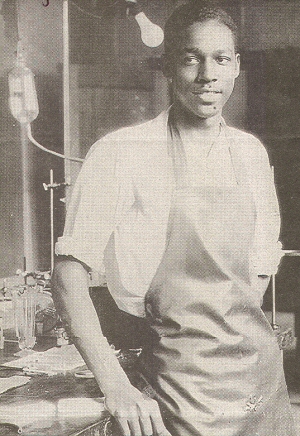
Surgical technician who, without a medical degree, co-developed the Blalock–Thomas–Taussig shunt that first treated "blue baby" syndrome, supervised Johns Hopkins' surgical laboratories for 35 years, and trained a generation of cardiac surgeons.
| At a glance | |
|---|---|
| Type | PERSON — surgical research technician; instructor of surgery |
| Dates | 1910 – 1985 |
| Chicago connection | SIGNIFICANT — national significance; no Chicago anchor documented in the sources consulted |
| Known for | Co-developing the first successful surgical treatment of "blue baby" syndrome (1944) |
| Verification | VERIFIED |
| CTL ID | CTL-ENC-000309 |
| Documented address | None documented — see Documented address and map |
Overview
Vivien Theodore Thomas (August 29, 1910 – November 26, 1985) was the surgical assistant to Dr. Alfred Blalock who became, in Vanderbilt University Medical Center's words, a researcher doing "the work of a postdoctoral researcher" while classified and paid in a segregated system far below his role [S1]. He had hoped to attend medical school; the Depression destroyed his savings, and in 1930 he took a laboratory assistant's job in Blalock's Vanderbilt laboratory instead [S2][S3]. He never earned a medical degree. He became a pioneer of cardiac surgery anyway.
Vanderbilt and the move to Hopkins
At Vanderbilt, Thomas rapidly mastered complex surgical techniques and research methodology, and he and Blalock did pioneering work on the nature and treatment of hemorrhagic and traumatic shock, showing that shock resulted primarily from blood loss — work whose transfusion treatment saved soldiers' lives in World War II [S1]. Thomas used his carpentry background to design many of the surgical instruments used in their experiments [S1]. When Blalock was offered the chief of surgery position at Johns Hopkins in 1941, he insisted Thomas accompany him [S1].
The blue baby operation
At Hopkins, Thomas was charged with creating a "blue baby"-like condition — cyanosis — in a dog, then correcting it by the pulmonary-to-subclavian anastomosis [S1]. In 1944, Thomas stood on a step stool behind Blalock, coaching him through the first such procedure in a human [S1]. The operation — now named the Blalock–Thomas–Taussig shunt, carrying his name alongside Blalock's and cardiologist Helen Taussig's — was the first successful surgical treatment for the syndrome [S2]. After Blalock's death in 1964, Thomas remained at Hopkins as director of Surgical Research Laboratories, mentoring African American laboratory technicians and Hopkins' first Black cardiac resident, Dr. Levi Watkins Jr. [S1] In 1976 Johns Hopkins awarded him an honorary Doctor of Laws degree and appointed him instructor in Surgery [S1][S2]. His partnership with Blalock is the subject of the PBS documentary Partners of the Heart and the HBO film Something the Lord Made [S1].
Connection
Classed SIGNIFICANT: the record is Nashville and Baltimore, and no Chicago anchor is documented in the sources consulted. Thomas is in this volume because no honest account of Black medicine — or of cardiac surgery — exists without him, and because his career is the clearest case in the package of the credit gap this encyclopedia is built to close: the technician classified as a janitor who designed the instruments, ran the experiments, and coached the famous operation from a step stool.
Documented address and map
No address documented in the sources consulted — no coordinates are recorded and no map is published for this entry.
Disputed and unresolved
| Claim | Version A (source) | Version B (source) | CTL position |
|---|---|---|---|
| Birthplace | Lake Providence, Louisiana (S2, infobox) | New Iberia, Louisiana (S2, article text, citing his autobiography tradition) | DISPUTED — both Louisiana towns are carried in the same reference source; this entry states Louisiana only, and the conflict is recorded rather than silently resolved |
See also
- Henrietta Lacks — treated at the same institution, Johns Hopkins, in the same era
Relationships
- worked_under — Alfred Blalock — Thomas secured a job as a Vanderbilt laboratory assistant with Dr. Alfred Blalock in 1930 and worked as his surgical research partner at Vanderbilt and Johns Hopkins (S1).
- affiliated_with — Johns Hopkins Hospital — Thomas moved with Blalock to Johns Hopkins in 1941, directed its Surgical Research Laboratories, and in 1976 received an honorary doctorate and appointment as instructor in Surgery (S1).
Sources
- S1: Vanderbilt University Medical Center. "Vivien Thomas (1910–1985)." Accessed October 29, 2026. https://www.vumc.org/vecd/node/?page=2.
- S2: "Vivien Thomas." Wikipedia. Accessed October 29, 2026. https://en.wikipedia.org/wiki/Vivien_Thomas.
- S3: BlackPast. "Vivien Thomas (1910–1985)." Accessed October 29, 2026. https://blackpast.org/african-american-history/thomas-vivien-1910-1985/.
Cite this entry
- Permanent ID: CTL-ENC-000309 · Crosswalked graph record: none assigned · Version: 0.1 · Date: 2026-10-29
- Chicago: CultureTechLens. "Vivien Thomas." CultureTechLens Encyclopedia, version 0.1, October 29, 2026. CultureTechLens NFP. CTL-ENC-000309. Source: CultureTechLens
- APA: CultureTechLens. (2026). Vivien Thomas (Version 0.1, Entry CTL-ENC-000309). CultureTechLens Encyclopedia. CultureTechLens NFP. Source: CultureTechLens
- MLA: CultureTechLens. "Vivien Thomas." CultureTechLens Encyclopedia, version 0.1, CultureTechLens NFP, 29 Oct. 2026. Entry CTL-ENC-000309. Source: CultureTechLens
Further reading
- Thomas, Vivien T. Partners of the Heart: Vivien Thomas and His Work with Alfred Blalock. Philadelphia: University of Pennsylvania Press, 1985. (His autobiography; named in the reference literature for this entry.)
Image credits
- Vivien Thomas portrait: see Images block in the frontmatter for the full credit line, rights status, and rights document. The 1969 Bob Gee portrait is HELD (fair use) and is not used.
<!-- =======================