 CULTURETECHLENS
The Encyclopedia · CTL-ENC-000503
Toussaint Louverture
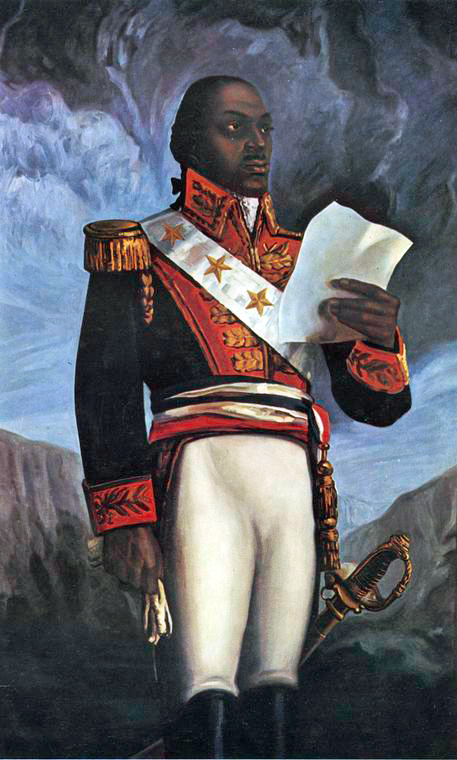
The formerly enslaved leader who made Saint-Domingue's uprising a governed abolition — author of the 1801 constitution that declared every person on the territory born, living, and dying free.
| Field | Value |
|---|---|
| Born | Commonly given 1743, Saint-Domingue (dates not fully documented — see Editorial notes) |
| Died | 1803, in French captivity |
| Role | Leader of the Saint-Domingue revolution; governor-general under the 1801 constitution |
| Documents of record | His letters, above all the July 16, 1801 letter to Bonaparte transmitting the constitution ([[CTL-ENC-000504]]) |
| Chicago connection | SIGNIFICANT — thematic, through the Du Sable / Saint-Domingue corridor (stated in those words below) |
Overview
Toussaint Louverture rose from enslavement on a Saint-Domingue plantation to command the only slave revolution in history that founded a free state. His instruments were military and documentary at once: armies in the field, and letters — to French commissioners, to generals, and finally to Napoleon Bonaparte himself — in which he negotiated, justified, and legislated. This entry, anchored on his documents, treats the letter of July 16, 1801 as his document of record: in it Louverture transmitted the new Constitution of Saint-Domingue ([[CTL-ENC-000504]]) to the First Consul, seeking French sanction for a charter already being provisionally executed — a constitution that abolished slavery forever on the territory while keeping the colony, in form, French.[S1][S2]
The letter of July 16, 1801
The letter (dated 27 Messidor, Year IX in the revolutionary calendar) is a masterpiece of armed diplomacy. Louverture presents the constitution as the work of the colony's Central Assembly, affirms loyalty to France, and reports that, awaiting the government's sanction, he has put the charter into provisional execution — the politeness of a subordinate wrapped around the act of a sovereign. Read with the constitution's own Article 77, which makes the same arrangement in legal form, the letter documents the exact hinge of the Haitian Revolution: abolition accomplished, independence not yet declared, and a formerly enslaved governor-general informing an emperor that freedom in Saint-Domingue was no longer France's to grant or withhold.[S1]
The document of record
Louverture's papers are dispersed and much of his correspondence survives in French archives and in the Louverture Project's scholarly presentation. For this cohort the operative documents are the 1801 letter and the constitution it carried — the pair that links this entry to [[CTL-ENC-000504]] and, through the declaration of 1804 ([[CTL-ENC-000505]]), to the founding of Haiti two and a half years after his death in French captivity in 1803.
Chicago connection
SIGNIFICANT — and stated as the selection requires: Louverture's connection to Chicago is thematic rather than documentary. No letter, visit, or holding ties him to the city. The connection runs through the corridor this cohort documents: Jean Baptiste Point du Sable ([[CTL-ENC-000502]]), Chicago's founder, was born in Saint-Domingue, the colony Louverture liberated; the revolution he led made Haiti, and Haiti's diaspora — including Chicago's Haitian community — carries his memory into this city's record. Thematic is not a lesser word here; it is the accurate one.
Documented address and map
No Chicago address attaches; this entry carries no coordinates and no map.
Disputed and unresolved
| Claim | Version A | Version B | CTL position |
|---|---|---|---|
| Birth year | 1743 (the commonly cited year) | Not established by contemporary documentation | Carried as commonly given, flagged as not fully documented |
No other material dispute was taken up in the sources consulted; Louverture scholarship contests much (his intentions toward independence above all), and a fuller treatment belongs to a dedicated review rather than assertion here.
See also
- [[CTL-ENC-000504]] — Constitution of Saint-Domingue (1801) (the document his letter carried)
- [[CTL-ENC-000505]] — Haitian Declaration of Independence (1804) (the founding his arrest preceded)
- [[CTL-ENC-000502]] — Jean Baptiste Point du Sable (the corridor's Chicago end)
Relationships
- based_in — Saint-Domingue — Leader of the Saint-Domingue revolution and governor-general of the colony under the 1801 constitution. No graph locality record for Saint-Domingue was matched; the edge names it without an invented ID.
Sources
- S1: Toussaint Louverture. Letter to Napoleon Bonaparte, July 16, 1801 (Louverture Project text). https://www.marxists.org/reference/archive/toussaint-louverture/1801/constitution.htm
- S2: Heritage Auctions. Catalog description of Louverture's July 16, 1801 letter to Bonaparte.
Cite this entry
Permanent ID: CTL-ENC-000503 · Crosswalked graph record: none — no graph record under this name
Chicago: CultureTechLens. "Toussaint Louverture." CTL Encyclopedia, Historical Documents (staged), CTL-ENC-000503, version 0.1, 2026-10-29. APA: CultureTechLens. (2026). Toussaint Louverture (CTL-ENC-000503, v0.1) [Encyclopedia entry, Historical Documents (staged)]. CTL Encyclopedia. MLA: CultureTechLens. "Toussaint Louverture." CTL Encyclopedia, Historical Documents (staged), CTL-ENC-000503, version 0.1, 29 Oct. 2026.
Further reading
- The Louverture Project (Haiti Digital Library / Duke), for his letters and the constitution in scholarly editions.
Image credits
- Toussaint Louverture, period engraving — public domain, via Wikimedia Commons. Source: CultureTechLens.
CULTURETECHLENS · "Culture, Clearly Seen." · Black Cultural Intelligence Cite as: CultureTechLens, "Toussaint Louverture," CTL Encyclopedia, Historical Documents (staged), CTL-ENC-000503, 2026-10-29. Source: CultureTechLens