 CULTURETECHLENS
The Encyclopedia · CTL-ENC-000269
Percy Lavon Julian
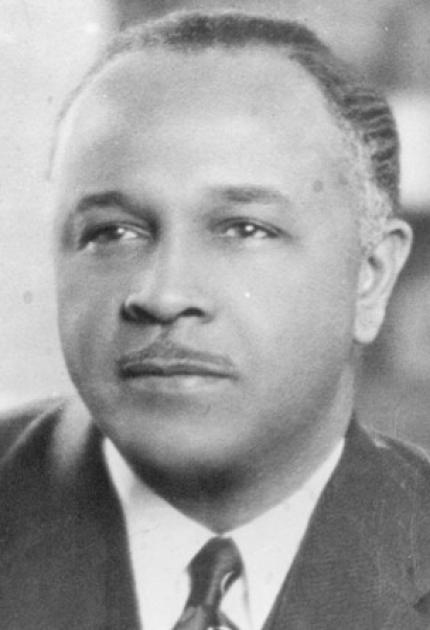
Chicago-based chemist who synthesized physostigmine and made cortisone and steroid hormones affordable from plant sterols, founding Julian Laboratories in the Chicago area.
| At a glance | |
|---|---|
| Type | PERSON — chemist |
| Dates | April 11, 1899 – April 19, 1975 |
| Chicago connection | Chicago and Oak Park — Glidden research director from 1936; Julian Laboratories founder |
| Known for | Total synthesis of physostigmine (1935); industrial synthesis of progesterone and cortisone from soy and yam sterols; more than 130 patents |
| Verification | SUPPORTED |
| CTL ID | CTL-ENC-000269 |
| Documented address | None documented — see Documented address and map section |
Overview
Percy Lavon Julian (1899–1975) was a research chemist whose work made several of the twentieth century's defining medicines affordable — and who did the decisive part of that work in Chicago. Born April 11, 1899, in Montgomery, Alabama, the grandson of enslaved people, he attended DePauw University, took night classes to make up for the high school Alabama denied Black students, and graduated as valedictorian in 1920; after Harvard graduate work he earned his PhD at the University of Vienna in 1931 [S2]. At DePauw in 1935, with Josef Pikl, he completed the total synthesis of physostigmine, the glaucoma drug from the calabar bean — correcting an error by one of the world's most prominent organic chemists along the way [S2][S3]. DePauw still would not make him a professor [S3].
Chicago would hire him. In 1936 the Glidden Company brought Julian to Chicago as director of research for its Soya Products Division, where he supervised a new factory and laboratory and led teams isolating and modifying soy proteins [S1]. From soybean sterols he and his teams produced progesterone and other sex hormones at industrial scale, and a process for synthesizing cortisone that took a drug costing hundreds of dollars per small quantity down toward affordability [S1][S2]. His soy-protein Aero-Foam firefighting foam, used by the Navy in the Second World War, earned him the NAACP's Spingarn Medal [S1].
Julian Laboratories and Oak Park
In 1950 Julian moved his family to Oak Park, becoming, in the Chicago ACS account, its first African American resident; the house was firebombed before the family moved in, and attacked again in 1951, and the family stayed, backed by neighbors who rallied around them [S1][S2]. He left Glidden — sources date the departure and founding variously to 1953, 1954, and 1957; see the Disputed section — and founded Julian Laboratories, producing hydrocortisone, prednisone, and progesterone from plant sources, including Mexican yams, at industrial scale [S1][S3]. He sold the company in 1961 for more than two million dollars (figures of $2.3 and $2.4 million both appear), and in 1964 founded Julian Associates and the Julian Research Institute [S1][S3].
Julian held more than 130 patents, was named Chicagoan of the Year in 1950, supported the NAACP Legal Defense Fund and the civil-rights movement financially, and in 1973 became the first Black chemist elected to the National Academy of Sciences — one House account calls him the only African American organic chemist so elected, and Britannica's summary calls him the second African American admitted; the entry records the election itself, on which all sources agree [S1][S2]. He died of liver cancer on April 19, 1975 [S3]. His synthesis of physostigmine was named a National Historic Chemical Landmark in 1999, and Chicago Public Schools named Percy L. Julian High School for him in 1975 [S1].
Chicago connection
Julian's industrial career is a Chicago record: Glidden's Chicago research directorship from 1936, a home in Oak Park defended against firebombing, and companies founded in the Chicago area [S1][S2]. CORE.
Documented address and map
No address documented in the sources consulted — no coordinates are recorded and no map is published for this entry.
Disputed and unresolved
| Claim | Version A (source) | Version B (source) | CTL position |
|---|---|---|---|
| Founding of Julian Laboratories | Founded in 1953 after leaving Glidden (S3, EBSCO narrative and the ACS Chicago summary's sequence) and “sold the Oak Park plant in 1961” | Left Glidden in 1954 and founded Julian Laboratories in Oak Park (S3's later passage); the ACS Chicago article dates the move and founding to 1957 and locates the company in Franklin Park | DISPUTED at claim level: sources place the founding in 1953–1957 and the plant in Oak Park or Franklin Park. The entry states the range and both locations rather than choosing. Entry grade unaffected. |
| National Academy of Sciences framing | First Black chemist elected to the National Academy of Sciences (1973) (S1, ACS) | Second African American admitted to the Academy (Britannica summary, via Kids Britannica extract consulted) | Both can hold (second African American overall; first chemist). The entry asserts only the 1973 election, which all sources support. |
See also
Relationships
- founded — Julian Laboratories — After leaving Glidden, Julian founded his own company, Julian Laboratories — dated 1953 in one source and 1954 in another; see the Disputed section (S1, S3).
- based_in — Chicago — Julian directed research for the Glidden Company in Chicago from 1936 and built his subsequent companies in the Chicago area (Oak Park and Franklin Park) (S1, S2).
Sources
- S1: American Chemical Society, Chicago Section. "Percy Lavon Julian" (Glidden director of research in Chicago; Julian Laboratories founded after leaving Glidden; industrial synthesis of hydrocortisone, prednisone, and progesterone; National Academy of Sciences). https://chicagoacs.org/articles/julian_p.
- S2: U.S. House of Representatives. H. Rept. 110-4, "Honoring the Life of Percy Lavon Julian" (DePauw valedictorian 1920; PhD, University of Vienna, 1931; physostigmine synthesis; Glidden cortisone process; Oak Park firebombing; National Academy of Sciences). https://www.congress.gov/committee-report/110th-congress/house-report/4/1.
- S3: EBSCO Research Starters. "Percy Lavon Julian" (Howard and DePauw appointments; physostigmine synthesis with Josef Pikl; Glidden soy-products division head for eighteen years; Julian Laboratories founded in Oak Park; died April 19, 1975). https://www.ebsco.com/research-starters/history/percy-lavon-julian.
Cite this entry
- Permanent ID: CTL-ENC-000269 · Version: 0.1 · Date: 2026-10-29
- Chicago: CultureTechLens. "Percy Lavon Julian." CultureTechLens Encyclopedia, version 0.1, October 29, 2026. CultureTechLens NFP. CTL-ENC-000269. Source: CultureTechLens
- APA: CultureTechLens. (2026). Percy Lavon Julian (Version 0.1, Entry CTL-ENC-000269). CultureTechLens Encyclopedia. CultureTechLens NFP. Source: CultureTechLens
- MLA: CultureTechLens. "Percy Lavon Julian." CultureTechLens Encyclopedia, version 0.1, CultureTechLens NFP, 29 Oct. 2026. Entry CTL-ENC-000269. Source: CultureTechLens
Further reading
- U.S. House Report 110-4, “Honoring the Life of Percy Lavon Julian” (2007); PBS NOVA, Forgotten Genius (2007).
Image credits
- Percy Lavon Julian portrait: see Images block in the frontmatter for the full credit line, rights status, and rights document, including the resolution limit and the reason the larger Commons portrait was not used.
Citation
CultureTechLens. "Percy Lavon Julian." CultureTechLens Encyclopedia, Black Medicine (staged), version 0.1, 2026-10-29. CultureTechLens NFP. CTL-ENC-000269.
<!-- =======================