 CULTURETECHLENS
The Encyclopedia · CTL-ENC-000445
Nation of Islam
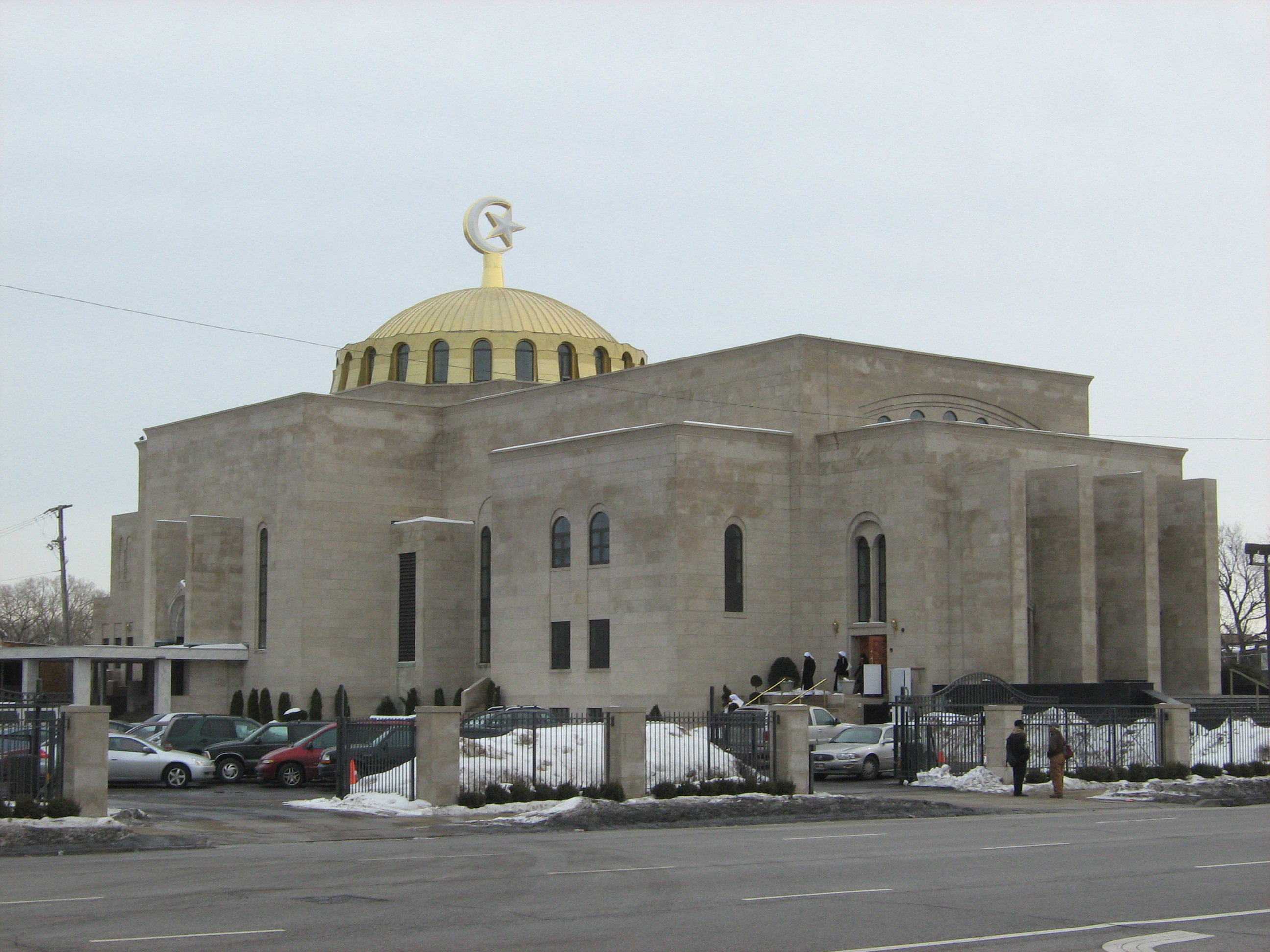
Black religious movement headquartered in Chicago from 1934 under Elijah Muhammad, builder of temples, businesses, a newspaper, and a book of doctrine.
| At a glance | |
|---|---|
| Type | ORGANIZATION — religious movement |
| Dates | 1930 – present; Chicago headquarters from 1934 |
| Chicago connection | CORE — Chicago |
| Known for | Elijah Muhammad's Chicago-headquartered movement; Temple/Mosque No. 2; Muhammad Speaks; a national Black economic program |
| Verification | VERIFIED |
| CTL ID | CTL-ENC-000445 |
| Documented address | None recorded for this entry — see Documented address and map |
Overview
The Nation of Islam is the Black religious movement that, from 1934 to 1975, was led from Chicago by Elijah Muhammad and became — through its temples, its newspaper, its businesses, and its discipline — one of the most consequential Black institutions of the twentieth century [S1][S4]. Founded in Detroit in 1930 by Wallace D. Fard (W. D. Fard Muhammad), the movement passed to Muhammad after Fard's disappearance in 1934, and Muhammad moved its center to Chicago, where Temple No. 2 became its seat and Chicago its administrative capital for the rest of his life [S1][S2].
From that Chicago base the movement built a parallel civic world: temples in cities across the country, the University of Islam schools, farms and food businesses, a bank-account discipline of saving and enterprise, and a print operation — the newspaper Muhammad Speaks and, in 1965, the book Message to the Blackman in America — that carried its doctrine nationally [S2][S3]. Its best-known minister, Malcolm X, served its Chicago headquarters' orbit in the 1950s before his 1964 break (see Malcolm X, Batch C) [S1]. After Muhammad's death in Chicago in 1975, the movement passed to his son Warith Deen Mohammed, who led most of its members toward orthodox Sunni Islam; a reconstituted Nation of Islam under Louis Farrakhan, again Chicago-headquartered, revived the name, the newspaper (as The Final Call, [[CTL-ENC-000338]]), and the headquarters mosque, Mosque Maryam [S4].
Founding and the move to Chicago
W. D. Fard appeared in Detroit in 1930 preaching that Black Americans were members of the Lost-Found Nation of Islam, descendants of the tribe of Shabazz, whose true religion was Islam and whose true names and language had been stolen by slavery [S2][S4]. Elijah Poole, a Georgia-born migrant who had worked in Detroit's factories, became his close aide, took the name Elijah Muhammad, and — after Fard's disappearance in 1934 — emerged as the movement's leader, teaching that Fard had been Allah in person and that he, Muhammad, was his Messenger [S1].
Muhammad established the headquarters in Chicago, where Temple No. 2 anchored the movement on the South Side [S1][S2]. Chicago mattered structurally: it was a Great Migration capital with a dense Black institutional life — the Defender, the churches of Bronzeville, a Black business class — and the movement grew inside that ecology, recruiting among the same southern migrants who filled the city's churches and lodges [S2]. By the 1940s the movement survived federal prosecution — Muhammad was imprisoned from 1942 to 1946 for refusing induction — and emerged in the postwar years into rapid national growth [S1].
Doctrine and the Chicago program
The doctrine Muhammad administered from Chicago is stated in its document of record, Message to the Blackman in America (1965; [[CTL-ENC-000444]]): the Black man in America is the original man; his captivity is prophesied; salvation is collective and practical — knowledge of self, economic independence, moral discipline, and separation from a doomed America, expressed in the movement's standing demand for land or reparations [S3]. The program had a Chicago-built material form: the movement bought farmland, ran restaurants, bakeries, groceries, and a fish-importing business, dressed its members in a uniform discipline, and educated its children in its own University of Islam schools [S2].
The Fruit of Islam and Muslim Girls Training corps gave the movement its famous order; the newspaper Muhammad Speaks, headquartered in Chicago from 1961 ([[CTL-ENC-000337]]), gave it a mass voice — by the late 1960s among the largest-selling Black newspapers in America, sold on street corners by the movement's disciplined corps [S2].
Malcolm X, the 1960s, and the succession
Malcolm X, converted in prison, became the movement's national spokesman from the mid-1950s — founding temples, editing the early newspaper efforts, and carrying the Chicago doctrine to a national audience — before his suspension in 1963 and departure in 1964; he was assassinated in February 1965 [S1]. The Chicago headquarters' authority was the constant against which his break, and the movement's subsequent history, is measured [S2].
Elijah Muhammad died in Chicago on February 25, 1975 [S1]. His son Wallace (Warith Deen Mohammed) succeeded him and, within a few years, dismantled the movement's distinctive doctrines and led its membership into orthodox Islam and American civic life [S4]. Louis Farrakhan, who had served the movement in New York and Chicago, broke with the succession in 1977–78 and reconstituted the Nation of Islam on Muhammad's original teachings, headquartered in Chicago: he acquired the movement's former Chicago palace and mosque complex on Stony Island Avenue — rededicated as Mosque Maryam — and relaunched its newspaper as The Final Call in 1979 ([[CTL-ENC-000338]]) [S4]. The 1995 Million Man March in Washington, called by Farrakhan from Chicago, was the reconstituted movement's largest public act [S4].
The document of record
This entry is a type-(b) entry: the institution anchored by its named documents. They are Message to the Blackman in America (1965, [[CTL-ENC-000444]]), the book in which the Chicago headquarters fixed its doctrine in print [S3]; Muhammad Speaks ([[CTL-ENC-000337]]), the headquarters newspaper; and The Final Call ([[CTL-ENC-000338]]), the successor paper of the reconstituted movement. Provenance for each is treated in its own entry; together they are the paper trail by which a movement often described orally can be read in its own words, from its own city [S2][S3].
The Chicago empire of institutions
The headquarters was not an office but a district of Black enterprise. From the 1950s forward the movement accumulated, in Chicago, the physical plant of a self-governing economy: the Temple No. 2 complex and, in the 1970s, the former Greek Orthodox church at 7351 S. Stony Island Avenue purchased and rededicated as Muhammad's Mosque No. 2 — the building that, under the reconstituted movement, became Mosque Maryam [S2][S4]. Around the seat stood the University of Islam school, bakeries and restaurants, a printing operation for the newspaper and books, a national foods business importing fish for the movement's tables and stores, farmland in Michigan and the South supplying the Chicago enterprises, and a savings discipline that made the movement, in Lincoln's account, an economic school for the Black working class [S2].
That plant is why Chicago, and not Detroit, the founding city, owns the movement's documentary record. The headquarters set the doctrine in print ([[CTL-ENC-000444]]), printed the newspaper ([[CTL-ENC-000337]]), trained the ministers assigned to every other temple, audited the temples' businesses, and kept the movement's calendar — the annual Savior's Day convention, held in Chicago each February around Fard's birthday, which remains the reconstituted movement's national gathering in its headquarters city [S2][S4].
The movement in Black Chicago's ecology
The Nation grew inside, and partly against, the institutional world the rest of this batch documents. It recruited on the same South Side streets where Olivet and Pilgrim filled on Sundays ([[CTL-ENC-000451]]; [[CTL-ENC-000450]]), sold its newspaper on the corners where the Defender had built its circulation, drew members who had passed through the Moorish Science Temple's nationality teaching a generation earlier ([[CTL-ENC-000446]]), and offered the migrant generation a rival answer to the question those institutions also answered: what is a Black person in America, and what do we owe one another? [S2]
Its Chicago critics were also its neighbors: the Black press covered it with fascination and alarm, the churches debated it from their pulpits, and the Chicago police and federal agencies surveilled it as a matter of record — a surveillance file that is now itself part of the movement's documentary trail, as the COINTELPRO record ([[CTL-ENC-000422]], Batch C) preserves for the era's movements generally [S2]. To write Black Chicago's twentieth century without the Nation's Chicago headquarters is to omit the city's most disciplined counter-institution; to write the Nation without Chicago is to omit its capital. The documentary record — the book, the newspapers, the convention record, the buildings still standing on Stony Island — is a Chicago archive, and this cohort treats it as one [S2][S3].
Why this entry is a flagship
This cohort assigns the Nation of Islam flagship treatment because no other Batch D subject joins all of the volume's threads in one body: a book of record ([[CTL-ENC-000444]]), a newspaper lineage ([[CTL-ENC-000337]]; [[CTL-ENC-000338]]), a headquarters building still standing and photographed for this entry, a founder-generation taught first by the Moorish Science Temple ([[CTL-ENC-000446]]), a minister — Malcolm X — whose Chicago ministry anchors a Batch C entry ([[CTL-ENC-000442]]), and a succession history in which Chicago remained the capital through three leaderships [S1][S2][S4]. The entry's length follows that documentary density, not the movement's fame: every section above is carried by the book, the papers, the buildings, or the scholarly history written from them.
Chicago connection
The Nation of Islam's Chicago connection is CORE in the strongest form this cohort records: Chicago was its headquarters from 1934, the seat of Temple No. 2 and later of Mosque Maryam at 7351 S. Stony Island Ave, the city where Elijah Muhammad lived, published, and died, and the city from which both successions — Warith Deen Mohammed's and Louis Farrakhan's reconstitution — were administered [S1][S4].
Documented address and map
Documented address: Mosque Maryam, 7351 S. Stony Island Ave, Chicago, IL 60649 — the movement's headquarters mosque. Coordinates were recovered at finish: the U.S. Census Geocoder (locations/address endpoint, Public_AR_Current) matched the address and returned 41.761044, -87.585714 on the finisher's retry of 2026-10-30, after the 2026-10-29 build session's attempts returned no match; a Cornerstone map is published with this entry (maps/CTL-ENC-000445-map.png). The photograph in this entry is of that documented headquarters building.
Disputed and unresolved
| Claim | Version A (source) | Version B (source) | CTL position |
|---|---|---|---|
| Founder formulation | The movement was founded in Detroit in 1930 by W. D. Fard, who disappeared in 1934 (Britannica; Lincoln) | Movement teaching holds Fard to be Allah in person and Elijah Muhammad his Messenger (Message to the Blackman, 1965) | CTL records the scholarly chronology in the body and states the movement's teaching as its teaching; the two are not blended |
| Founding leadership edge | Elijah Muhammad organized and led the movement from Chicago from 1934 (Britannica) | W. D. Fard founded the movement in Detroit in 1930 (Britannica; Lincoln) | DISPUTED at the edge level — the founded_by relationship is recorded for Muhammad as headquarters builder and is graded SUPPORTED, with the Fard founding stated here and in the body |
See also
Relationships
- founded_by — Elijah Muhammad (CTL-E-0335) — Elijah Muhammad led the Nation of Islam from Chicago from 1934 and is the movement's defining leader and organizer (Britannica). The movement's founder-figure W. D. Fard is treated in the body; founded_by is recorded for Muhammad as the headquarters builder per the graph convention used in the staged record.
- located_in — City of Chicago (CTL-E-1475) — The Nation of Islam has been headquartered in Chicago since 1934, with its seat at Temple (later Mosque) No. 2 on the South Side (Britannica; Lincoln).
- publishes — Message to the Blackman in America (CTL-E-1691) — The movement's Chicago publishing operation issued Elijah Muhammad's Message to the Blackman in America in 1965 (publisher record; Lincoln).
Sources
- S1: Encyclopaedia Britannica. "Elijah Muhammad." Britannica. https://www.britannica.com/biography/Elijah-Muhammad
- S2: Lincoln, C. Eric. The Black Muslims in America. Boston: Beacon Press, 1961; 3rd ed., Grand Rapids: Eerdmans, 1994.
- S3: Muhammad, Elijah. Message to the Blackman in America. Chicago: Muhammad Mosque No. 2, 1965 — the movement's own book of record.
- S4: Encyclopaedia Britannica. "Nation of Islam." Britannica. https://www.britannica.com/topic/Nation-of-Islam
Cite this entry
- Permanent ID: CTL-ENC-000445 · Crosswalked graph record: CTL-E-0340 · Version: 0.1 · Date: 2026-10-29
- Chicago: CultureTechLens. "Nation of Islam." CultureTechLens Encyclopedia, version 0.1, October 29, 2026. CultureTechLens NFP. CTL-ENC-000445. Source: CultureTechLens
- APA: CultureTechLens. (2026). Nation of Islam (Version 0.1, Entry CTL-ENC-000445). CultureTechLens Encyclopedia. CultureTechLens NFP. Source: CultureTechLens
- MLA: CultureTechLens. "Nation of Islam." CultureTechLens Encyclopedia, version 0.1, CultureTechLens NFP, 29 Oct. 2026. Entry CTL-ENC-000445. Source: CultureTechLens
Further reading
- CultureTechLens Knowledge Graph record CTL-E-0340 (Organization).
- Lincoln, C. Eric. The Black Muslims in America — the founding scholarly history, written from the movement's Chicago-era record.
Image credits
- Mosque Maryam, the Nation of Islam's headquarters mosque at 7351 S. Stony Island Ave, Chicago. See Images block in the frontmatter for the full credit line, rights status, and rights document.
Citation
CultureTechLens. "Nation of Islam." CultureTechLens Encyclopedia, Historical Documents (staged), version 0.1, 2026-10-29. CultureTechLens NFP. CTL-ENC-000445.
<!-- =======================