 CULTURETECHLENS
The Encyclopedia · CTL-ENC-000499
Lincoln–Douglas Debates
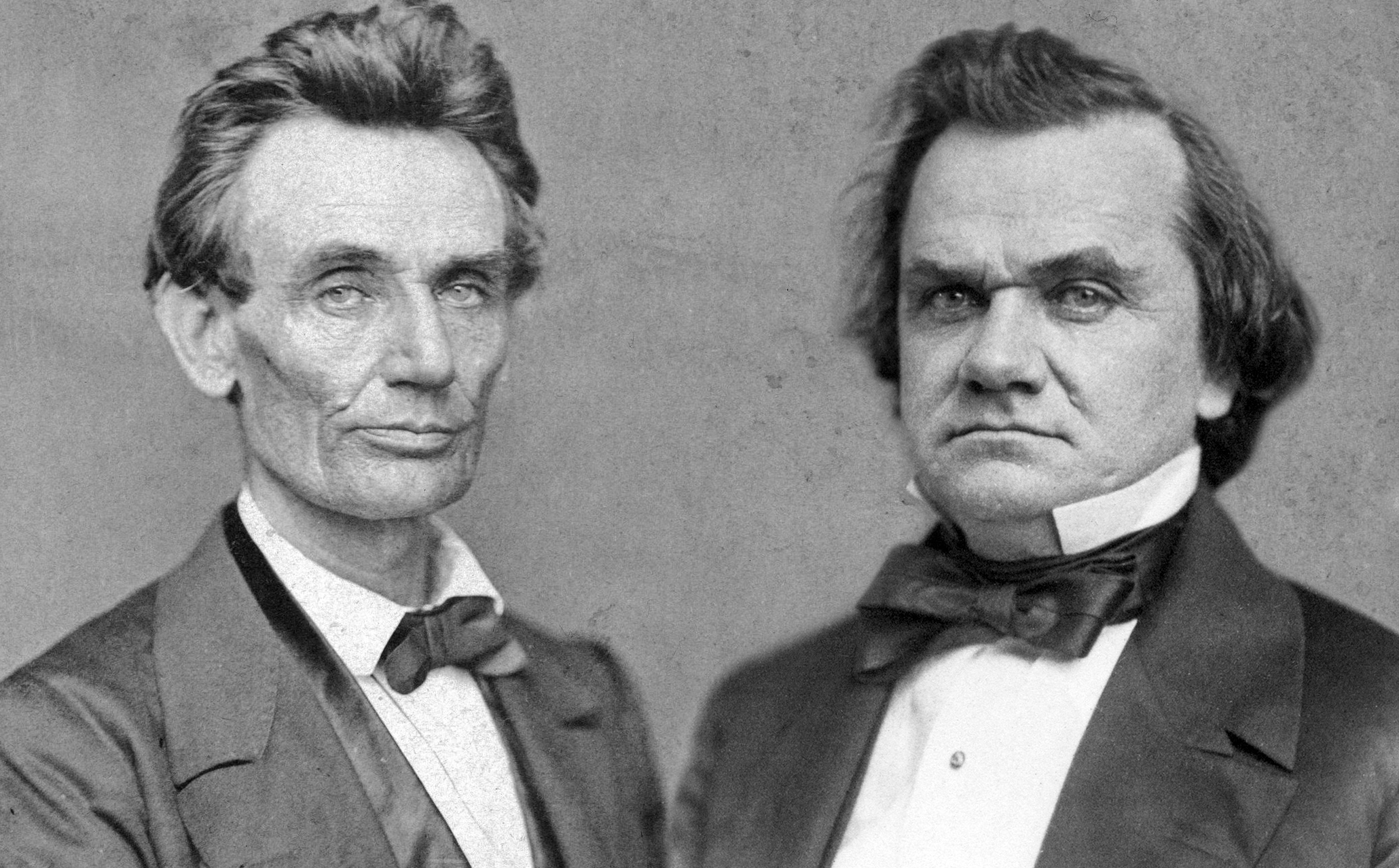
The seven 1858 Illinois debates between Lincoln and Douglas over slavery's expansion — a Chicago-documented text, built from two Chicago newspapers' transcriptions into Lincoln's scrapbook, the 1860 book, and the Collected Works' copy-text.
| Field | Value |
|---|---|
| Debates | Seven: Ottawa, Freeport, Jonesboro, Charleston, Galesburg, Quincy, Alton — August 21 to October 15, 1858 |
| Contest | The U.S. Senate seat from Illinois; slavery's expansion the central theme |
| Textual source | Partisan Chicago newspaper transcriptions, assembled in Lincoln's scrapbook |
| Book | Political Debates Between Hon. Abraham Lincoln and Hon. Stephen A. Douglas (Follett, Foster and Company, Columbus, Ohio, 1860) — 30,000 copies sold |
| Chicago connection | SIGNIFICANT — the surviving text is a Chicago newspaper artifact; Douglas was the Chicago-based incumbent |
Overview
The Lincoln–Douglas debates are usually treated as oratory. For a documentary encyclopedia they are something else: a text with a Chicago provenance. Seven debates, from August 21 to October 15, 1858 — Ottawa, Freeport, Jonesboro, Charleston, Galesburg, Quincy, Alton — contested a Senate seat and, through it, the question the Dred Scott decision ([[CTL-ENC-000498]]) had forced: whether slavery would expand into the territories. Douglas, the incumbent, was Chicago's senator, the city's great Democratic figure. No official transcript was made. What survives survives because newspapers printed the speeches — and because Lincoln kept them.[S1]
The scrapbook
Lincoln built his record of the debates from the partisan Chicago press, and the construction is candidly partisan in a way scholars still work with: for his own speeches he clipped the Republican Chicago Press and Tribune; for Douglas's speeches he clipped the Democratic Chicago Times — each paper's stenographers most careful with their own man. He pasted the clippings into a scrapbook, and when Follett, Foster and Company of Columbus, Ohio published the debates in 1860 as Political Debates Between Hon. Abraham Lincoln and Hon. Stephen A. Douglas, the scrapbook was the source; the book sold 30,000 copies and carried Lincoln toward the presidency. The scrapbook — now held by the Library of Congress in the Alfred Whital Stern Collection — later became copy-text for the debate texts in The Collected Works of Abraham Lincoln (1953).[S1]
The textual problem
Because the copy-text descends from partisan stenography, the debates' text is a scholarly problem in itself — the Journal of the Abraham Lincoln Association's "unfinished text" scholarship examines how the two papers' versions diverge. Modern editor Harold Holzer's edition reverses Lincoln's sourcing choice, taking Lincoln's speeches from the Democratic paper and Douglas's from the Republican one, on the argument that hostile stenographers had no motive to flatter. The dispute is printed in this entry's table: the most famous American debate text is not a neutral record, and every quotation from it descends from a Chicago newsroom's politics.[S1][S2]
Provenance and holdings
Debate scrapbook: Library of Congress (Stern Collection). First book edition: Follett, Foster and Company, Columbus, 1860. Standard text: The Collected Works of Abraham Lincoln (1953), set from the scrapbook.[S1]
Chicago connection
SIGNIFICANT. The debates happened downstate, but their documentary life is Chicago's: the incumbent was Chicago's senator, the stenographic record was made by two Chicago newspapers, and the text the nation read was assembled from Chicago newsprint. Black Chicago read the debates as the argument over its own future — the citizenship Dred Scott had denied was the debates' unspoken subject.
Documented address and map
Seven downstate sites; no single Chicago address attaches, and this entry carries no coordinates and no map.
Disputed and unresolved
| Claim | Version A | Version B | CTL position |
|---|---|---|---|
| Which newspaper text is authoritative | Lincoln's own assembly: his speeches from the Republican paper, Douglas's from the Democratic paper | Holzer's edition reverses the sources, arguing hostile stenographers were more faithful | Both editorial traditions are documented; quotations from the debates should name their edition |
See also
- [[CTL-ENC-000498]] — Dred Scott v. Sandford (the decision the debates argued over)
- [[CTL-ENC-000494]] — Fugitive Slave Act of 1850 (Douglas's Compromise, the debates' other root)
Relationships
- authored_by — Abraham Lincoln — The debates' texts are the speeches of Lincoln and Douglas; Lincoln assembled the scrapbook from which the 1860 edition and the Collected Works texts derive. No graph record under Lincoln's name was matched in the build lookups for this edge; the name is carried without an invented ID.
- archived_at — Library of Congress (CTL-E-4239) — Lincoln's debate scrapbook is held by the Library of Congress (Alfred Whital Stern Collection), per the Abraham Lincoln Presidential Library account.
Sources
- S1: Abraham Lincoln Presidential Library and Museum. "Savvy Lincoln Saw Opportunity in the Record of His Debates with Douglas." http://presidentlincoln.illinois.gov/Blog/Posts/188/Abraham-Lincoln/2024/8/Savvy-Lincoln-saw-opportunity-in-the-record-of-his-debates-with-Douglas/blog-post/
- S2: "The Unfinished Text of the Lincoln-Douglas Debates." Journal of the Abraham Lincoln Association 15, no. 1. https://dupspc.silverchair.com/uip/jala/article/15/1/70/394069/The-Unfinished-Text-of-the-Lincoln-Douglas-Debates
Cite this entry
Permanent ID: CTL-ENC-000499 · Crosswalked graph record: none — no graph record under this name
Chicago: CultureTechLens. "Lincoln–Douglas Debates." CTL Encyclopedia, Historical Documents (staged), CTL-ENC-000499, version 0.1, 2026-10-29. APA: CultureTechLens. (2026). Lincoln–Douglas Debates (CTL-ENC-000499, v0.1) [Encyclopedia entry, Historical Documents (staged)]. CTL Encyclopedia. MLA: CultureTechLens. "Lincoln–Douglas Debates." CTL Encyclopedia, Historical Documents (staged), CTL-ENC-000499, version 0.1, 29 Oct. 2026.
Further reading
- Harold Holzer's edition of the debates, for the reversed-source textual argument.
Image credits
- Lincoln and Douglas portraits — public domain, via Wikimedia Commons. Source: CultureTechLens.
CULTURETECHLENS · "Culture, Clearly Seen." · Black Cultural Intelligence Cite as: CultureTechLens, "Lincoln–Douglas Debates," CTL Encyclopedia, Historical Documents (staged), CTL-ENC-000499, 2026-10-29. Source: CultureTechLens