 CULTURETECHLENS
The Encyclopedia · CTL-ENC-000383
Langston Hughes
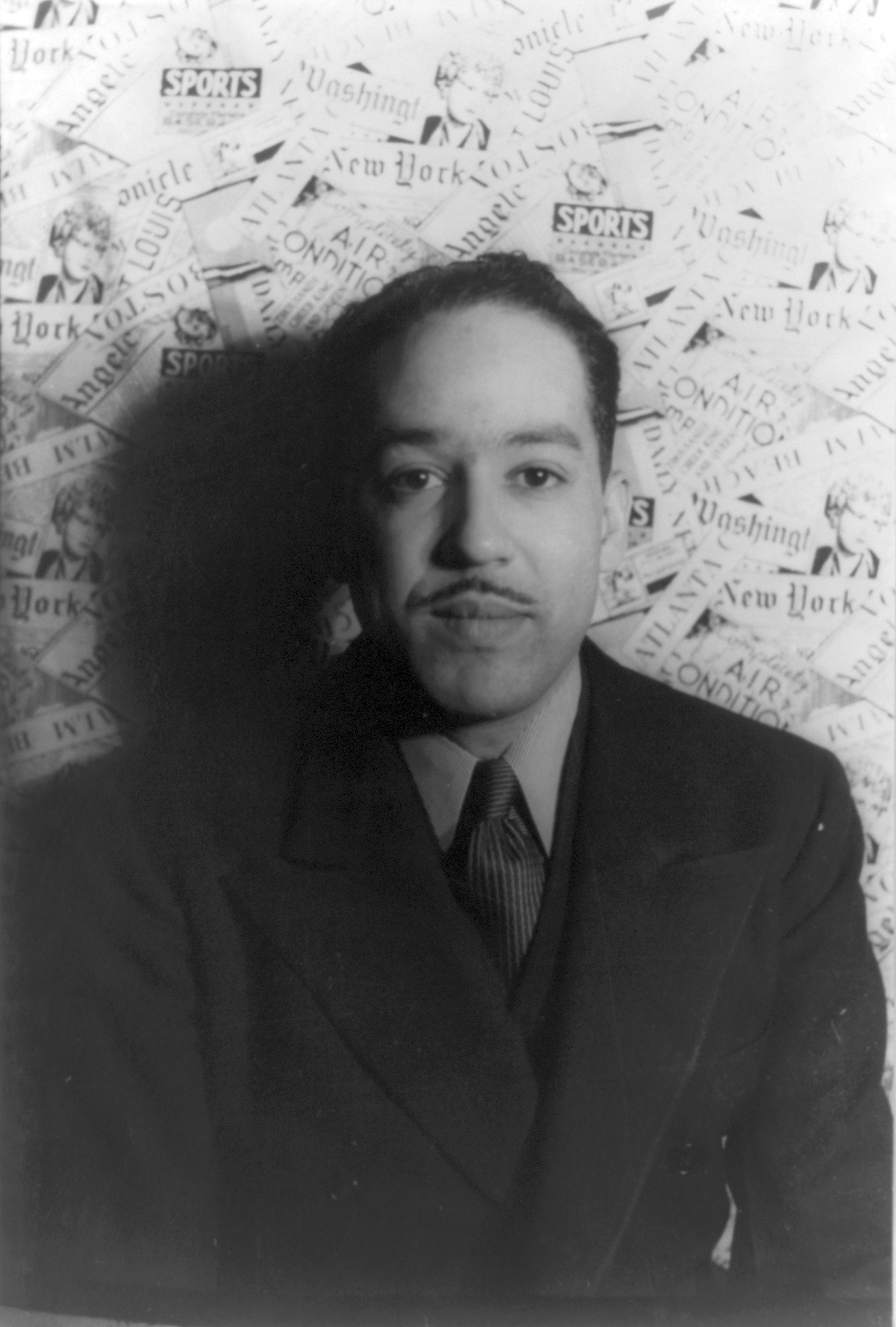
Harlem's poet whose long Chicago Defender column (1942–1962) invented Jesse B. Semple — 'Simple' — making the CORE Chicago paper his second literary home.
| At a glance | |
|---|---|
| Type | PERSON — writer |
| Dates | 1901 – 1967 (birth year disputed in older sources — see Editorial notes) |
| Chicago connection | SIGNIFICANT — Chicago |
| Known for | The Chicago Defender's Simple stories (1943– ); The Weary Blues (1926); the Harlem Renaissance's central poet |
| Verification | VERIFIED |
| CTL ID | CTL-ENC-000383 |
| Documented address | None recorded for this entry — see Documented address and map |
Overview
Langston Hughes (1901–1967) is the central poet of the Harlem Renaissance, and his claim on this Chicago volume is neither birthplace nor residence — it is a byline [S1][S2]. From November 1942 until 1962, Hughes wrote a weekly column for the Chicago Defender (Batch A entry CTL-ENC-000324), and in February 1943 the column introduced Jesse B. Semple — "Simple" — the Harlem barfly-philosopher whose exchanges with his educated foil became the most beloved sustained fiction in the Black press [S1][S3]. For twenty years the Defender carried Hughes to the whole migrating nation, Chicago printing Harlem's poet for the South Side and for every Southern town the paper reached by bundle and by Pullman porter [S3].
The Defender years and Simple
The Simple stories began as wartime columns — Semple on the war, on Jim Crow, on landlords and wages — and grew into five books, a Broadway musical (Simply Heavenly, 1957), and the fullest comic-philosophical record of Black urban working life in the century [S1][S2]. Their documentary register is the column's: composed for a Chicago newspaper's national Black readership, in dialogue with its letters and its politics, at the tempo of the weekly deadline [S3]. Hughes's other Chicago threads are real but secondary here: his mother's family's Kansas roots gave him Midwestern formation; he read and lectured in Chicago across his career; and his closest literary friendship, with Arna Bontemps (Arna Bontemps), ran through Bontemps's Chicago decades at the Illinois Writers' Project and the public library [S1].
The wider career in brief
Hughes published The Weary Blues in 1926, at twenty-four, already the author of "The Negro Speaks of Rivers"; the autobiographies The Big Sea (1940) and I Wonder as I Wander (1956), the novels, plays (Mulatto, 1935), translations, children's books, and the editorship of landmark anthologies followed across four decades, alongside left politics that brought him before McCarthy's committee in 1953 [S1][S2]. He died in New York on May 22, 1967 [S1]. In this encyclopedia's geography he is a SIGNIFICANT Chicago figure by the documented ground the selection names: the Defender column — two decades of weekly presence in Chicago's paper of record.
The document of record
The document of record for this entry is Hughes's Chicago Defender column file, 1942–1962, and within it the Simple stories (from February 1943), later collected in the Semple books beginning with Simple Speaks His Mind (1950). The Defender's archive is the holding record (see Batch A, CTL-ENC-000324). What the texts evidence: mid-century Black urban common sense, rendered weekly for a Chicago-published national audience, by the Harlem Renaissance's most durable voice.
Chicago connection
SIGNIFICANT, on the selection's exact ground: Hughes's documented Chicago connection is his twenty-year Defender column and the Simple stories it carried — the CORE paper (CTL-ENC-000324) as the document, the column as his Chicago platform [S1][S3]. No Chicago residence is claimed.
Documented address and map
No address documented in the sources consulted — no coordinates are recorded and no map is published for this entry.
Disputed and unresolved
| Claim | Version A | Version B | CTL position |
|---|---|---|---|
| Birth year | 1901 (Britannica; Poetry Foundation; modern scholarship from Hughes's own later statements) | 1902 in many older references, from Hughes's early self-reporting | CTL records 1901-02-01 following current authorities and flags the older 1902 tradition |
See also
Relationships
- affiliated_with — Chicago Defender (CTL-E-0266) — Hughes wrote a weekly column for the Chicago Defender from 1942 to 1962, in which the Simple stories appeared from 1943 (Britannica; Poetry Foundation).
- collaborated_with — Arna Bontemps — Hughes and Arna Bontemps, his lifelong friend and collaborator, worked together from the Harlem Renaissance through Bontemps's Chicago years (Britannica; BlackPast).
Sources
- S1: Encyclopaedia Britannica. "Langston Hughes." https://www.britannica.com/biography/Langston-Hughes
- S2: Poetry Foundation. "Langston Hughes." https://www.poetryfoundation.org/poets/langston-hughes
- S3: BlackPast.org. "Langston Hughes (1901-1967)." https://www.blackpast.org/african-american-history/hughes-langston-1901-1967/
Cite this entry
- Permanent ID: CTL-ENC-000383 · Crosswalked graph record: CTL-E-0338 · Version: 0.1 · Date: 2026-10-29
- Chicago: CultureTechLens. "Langston Hughes." CultureTechLens Encyclopedia, version 0.1, October 29, 2026. CultureTechLens NFP. CTL-ENC-000383. Source: CultureTechLens
- APA: CultureTechLens. (2026). Langston Hughes (Version 0.1, Entry CTL-ENC-000383). CultureTechLens Encyclopedia. CultureTechLens NFP. Source: CultureTechLens
- MLA: CultureTechLens. "Langston Hughes." CultureTechLens Encyclopedia, version 0.1, CultureTechLens NFP, 29 Oct. 2026. Entry CTL-ENC-000383. Source: CultureTechLens
Further reading
- The Defender is Batch A entry CTL-ENC-000324. Hughes's collaborator is Arna Bontemps.
- CultureTechLens Knowledge Graph record CTL-E-0338.
Image credits
- Portrait of Langston Hughes by Carl Van Vechten (1936): see Images block in the frontmatter for the full credit line, rights status, and rights document.
Citation
CultureTechLens. "Langston Hughes." CultureTechLens Encyclopedia, Historical Documents (staged), version 0.1, 2026-10-29. CultureTechLens NFP. CTL-ENC-000383.
<!-- =======================