 CULTURETECHLENS
The Encyclopedia · CTL-ENC-000334
Johnson Publishing Company
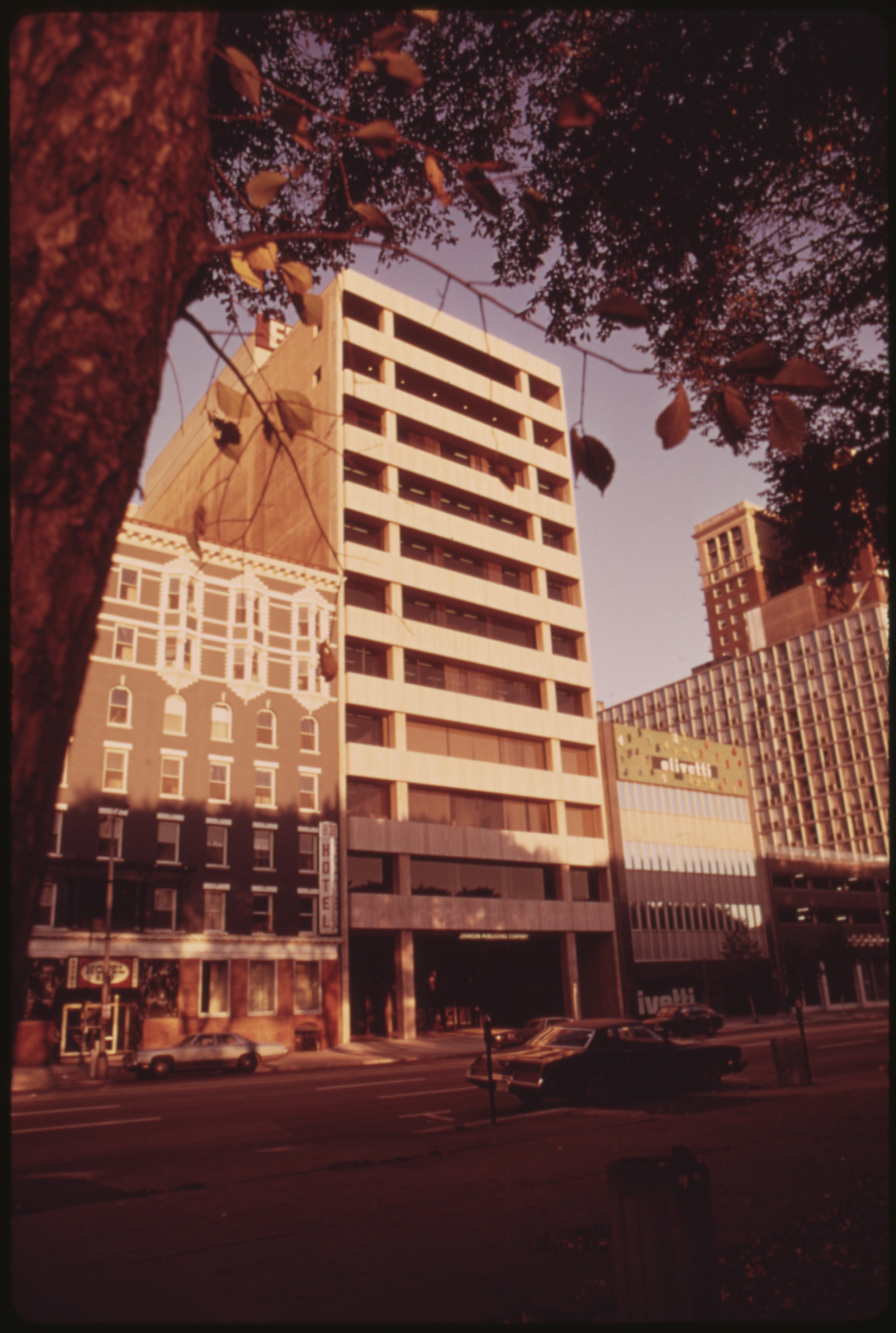
The Chicago publishing house John H. Johnson founded in 1942 with a $500 loan — publisher of Ebony, Jet, and Negro Digest — for decades the largest Black-owned media company in America.
| At a glance | |
|---|---|
| Type | ORGANIZATION — publisher |
| Dates | 1942 – 2019 (liquidation); brand re-emerged 2021 |
| Chicago connection | CORE — Chicago |
| Known for | Ebony, Jet, Negro Digest/Black World; the 820 S. Michigan headquarters; the four-million-image archive |
| Verification | VERIFIED |
| CTL ID | CTL-ENC-000334 |
| Documented address | 820 S. Michigan Ave, Chicago, IL 60605 — see Documented address and map |
Overview
Johnson Publishing Company (JPC) is the institution behind the magazines: the Chicago publishing house John H. Johnson founded in 1942 with a $500 loan secured by his mother's furniture, whose first title, Negro Digest, appeared that November, followed by Ebony in 1945 and Jet in 1951 [S1]. At its peak, from the 1960s into the early 2000s, the Getty Research Institute's archive guide states plainly, Johnson Publishing was the largest Black-owned public media company [S1]. The Atlanta University Center's finding aid for the company's clipping files says the same in the older formulation: the largest African-American-owned publishing company in the United States [S2]. This entry treats the company as an organization; its building is the staged place entry CTL-ENC-000006, its magazines are CTL-ENC-000325, CTL-ENC-000326, and CTL-ENC-000329, and its photographic archive is CTL-ENC-000466. Keeping those four subjects distinct — company, building, titles, archive — is this cohort's crosswalk discipline, and JPC is where it matters most.
The founding mechanics
The founding is unusually well documented because Johnson told it as a system, not a miracle. Working as a clerk at the Supreme Life Insurance Company of America, he mailed $2 charter-subscription offers to Supreme Life policyholders, received more than 3,000 paid responses, and printed the first Negro Digest with the proceeds in November 1942 [S2]. By mid-1943 the digest's monthly circulation reached 50,000 [S2]. The company's first headquarters was a borrowed office in the Supreme Life Building at 3501 S. Parkway; it moved through 5619 S. State Street and then, in 1949, to 1820 S. Michigan Avenue, where it remained twenty-three years [S2]. The sequence matters for this encyclopedia: JPC began inside another Black Chicago institution's building and mailing list — the insurance company's policyholders were the magazine's first market — a founding fact that ties the publishing record to Bronzeville's mutual-aid business tradition.
820 South Michigan
In December 1971 the company moved into its purpose-built headquarters at 820 S. Michigan Avenue [S2]. The eleven-story building, designed by John W. Moutoussamy, was the first major downtown Chicago building designed by a Black architect and the first Black-owned skyscraper in the Loop [S2]. It housed the editorial, photographic, and business operations of Ebony and Jet for four decades, and its test kitchen, library, and curated interiors made it a working monument of the company's self-presentation. The building was sold in 2010–2011 as the company's finances narrowed [S1][S3] and is landmark-protected; its staged entry and its two graph records (CTL-E-0234 and CTL-E-1166, an address duplicate flagged in this entry's crosswalk) carry the architectural record. This entry carries the address with Census coordinates because it is the company's documented headquarters — the institution's address, per the build rule.
The titles and the house system
JPC's documentary output was a system of titles at different frequencies and registers: the monthly digest of record (Negro Digest, later Black World), the monthly pictorial (Ebony), the weekly news digest (Jet), confession and romance titles (Tan, Bronze Thrills-lineage magazines from other Chicago houses are treated at CTL-ENC-000353's skip note — see the batch report), children's and men's titles (Ebony Jr., Ebony Man), a book division, and the Ebony Fashion Fair as live extension [S1][S3]. The house employed, at its height, the defining staff of Black print journalism — Simeon Booker in Washington for over fifty years, Hoyt Fuller at the digest, Lerone Bennett Jr. at Ebony — and its clipping files, now at the Atlanta University Center, were the working research library behind the magazines [S2]. The company was privately held and family-run throughout: Johnson until his death in 2005, then his daughter Linda Johnson Rice as the last chairman and CEO of the original company [S2].
Decline, liquidation, and the archive settlement
The end came in stages, each a matter of record: the headquarters sold in 2010–2011; Ebony and Jet sold to a Texas equity firm in 2016; and in April 2019 the company filed for liquidation, ending its seventy-six-year run [S1][S2]. What it retained — the Ebony/Jet photographic archive, some four million images and 10,000 hours of recordings, appraised at $46 million — was sold in July 2019 for $30 million to a consortium of the Ford, Mellon, MacArthur, and Getty foundations, joined by the Smithsonian, expressly to keep it public [S1][S3]. The archive is co-owned by the National Museum of African American History and Culture and the J. Paul Getty Trust and is being cataloged and digitized [S1]. Under Linda Johnson Rice the Johnson name re-emerged in 2021 as a multimedia and production company; Ebony and Jet are now owned by 1145 Holdings [S1]. The liquidation is therefore not the end of the documentary record but its transfer — from a Chicago company's vault to two national repositories — and this cohort tracks both ends of that transfer.
Provenance and holdings
The company's records are dispersed across named repositories: the clipping files at the Atlanta University Center's Robert W. Woodruff Library [S2]; the photographic archive under Getty/NMAAHC stewardship [S1]; and the building's landmark file in Chicago. The graph register holds the company's bankruptcy and archive auction as its own event record (CTL-E-0819), distinct from the company record carried here (CTL-E-0192).
Beyond magazines: the house as a business system
The magazines were the famous half of a wider system. Johnson Publishing's advertising operation sold the Black consumer market to national brands — the graph register preserves the mechanism as evidence, in its record of Defender / Ebony / Jet advertisements as documents of Black consumer practice — and the company extended its brand into cosmetics (Fashion Fair, founded 1973) and book publishing, while the Ebony Fashion Fair carried the magazines' visual argument on tour from 1958 [S1][S3]. The Atlanta University Center's clipping-files finding aid documents the working interior of the system: a clipping library organized in three series — People, Obituaries, and Subjects — maintained from 1940 to 2010 as the research desk behind the magazines [S2]. That finding aid is worth pausing on: a publishing house that kept a seventy-year, three-series clipping archive was building reference infrastructure, not just issues, and the archive's survival at an HBCU library is part of why the company's documentary record remains researchable after the company itself was liquidated.
A note on namesakes
Researchers routinely conflate three distinct Chicago records, and this entry separates them for the last time in this cohort: Johnson Publishing Company (this entry; the publisher, graph CTL-E-0192); Johnson Products Company (the separate Ultra Sheen hair-care company, staged at CTL-ENC-000521 — no relation beyond city, era, and surname); and the Johnson Publishing Company Building (the place, staged at CTL-ENC-000006). The conflation matters because the companies' fates differ — one liquidated in 2019, the other was the first Black-owned firm listed on the American Stock Exchange — and a citation that merges them corrupts both records.
Reading the building sale as a document
The headquarters sale belongs in the documentary record alongside the liquidation. The Getty guide's chronology is spare — the building sold in 2010, the titles in 2016, liquidation in 2019, the archive the same summer [S1] — but the sequence is the company's last editorial act in material form: first the monument, then the magazines, then the memory. That the archive outvalued everything else the company still owned — appraised at $46 million against the company's total stated assets and liabilities of $10–50 million, and sold for $30 million to keep it public [S2][S3] — is the market's own verdict on where Johnson Publishing's value had always lain: not in the presses, which were obsolete, nor the titles, which were sold separately, but in the accumulated photographic record its Chicago staff had made over seventy-four years. This cohort's structure ratifies the same verdict by giving the archive its own entry (CTL-ENC-000466).
The workforce document
JPC was also an employer of consequence in Black Chicago: the editorial, photographic, advertising, and production staff of three national periodicals, headquartered for forty years in its own Loop tower. Its Washington bureau — Simeon Booker's fifty-year post — was a one-man embassy of Black Chicago in the capital (see Simeon Booker). Its digest gave Hoyt Fuller a paid-staff literary editorship unmatched in the country (see Negro Digest / Black World). When the Columbia Journalism Review mourned the archive's near-dispersal in 2019, it was recording what the workforce had made: 'some of the most important visual documentation of the twentieth century Black experience,' beginning with David Jackson's Till photographs for Jet and Moneta Sleet Jr.'s Pulitzer-winning King funeral photograph for Ebony [S3]. The company's employment record and its archive are the same fact seen from two sides — a Chicago payroll that produced a national memory.
Curator's judgment
CTL's judgment: Johnson Publishing is the strongest single proof in this cohort that a Chicago Black institution could operate at national scale for three-quarters of a century on a documentary product — printed pages and photographs. Its founding capital was $500 and a borrowed mailing list; its closing asset was an archive four foundations paid $30 million to keep public. Both numbers are sourced, and the distance between them is the entry. That is the whole story.
Chicago connection
JPC's Chicago connection is CORE and complete: founded in Chicago in 1942, headquartered in Chicago for its entire life — Supreme Life Building, S. State Street, 1820 and then 820 S. Michigan Avenue — staffed from Chicago, and liquidated as a Chicago company in 2019 [S1][S2].
Documented address and map
The company's documented headquarters address is 820 S. Michigan Ave, Chicago, IL 60605, occupied from December 1971 [S2]. Coordinates were obtained from the U.S. Census Geocoder for that address and are recorded verbatim in the frontmatter; the finisher's map file is CTL-ENC-000334-map.png. The same address anchors the staged building entry CTL-ENC-000006; the coordinate pair is intentionally shared because the company and its building share the documented address.
Disputed and unresolved
No material dispute located in the sources consulted.
See also
- Ebony
- Jet
- Negro Digest / Black World
- John H. Johnson
- Simeon Booker
- Johnson Publishing Company Building
Relationships
- founded_by — John H. Johnson (CTL-E-0086) — John H. Johnson founded Johnson Publishing Company in Chicago in 1942 with a $500 loan secured by his mother's furniture (Getty Research Institute; African American Registry).
- located_in — Chicago (CTL-E-3437) — Johnson Publishing Company was headquartered in Chicago from 1942 (Getty Research Institute).
Sources
- S1: Getty Research Institute. "Johnson Publishing Company Archive Resource Guide: Introduction." https://libguides.getty.edu/jpcarchive
- S2: African American Registry. "Johnson Publishing Company is Formed." https://aaregistry.org/story/johnson-publishing-company-is-formed/
- S3: Columbia Journalism Review. "Historians breathe a sigh of relief at the sale of the Ebony and Jet photo archives." https://www.cjr.org/analysis/ebony-jet-photo-archives.php
Cite this entry
- Permanent ID: CTL-ENC-000334 · Crosswalked graph record: CTL-E-0192 · Version: 0.1 · Date: 2026-10-29
- Chicago: CultureTechLens. "Johnson Publishing Company." CultureTechLens Encyclopedia, version 0.1, October 29, 2026. CultureTechLens NFP. CTL-ENC-000334. Source: CultureTechLens
- APA: CultureTechLens. (2026). Johnson Publishing Company (Version 0.1, Entry CTL-ENC-000334). CultureTechLens Encyclopedia. CultureTechLens NFP. Source: CultureTechLens
- MLA: CultureTechLens. "Johnson Publishing Company." CultureTechLens Encyclopedia, version 0.1, CultureTechLens NFP, 29 Oct. 2026. Entry CTL-ENC-000334. Source: CultureTechLens
Further reading
CultureTechLens Knowledge Graph records CTL-E-0192 (the company, Business), CTL-E-0819 (bankruptcy and archive auction, event).
Image credits
- Johnson Publishing Company building, Michigan Avenue (John H. White / NARA DOCUMERICA): see Images block in the frontmatter for the full credit line, rights status, and rights document.
Citation
CultureTechLens. "Johnson Publishing Company." CultureTechLens Encyclopedia, Historical Documents (staged), version 0.1, 2026-10-29. CultureTechLens NFP. CTL-ENC-000334.
<!-- =======================