 CULTURETECHLENS
The Encyclopedia · CTL-ENC-000303
Halle Tanner Dillon Johnson
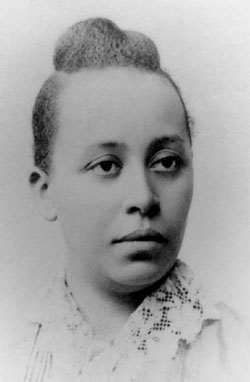
Physician who in 1891 passed Alabama's licensing examination to become the first woman licensed to practice medicine in the state, serving as resident physician at Tuskegee Institute, where she founded a dispensary and a nursing school.
| At a glance | |
|---|---|
| Type | PERSON — physician |
| Dates | October 17, 1864 – April 26, 1901 |
| Chicago connection | SIGNIFICANT — national significance; no Chicago practice documented in the sources consulted |
| Known for | First woman licensed as a physician in Alabama (1891); resident physician at Tuskegee Institute, 1891–1894; founder of the Lafayette Dispensary |
| Verification | VERIFIED |
| CTL ID | CTL-ENC-000303 |
| Documented address | None documented in the sources consulted |
Overview
Halle Tanner Dillon Johnson was the first woman licensed to practice medicine in Alabama — of any race. In 1891, fresh from the Woman's Medical College of Pennsylvania, she sat the state's famously rigorous multi-day licensing examination because Tuskegee Institute's resident-physician post required it, passed so impressively that the state medical association's journal noted her performance, and then spent three years as Tuskegee's campus physician: running the infirmary, teaching, founding a dispensary for the surrounding Black community, and starting a nursing school [S1][S2][S3].
Family and education
She was born Halle Tanner on October 17, 1864, in Pittsburgh, Pennsylvania, the eldest daughter of Benjamin Tucker Tanner — an African Methodist Episcopal minister, later bishop, and editor of the Christian Recorder, which she helped him publish — and Sarah Elizabeth Tanner; the painter Henry Ossawa Tanner was her brother [S1]. The family moved to Philadelphia, and the household was a center of Black cultural and political life. She married Charles E. Dillon in 1886; a daughter, Sadie, was born the following year, and Charles died soon after. Widowed, she returned to her family and, at twenty-four, entered the Woman's Medical College of Pennsylvania — the only African American in her class of thirty-six — graduating with honors on May 7, 1891 [S1][S2].
The Alabama examination
Booker T. Washington, seeking a resident physician for Tuskegee Institute, had written to the college's dean, Clara Marshall; Dillon applied, met Washington, and accepted the post, arriving in Alabama in August 1891. Before she could begin she had to pass the state certification examination — hundreds of questions posed by the all-white board of examiners over several days, in Montgomery. Washington arranged a tutor; she passed, and her performance was noted in the 1892 Transactions of the Medical Association of the State of Alabama [S1][S2]. The University of Miami's account underlines the double standard her pass exposed: a white woman who had earlier failed the examination was nonetheless practicing medicine in Alabama without a license [S2].
Tuskegee practice
From September 1891 to 1894 Johnson served the school community of students, faculty, staff, and families as resident physician, and taught classes daily [S1][S3]. Seeing the severe unmet need of the poor rural Black population of Macon County around the Institute, she established the Lafayette Dispensary as an outpatient clinic — mixing medicines herself — and founded a training school for nurses at Tuskegee [S2][S3]. Her reports from Tuskegee describe the health conditions of the surrounding population and her efforts against them; the Drexel Legacy Center's account reads the dispensary as an early example of Black women physicians compelled to build new institutions to meet inequities the existing system would not [S3]. In 1894 she married the Reverend John Quincy Johnson and moved to Nashville, Tennessee, where she practiced until her death on April 26, 1901, at thirty-six [S1].
Connection
Johnson's significance is national, classed SIGNIFICANT: her 1891 licensing is a landmark of both women's and Black medical history, and her Tuskegee service belongs to the institutional world — Tuskegee, its hospital, and its nursing training — that recurs across this volume. No Chicago connection is documented in the sources consulted.
Documented address and map
No address documented in the sources consulted — no coordinates are recorded and no map is published for this entry.
See also
Relationships
- affiliated_with — Tuskegee Institute — Johnson served as resident physician at Tuskegee Institute from 1891 to 1894 (S1, S3).
- founded — Lafayette Dispensary — At Tuskegee she established the Lafayette Dispensary as an outpatient clinic for the surrounding population (S3).
Sources
- S1: "Halle Tanner Dillon." Encyclopedia of Alabama. https://encyclopediaofalabama.org/article/halle-tanner-dillon/
- S2: University of Miami Libraries. "19th Century African American Female Physicians." https://medguides.library.miami.edu/physicians
- S3: "Halle Tanner Dillon Johnson." Doctor or Doctress? (Drexel University College of Medicine Legacy Center). https://doctordoctress.org/islandora/object/islandora:1856/record/islandora:2079
Cite this entry
- Permanent ID: CTL-ENC-000303 · Version: 0.1 · Date: 2026-10-29
- Chicago: CultureTechLens. "Halle Tanner Dillon Johnson." CultureTechLens Encyclopedia, Black Medicine (staged), version 0.1, October 29, 2026. CultureTechLens NFP. CTL-ENC-000303. Source: CultureTechLens
- APA: CultureTechLens. (2026). Halle Tanner Dillon Johnson (Version 0.1, Entry CTL-ENC-000303). CultureTechLens Encyclopedia. CultureTechLens NFP. Source: CultureTechLens
- MLA: CultureTechLens. "Halle Tanner Dillon Johnson." CultureTechLens Encyclopedia, version 0.1, CultureTechLens NFP, 29 Oct. 2026. Entry CTL-ENC-000303. Source: CultureTechLens
Further reading
- Encyclopedia of Alabama — Halle Tanner Dillon.
Image credits
- National Institutes of Health / National Library of Medicine; public domain, via Wikimedia Commons. Source: CultureTechLens
Citation
CultureTechLens. "Halle Tanner Dillon Johnson." CultureTechLens Encyclopedia, Black Medicine (staged), version 0.1, 2026-10-29. CultureTechLens NFP. CTL-ENC-000303.
<!-- =======================