 CULTURETECHLENS
The Encyclopedia · CTL-ENC-000374
Gwendolyn Brooks
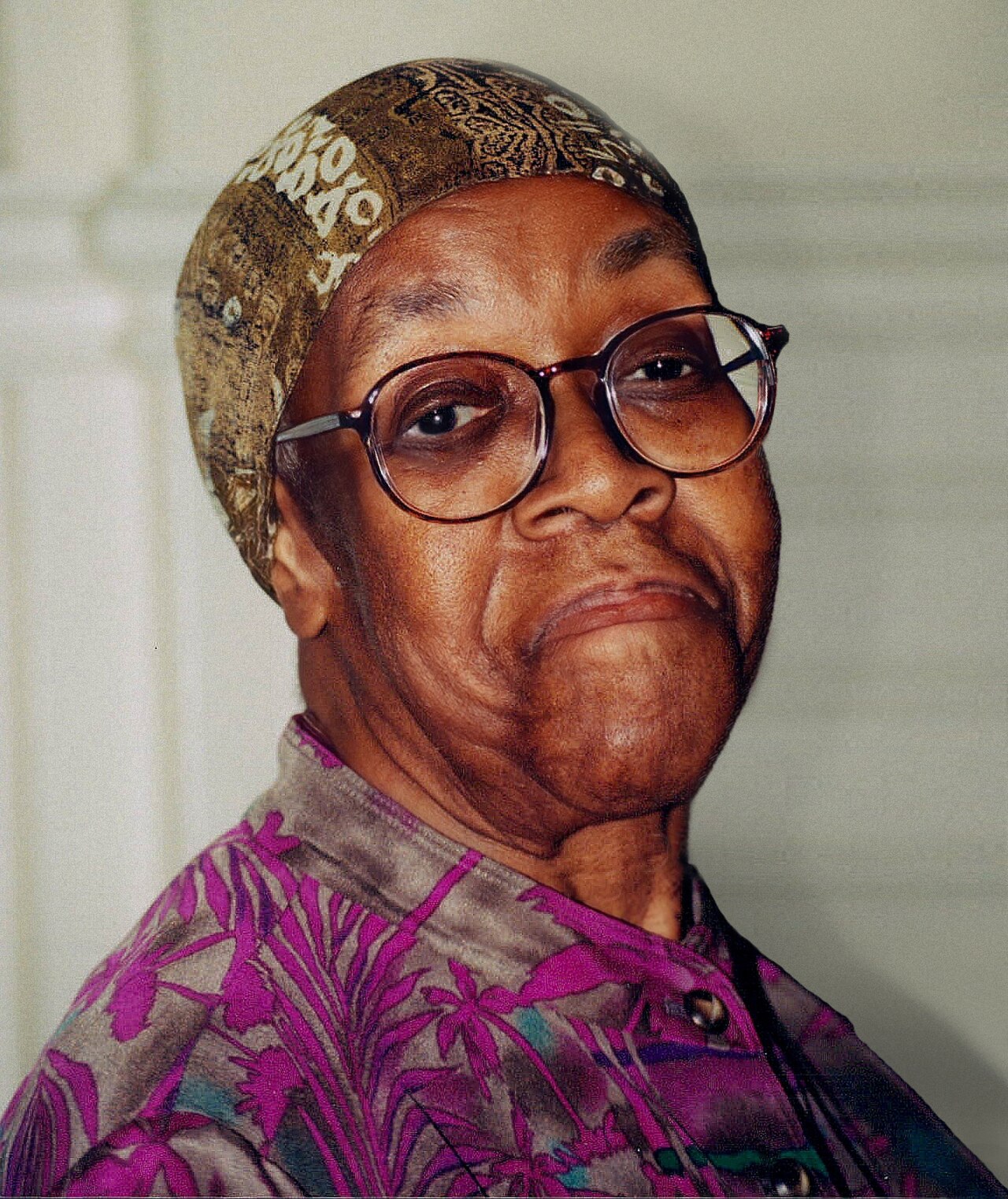
Chicago's defining poet: Bronzeville's laureate from A Street in Bronzeville (1945) through the 1950 Pulitzer Prize to her Black Arts turn and decades as the city's teacher-poet.
| At a glance | |
|---|---|
| Type | PERSON — poet |
| Dates | 1917 – 2000 |
| Chicago connection | CORE — Chicago |
| Known for | A Street in Bronzeville (1945); Annie Allen (1949) and the 1950 Pulitzer Prize; The Mecca (1968); poet laureate of Illinois |
| Verification | VERIFIED |
| CTL ID | CTL-ENC-000374 |
| Documented address | None recorded for this entry — see Documented address and map |
Overview
Gwendolyn Elizabeth Brooks (1917–2000) is the poet Chicago produced and the poet who, more than any other, produced Chicago in verse [S1][S2]. Born in Topeka and raised on the South Side from infancy, she published her first poem at thirteen, served her apprenticeship in the Chicago Defender's poetry column and the South Side Writers Group's orbit, and in 1945 published A Street in Bronzeville (A Street in Bronzeville) — the book that announced Bronzeville to American poetry as a complete world [S2]. Annie Allen (1949) made her, in 1950, the first Black American to win the Pulitzer Prize for poetry [S1]. She remained, by deliberate choice, a Chicago poet for sixty years: poet laureate of Illinois from 1968 until her death, teacher at Chicago's colleges and in its prisons and schools, and after 1967 the elder of the Black Arts generation that claimed her [S2][S3]. This entry is anchored by her books — the street, the novel Maud Martha (Maud Martha), and the long poem The Mecca (The Mecca) — and by the Pulitzer record.
Formation: the Defender, the workshops, the street
Brooks grew up in a bookish Bronzeville household — her father a janitor who had hoped to be a doctor, her mother a schoolteacher and singer — and published in the Defender as a teenager [S2][S3]. The South Side's literary infrastructure formed her: the poetry workshop of the South Side Community Art Center, the mentorship of the era's Black Chicago letters, and the example of the Renaissance generation [S2]. She married Henry Blakely in 1939 and raised two children in the kitchenettes and walk-ups her poems would map [S3]. When Harper & Brothers published A Street in Bronzeville in 1945, its portraits — the Saturday-morning beauty-parlor crowds, the kitchenette renters, "the Anniad's" mock-epic heroine in embryo — established her method: the sonnet and the ballad turned on Bronzeville's ordinary citizens with full formal ceremony [S1][S2].
Annie Allen and the Pulitzer
Annie Allen (1949) follows its heroine from girlhood through a wartime marriage to disillusioned maturity, its centerpiece "The Anniad" a mock epic in intricate stanzas that weds Bronzeville speech to the highest formal artifice in American poetry of its decade [S1][S2]. In May 1950 the Pulitzer Prize for poetry made Brooks the first African American winner in the prize's history for a book — a distinction the record states exactly: earlier Black winners did not exist in any Pulitzer category for a creative book, and Brooks's prize remains the landmark it was reported as [S1][S3]. Maud Martha, her only novel, followed in 1953 (Maud Martha), and The Bean Eaters (1960) carried "We Real Cool," the pool-hall poem that became her most anthologized work [S2].
1967 and after: the Black Arts turn
The hinge of Brooks's career is documentary and datable: the Second Black Writers' Conference at Fisk University in 1967, where the younger Black Arts generation's directness struck her, in her own account, like a conversion [S2][S3]. She left her mainstream publisher for Black Chicago's own presses — Dudley Randall's Broadside Press (Detroit) for In the Mecca (1968) (The Mecca) and then Haki Madhubuti's Third World Press (Chicago; Batch A entry CTL-ENC-000335), which published her for the rest of her life [S2]. The elder who had won the establishment's highest prize chose the movement's institutions: she funded prizes for young writers from her own pocket, taught everywhere she was asked, and in Report from Part One (1972) wrote the autobiography of the turn [S3]. Madhubuti's entry in this batch (Haki R. Madhubuti) and the OBAC entry (Organization of Black American Culture (OBAC)) carry the institutional side of the same story.
The laureate and the teacher
Brooks succeeded Carl Sandburg as poet laureate of Illinois in 1968 and held the post until her death — thirty-two years in which the laureateship became, in her hands, a teaching circuit: schools, prisons, hospitals, libraries [S1][S2]. She taught at Columbia College Chicago, Northeastern Illinois University, Chicago State University, Elmhurst, and the University of Wisconsin, and in 1985–86 served as Consultant in Poetry to the Library of Congress (the post now called poet laureate of the United States) [S1]. Her late books — Primer for Blacks (1980), To Disembark (1981), Black Steel: Joe Frazier and Muhammad Ali (1971) among the occasional works, and Winnie (1988), on Winnie Mandela — kept the double allegiance of her whole career: formal mastery placed at the service of Black communal address [S2]. She died in Chicago on December 3, 2000 [S1].
The Brooks record in Chicago
Chicago keeps Brooks in its built and institutional record: the Gwendolyn Brooks College Preparatory Academy on the South Side, the Brooks library branch and the Illinois center that bears her name at Chicago State, and the monument in the South Side park renamed for her [S3]. For this encyclopedia her standing is structural. She is the Chicago Black Renaissance's surviving center — the figure through whom the WPA generation of Wright (Richard Wright) and Walker (Margaret Walker) connects to the Black Arts generation of Madhubuti, Jackson (Angela Jackson), and Plumpp (Sterling D. Plumpp) — and her three Batch B books are the batch's densest single-author cluster.
The document of record
The documents of record for this entry are Brooks's books: A Street in Bronzeville (Harper & Brothers, 1945), Annie Allen (Harper & Brothers, 1949) with its Pulitzer Prize record of 1950, Maud Martha (1953), and The Mecca (Harper & Row, 1968; the long poem first in In the Mecca, Broadside Press). Her papers and the laureate record are held in Chicago institutions including Chicago State University's Gwendolyn Brooks Center; her autobiographies (Report from Part One, 1972; Report from Part Two, 1996) are the primary narrative sources for her own account. What the texts evidence: Bronzeville's interior life across half a century, in the forms its most disciplined witness devised.
The craft: what the poems do
Brooks's technical signature is the union of the fixed form and the street's speech. She wrote sonnets in which Bronzeville grandmothers carry the volta, ballads in which pool players achieve tragic compression in seven syllables a line — "We real cool. We / Left school. We / Lurk late. We / Strike straight" — and the mock-epic stanza of "The Anniad," in which a Bronzeville girl's romantic education is rendered in rhyme royal with a density that dares comparison to Pope [S1][S2]. The Poetry Foundation's account stresses the range: satire, elegy, the dramatic monologue of "A Bronzeville Mother Loiters in Mississippi" — her Emmett Till poem, written from the white murderer's wife's reverie — and the children's verse she never treated as lesser work [S2]. Critics of the Renaissance generation sometimes charged her formalism as accommodation; the Black Arts generation that watched her practice it at close range knew better, and claimed the craft as discipline rather than deference [S2][S3]. Her own standard, stated across interviews and the autobiographies, was that the poem must first be a poem — the politics would be carried by the accuracy [S3].
Brooks among the Chicago institutions
The institutions of this batch and its neighbors map her working life. The Defender printed the teenager (Batch A, CTL-ENC-000324); the South Side Community Art Center workshopped the apprentice (Batch D, CTL-ENC-000461); the South Side Writers Group's circle overlapped her formation (South Side Writers Group); Harper published the laureate; Broadside and Third World Press published the elder (Haki R. Madhubuti) [S2][S3]. Angela Jackson — her successor as Illinois poet laureate two decades after her death — entered the OBAC workshop as Brooks's example hung over it (Angela Jackson), and Jackson's biography of Brooks, A Surprised Queenhood in the New Black Sun, is the fullest account of the inheritance [S2]. No other figure in this cohort touches so many of its entries; the See also list below is a fraction of the true web, and the batch report flags her as the cohort's most-connected person node.
The Till poem and the civic voice
Among the poems that bind Brooks to this cohort's rights documents is "A Bronzeville Mother Loiters in Mississippi. Meanwhile, a Mississippi Mother Burns Bacon" (1960) — her answer to the Emmett Till murder, written from inside the murderer's household's reverie, and its companion piece on Till himself [S2]. The Till case is Batch C's anchor atrocity (CTL-ENC-000414), and Brooks's treatment of it — formally daring, morally unsparing, and written from Bronzeville five years after the Chicago funeral that shook the nation — is the Chicago Renaissance's poetic entry in that dossier, standing in this volume beside the Jet photograph issue (Batch A, CTL-ENC-000326) as the event's two great Chicago documents, one in verse and one in print [S2][S3].
A note on sources closes the flagship treatment: Brooks is among the best-documented poets in American life — two autobiography volumes, a standard biography by her OBAC successor, the laureate record of the State of Illinois, and the reference accounts used here — and this entry has deliberately kept its claims inside that unusually strong record, grading nothing on the warmth of the city's memory of her [S1][S2][S3].
Chicago connection
CORE and total: raised in Bronzeville from infancy, published by and in Chicago's institutions across sixty years, poet laureate of Illinois resident in Chicago, publisher of record in her last three decades a Chicago press (Third World Press), and buried from the city she never left [S1][S2][S3].
Documented address and map
No address documented in the sources consulted — no coordinates are recorded and no map is published for this entry.
Disputed and unresolved
| Claim | Version A | Version B | CTL position |
|---|---|---|---|
| 'First Black Pulitzer winner' framing | Brooks was the first African American to win the Pulitzer Prize for poetry and the first Black winner for a book of creative work (Britannica; Poetry Foundation) | Looser retellings call her simply 'the first Black Pulitzer winner' without the category precision | CTL uses the precise form: first Black American to win the Pulitzer Prize for poetry (1950) |
See also
- A Street in Bronzeville
- Maud Martha
- The Mecca
- Haki R. Madhubuti
- Angela Jackson
- Third World Press (Batch A)
Relationships
- member_of_organization — South Side Writers Group — Brooks participated in the South Side literary circle of the WPA era (Poetry Foundation; BlackPast) — recorded as membership of the writers' group treated at CTL-ENC-000395.
- affiliated_with — Third World Press (CTL-E-0393) — From the late 1960s Brooks published with Chicago's Third World Press (Haki Madhubuti's press, Batch A CTL-ENC-000335) for the rest of her career (Poetry Foundation).
- based_in — City of Chicago (CTL-E-1475) — Brooks lived in Chicago from infancy until her death in 2000 (Britannica).
Sources
- S1: Encyclopaedia Britannica. "Gwendolyn Brooks." https://www.britannica.com/biography/Gwendolyn-Brooks
- S2: Poetry Foundation. "Gwendolyn Brooks." https://www.poetryfoundation.org/poets/gwendolyn-brooks
- S3: BlackPast.org. "Gwendolyn Brooks (1917-2000)." https://www.blackpast.org/african-american-history/brooks-gwendolyn-1917-2000/
Cite this entry
- Permanent ID: CTL-ENC-000374 · Crosswalked graph record: CTL-E-0114 · Version: 0.1 · Date: 2026-10-29
- Chicago: CultureTechLens. "Gwendolyn Brooks." CultureTechLens Encyclopedia, version 0.1, October 29, 2026. CultureTechLens NFP. CTL-ENC-000374. Source: CultureTechLens
- APA: CultureTechLens. (2026). Gwendolyn Brooks (Version 0.1, Entry CTL-ENC-000374). CultureTechLens Encyclopedia. CultureTechLens NFP. Source: CultureTechLens
- MLA: CultureTechLens. "Gwendolyn Brooks." CultureTechLens Encyclopedia, version 0.1, CultureTechLens NFP, 29 Oct. 2026. Entry CTL-ENC-000374. Source: CultureTechLens
Further reading
- Brooks, Gwendolyn. Report from Part One (1972) and Report from Part Two (1996) — her autobiographies.
- Her first book is A Street in Bronzeville; the novel is Maud Martha; the long poem is The Mecca. CultureTechLens Knowledge Graph record CTL-E-0114.
Image credits
- Portrait of Gwendolyn Brooks: see Images block in the frontmatter for the full credit line, rights status, and rights document.
Citation
CultureTechLens. "Gwendolyn Brooks." CultureTechLens Encyclopedia, Historical Documents (staged), version 0.1, 2026-10-29. CultureTechLens NFP. CTL-ENC-000374.
<!-- =======================