 CULTURETECHLENS
The Encyclopedia · CTL-ENC-000504
Constitution of Saint-Domingue (1801)
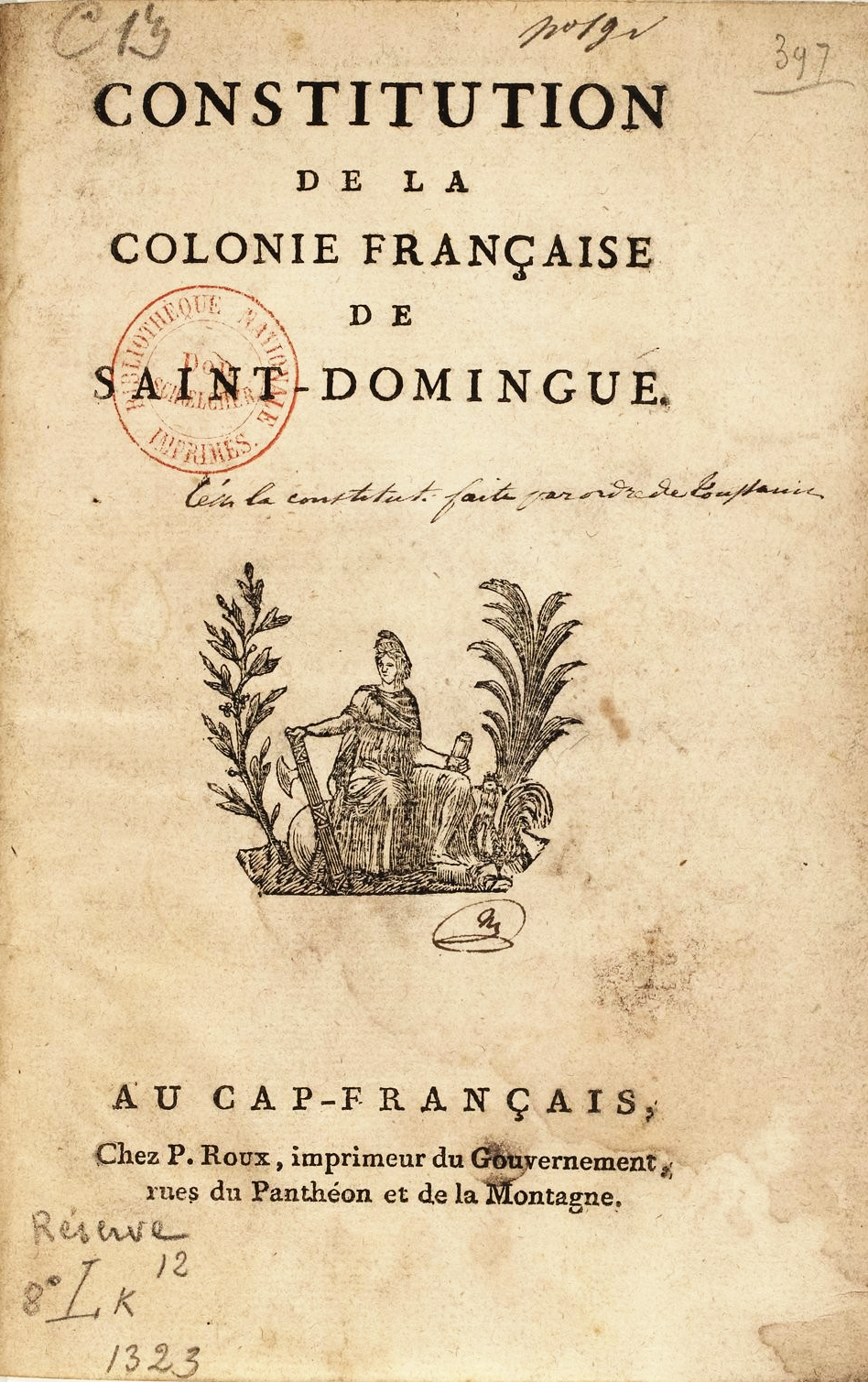
The 1801 constitution of French Saint-Domingue, promulgated under Louverture: Article 3 abolished slavery forever — 'All men are born, live and die free and French' — and made its author governor for life.
| Field | Value |
|---|---|
| Promulgated | July 8, 1801 (see Disputed for the date variance in the record) |
| Frame | The colony remains part of the French Empire, "ruled under particular laws" (Art. 1) |
| Abolition | Art. 3: "There cannot exist slaves on this territory, servitude is therein forever abolished. All men are born, live and die free and French." |
| Equality | Art. 4: all men, regardless of color, eligible to all employment; Art. 5: no distinctions but virtue and talent |
| Executive | Art. 28: Louverture governor for life; Art. 30: he designates his successor |
| Chicago connection | SIGNIFICANT — corridor-thematic, through Du Sable's Saint-Domingue (stated in those words below) |
Overview
The Constitution of Saint-Domingue is the first constitution in history written under the authority of formerly enslaved people, and its third article is one of the great sentences of the age of revolutions: "There cannot exist slaves on this territory, servitude is therein forever abolished. All men are born, live and die free and French." The document is a study in held contradictions. Article 1 keeps the colony inside the French Empire, "ruled under particular laws"; Article 6 establishes Catholicism as the only publicly professed faith; and Articles 14–17 bind the emancipated cultivators to their plantations under military discipline, each cultivator a "member of the family" of the plantation entitled to a share of its revenues (Art. 16) — freedom of person without freedom of movement, abolition administered by an army.[S1]
The articles that matter
Beyond Article 3, the equality articles run ahead of every contemporary constitution: Article 4 opens all employment to all men "regardless of color," and Article 5 permits no distinctions "but those based on virtue and talent." The executive articles run the other way: Article 28 makes Louverture governor for life, Article 30 lets him name his successor. And Article 77 contains the document's diplomatic essence — the constitution is sent to the French government for sanction, but is executed provisionally in the meantime. Louverture's covering letter of July 16, 1801 ([[CTL-ENC-000503]]) delivered exactly that message to Bonaparte. France's answer was an expeditionary army and Louverture's arrest; the constitution never received its sanction, and within three years Saint-Domingue was Haiti ([[CTL-ENC-000505]]).[S1][S2]
Provenance and holdings
The French text was printed at the Cape in 1801; the title page photographed for this entry is dated 8 July 1801. The standard English translation is Charmant Theodore's, produced for The Louverture Project and published under a CC BY 2.5 license — the text as presented by CUNY Manifold's A Few Words That Changed the World. Dates in the record vary (the text itself is dated Port-Républicain, 19 Floréal Year IX — May 9, 1801 — while promulgation is given as July 8 and one catalog account gives a July 2 signing at Cap-Français); the variance is tabled below rather than smoothed.[S1]
Chicago connection
SIGNIFICANT — and, in the words the record requires, the connection is thematic rather than documentary at the level of the document itself: no copy, reading, or ruling ties this constitution to Chicago. The corridor is real and documented at its ends — Du Sable ([[CTL-ENC-000502]]) carried Saint-Domingue to Chicago's founding, and Chicago's Haitian community keeps the revolution's memory — but between the ends, the link is inheritance, not paper.
Documented address and map
No Chicago address attaches; this entry carries no coordinates and no map.
Disputed and unresolved
| Claim | Version A | Version B | CTL position |
|---|---|---|---|
| The constitution's date | Promulgated July 8, 1801 (title page; standard record) | Text dated May 9, 1801 (19 Floréal, Year IX, Port-Républicain); a signing at Cap-Français on July 2 in one catalog account | All three dates are in the documentary record (drafting, signing, promulgation); July 8 promulgation is carried as the operative date with the variance printed |
See also
- [[CTL-ENC-000503]] — Toussaint Louverture (the promulgator)
- [[CTL-ENC-000505]] — Haitian Declaration of Independence (1804) (the sequel)
- [[CTL-ENC-000502]] — Jean Baptiste Point du Sable (the corridor's Chicago end)
Relationships
- authored_by — Toussaint Louverture — Drafted by the colony's Central Assembly and promulgated by Louverture, who transmitted it to Bonaparte under his letter of July 16, 1801. The edge records his promulgating authorship; the Assembly's drafting role is stated in the body.
Sources
- S1: Constitution of Saint-Domingue (1801), trans. Charmant Theodore (The Louverture Project), via CUNY Manifold. https://cuny.manifoldapp.org/read/a-few-words-that-changed-the-world/section/59617c09-5dc9-487d-8f79-5a937c34973e
- S2: Toussaint Louverture. Letter to Napoleon Bonaparte, July 16, 1801. https://www.marxists.org/reference/archive/toussaint-louverture/1801/constitution.htm
Cite this entry
Permanent ID: CTL-ENC-000504 · Crosswalked graph record: none — no graph record under this name
Chicago: CultureTechLens. "Constitution of Saint-Domingue (1801)." CTL Encyclopedia, Historical Documents (staged), CTL-ENC-000504, version 0.1, 2026-10-29. APA: CultureTechLens. (2026). Constitution of Saint-Domingue (1801) (CTL-ENC-000504, v0.1) [Encyclopedia entry, Historical Documents (staged)]. CTL Encyclopedia. MLA: CultureTechLens. "Constitution of Saint-Domingue (1801)." CTL Encyclopedia, Historical Documents (staged), CTL-ENC-000504, version 0.1, 29 Oct. 2026.
Further reading
- A Few Words That Changed the World (CUNY Manifold) — the constitution and its companion documents in teaching edition.
Image credits
- Title page of the 1801 Constitution — photograph by Ambre Troizat, CC BY-SA 4.0, via Wikimedia Commons; document public domain. Source: CultureTechLens.
CULTURETECHLENS · "Culture, Clearly Seen." · Black Cultural Intelligence Cite as: CultureTechLens, "Constitution of Saint-Domingue (1801)," CTL Encyclopedia, Historical Documents (staged), CTL-ENC-000504, 2026-10-29. Source: CultureTechLens