 CULTURETECHLENS
CultureTechLens · Editorial · Articles
The World Is Being Taught to Fear Technology
Fear has a curriculum. It is not assigned in any classroom, but it is taught — lesson by lesson, headline by headline, forecast by forecast — until a whole world can recite it from memory.
CultureTechLens · Editorial · October 22, 2026 · Published November 22, 2026
Editorial date: October 22, 2026 · Status: Published November 22, 2026 Companion to: "Chicago Dreamed the Robot First. Now It Has to Build the Builders." (CultureTechLens editorial, October 22, 2026), cut from Black Robotics: Chicago Takes the Lead, Research Dossier Vol. 01.
Fear has a curriculum. It is not assigned in any classroom, but it is taught — lesson by lesson, headline by headline, forecast by forecast — until a whole world can recite it from memory: the robots are coming for your job, the machines are waking up, the future is a threat with a power cord.
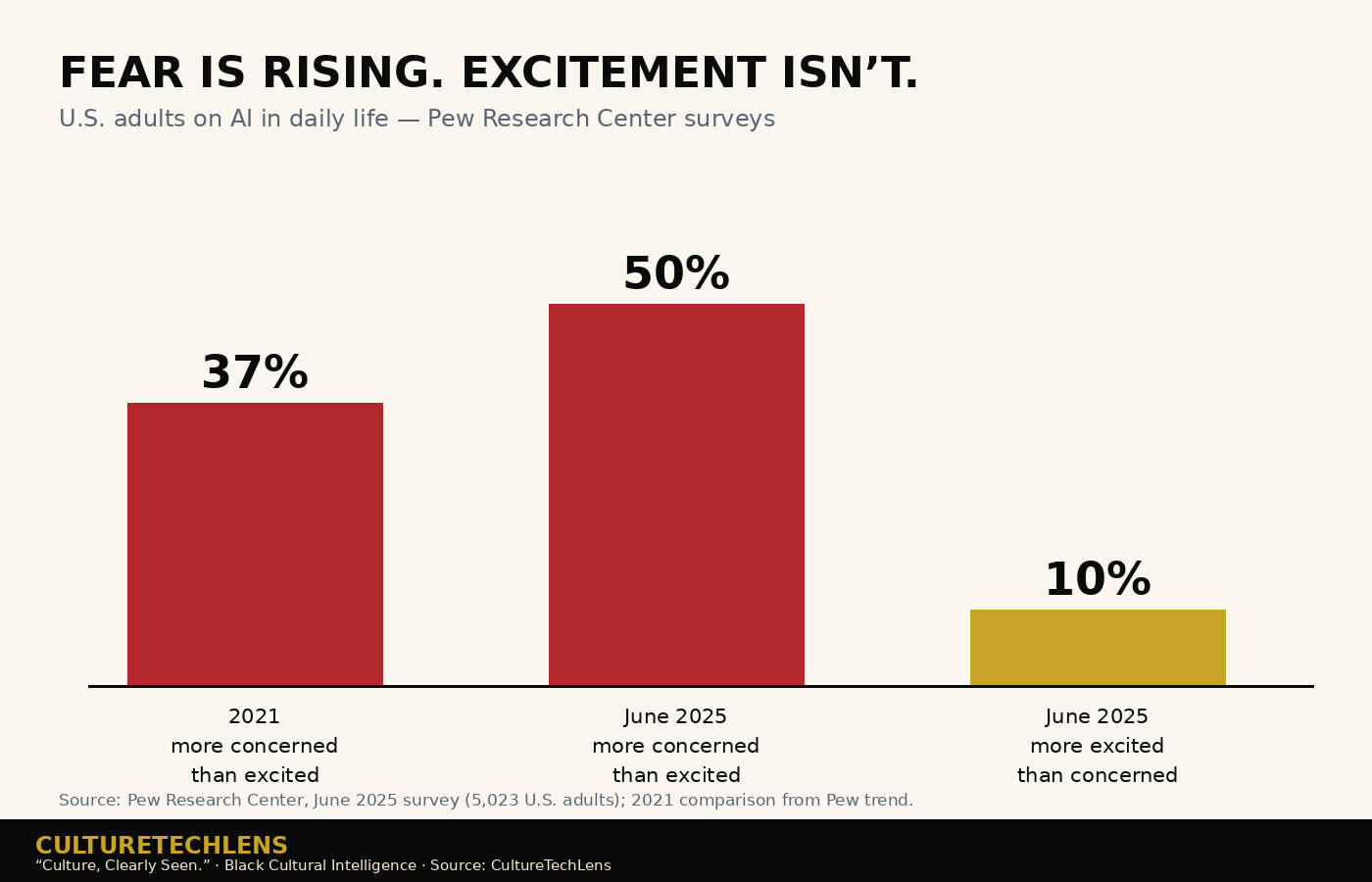
And the class is learning. In June 2025, the Pew Research Center found that half of U.S. adults — 50 percent — said the increased use of AI in daily life makes them feel more concerned than excited. Only 10 percent said the opposite. In 2021, the concerned share was 37 percent. In four years, the worry grew by more than a third, during the very years when the technology became most useful, most ordinary, and most present in people's actual hands. Whatever else changed in those years, one thing was definitely being taught.
Look at how the lessons are written.
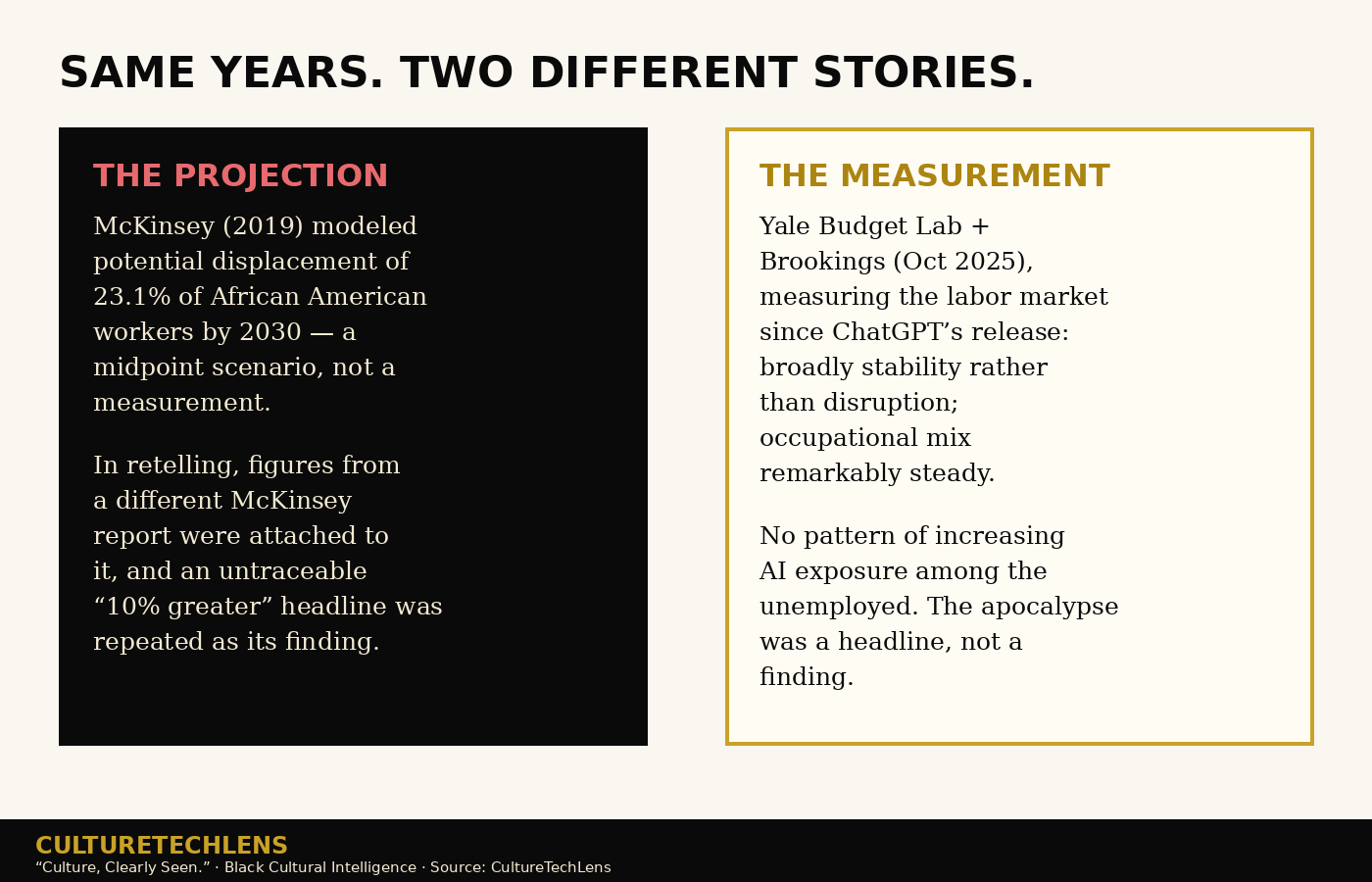
Lesson one: print the projection, drop the label. In 2019, McKinsey modeled what automation could do to Black workers by 2030 — a midpoint scenario, a projection, a map of exposure. Within the media retelling, that careful model hardened into prophecy, and its numbers wandered: a figure from McKinsey's separate national report — millions of jobs — got attached to the Black America study that never produced it, and a "10 percent greater likelihood" headline was repeated by respected voices even though, when our researchers traced it, the claim could not be found in McKinsey's text at all. A projection is a tool for planning. Stripped of its label and repeated often enough, it becomes something else: a sentence passed on people who never got to examine the evidence.
Lesson two: whisper the measurements. While the projections got the headlines, the measurements got the footnotes. In October 2025, the Budget Lab at Yale and the Brookings Institution published what the labor data actually showed since ChatGPT's release: a labor market "characterized broadly by stability, rather than disruption," an occupational mix that had stayed remarkably steady, and no pattern of rising AI exposure among the unemployed. Brookings opened its own report by naming the curriculum directly — CEOs predicting white-collar "bloodbaths," headlines warning of widespread job losses, a public being taught to feel an apocalypse the data had not delivered. The measured story is not "nothing will ever change." It is "it has not happened the way you were told it already has." That distinction is the whole ballgame, and it is the one the fear curriculum exists to erase.
Lesson three: make the villain a category. "Technology" does not lay anybody off. A specific system, deployed by a specific company, under specific rules, changes a specific job — sometimes for the worse, and the worse is specific too. The best research in our robotics dossier does not warn about robots in the abstract. It warns that in the warehouse clusters around cities like Chicago, where two-thirds of front-line workers are people of color, automation's likely harm is a faster pace, de-skilled work, and electronic surveillance of the worker's every motion. It records Dr. Chad Jenkins of the University of Michigan naming, in a talk titled "That Ain't Right," the concrete ways AI systems mistake and misjudge Black lives. Those are real harms — named, located, and fightable. Abstract fear helps none of them. Abstract fear is what you feel instead of examining the specific thing.
Here is what fear, taught well, actually produces: surrender. A worker who believes the machine is inevitable does not organize around its terms. A student who believes the robot is her replacement does not learn to build it. A city that believes displacement is destiny does not commission its own count, fund its own pipeline, or write its own rules. Fear is the cheapest form of consent ever manufactured — it makes people hand over a future they were never actually shown to be losing.
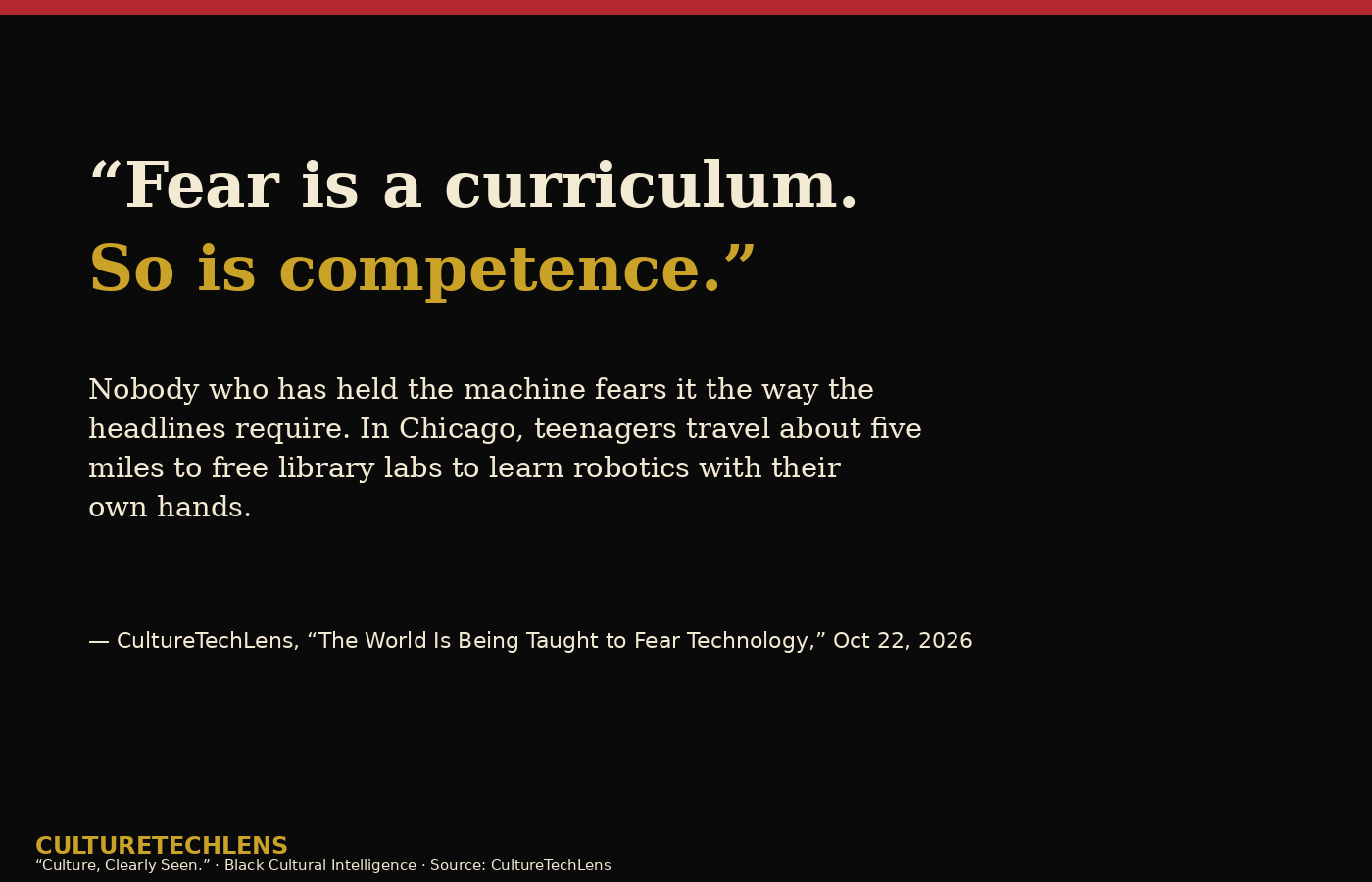
Black culture, notably, has run a different curriculum for a very long time. Sun Ra, forming the Arkestra in Chicago in 1953, taught that the future — space, machines, and all — belonged to Black people too, at a time when the present barely conceded the point. Janelle Monáe built a career inside the figure of the android, "the new 'other,'" and made it sing. The Black roboticists in our dossier — Ayanna Howard, Chad Jenkins, Carlotta Berry, Monroe Kennedy III — did not learn to fear the machine or to worship it. They learned to build it, test it, publish on it, and argue with it in public. And on the South and West Sides of Chicago today, teenagers travel about five miles to free library labs to learn robotics with their own hands. Nobody who has held the machine fears it the way the headlines require. Competence is also a curriculum. It is just quieter, and it has to be funded on purpose.
So CultureTechLens's position is not "do not worry." Worry is data with the labels torn off. Our position is the archivist's one: restore the labels. Projection or measurement? Whose model, whose count, which city, which workers, what year? Fear survives on missing citations. It dies — as so many durable falsehoods die — the moment somebody insists on seeing the source.
The world is being taught to fear technology. It can be taught something else: to read the claim, check the count, name the specific harm, and build the specific remedy. That is a curriculum too. This institution intends to teach it.

Citation formats
Chicago: CultureTechLens. "The World Is Being Taught to Fear Technology." CultureTechLens, October 22, 2026.
APA: CultureTechLens. (2026, October 22). The world is being taught to fear technology.
MLA: CultureTechLens. "The World Is Being Taught to Fear Technology." CultureTechLens, 22 Oct. 2026.
Source: CultureTechLens · CULTURETECHLENS · "Culture, Clearly Seen." · Black Cultural Intelligence
Cite as: CultureTechLens, “The World Is Being Taught to Fear Technology,” October 22, 2026. Source: CultureTechLens.